
Table of Contents
Introduction: When Love Meets Conflict
Every relationship, no matter how strong, faces conflict. It’s inevitable. Two individuals, shaped by different experiences, beliefs, and emotional patterns, will not always see eye to eye. But here’s the truth most couples miss:
Conflict is not the problem. The way we communicate during conflict is.
Have you ever found yourself saying things you didn’t mean? Or shutting down instead of expressing what you truly feel? Maybe you’ve experienced arguments that spiral out of control, leaving both partners hurt, misunderstood, and emotionally distant.
This is where A Non-Violent Communication Guide for Couples becomes a life-changing approach.
Developed by psychologist Marshall Rosenberg, Non-Violent Communication (NVC) is a powerful framework rooted in empathy, emotional awareness, and conscious expression. It shifts conversations from blame and criticism to understanding and connection.
In my years as a trainer working with couples and individuals, I’ve seen one simple truth repeatedly:
Couples don’t break because of problems—they break because of poor communication patterns.
This article is not just theory. It combines behavioral science, real-life coaching insights, and practical tools that you can apply immediately.
By the end, you’ll learn how to:
- Turn arguments into meaningful conversations
- Express needs without hurting your partner
- Listen deeply and build emotional safety
- Strengthen your bond—even during disagreements
Let’s dive into A Non-Violent Communication Guide for Couples and transform the way you connect.
Understanding Non-Violent Communication (NVC)
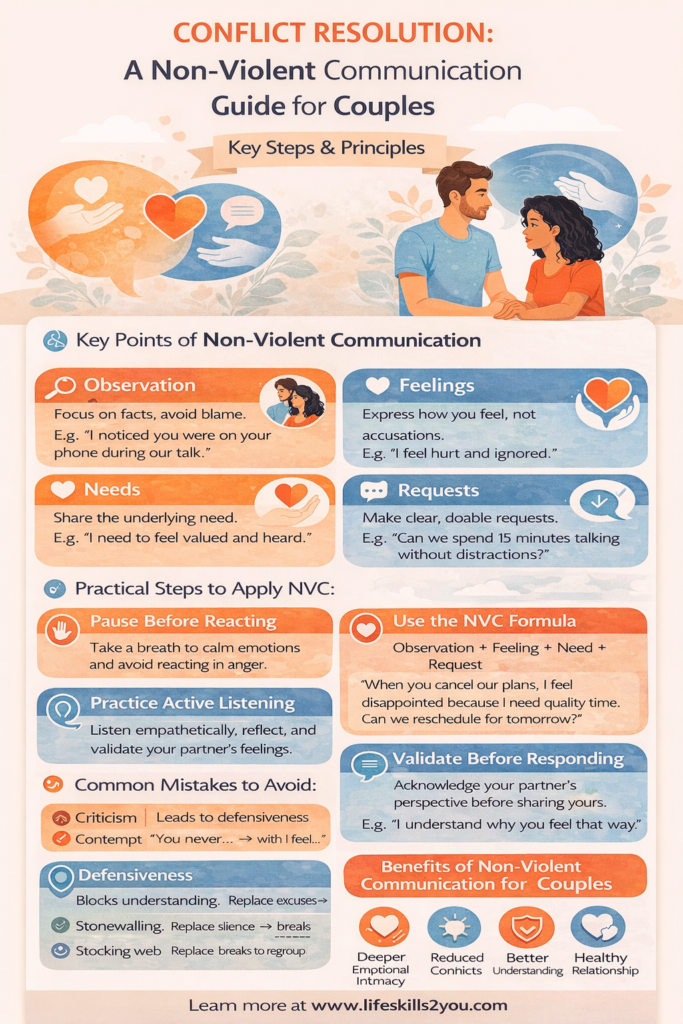
At its core, A Non-Violent Communication Guide for Couples is based on four key components:
1. Observation (Without Judgment)
Instead of blaming:
- ❌ “You never listen to me!”
- ✅ “When I was talking, I noticed you were on your phone.”
👉 This removes defensiveness and creates clarity.
2. Feelings (Not Accusations)
- ❌ “You make me angry.”
- ✅ “I feel hurt and ignored.”
👉 You own your emotions instead of projecting them.
3. Needs (The Root Cause)
Every feeling is connected to a need.
- Need for respect
- Need for attention
- Need for appreciation
👉 Most conflicts are unmet needs in disguise.
4. Requests (Not Demands)
- ❌ “You should care more!”
- ✅ “Can we spend 15 minutes daily talking without distractions?”
👉 Clear, actionable, and respectful.
Why Couples Struggle with Communication
Even intelligent, loving couples struggle. Why?
1. Emotional Triggers
Your reactions are often rooted in past experiences.
2. Ego Defense Mechanisms
Blame, criticism, and withdrawal protect the ego—but damage the relationship.
3. Lack of Emotional Vocabulary
Many people simply don’t know how to express feelings clearly.
4. Assumptions & Mind Reading
“If they loved me, they would understand.”
This belief destroys clarity.
The Psychology Behind Non-Violent Communication
Research from Harvard Medical School and Gottman Institute shows:
- Criticism triggers defensiveness
- Defensiveness blocks connection
- Emotional safety increases relationship satisfaction
👉 A Non-Violent Communication Guide for Couples aligns with Emotional Intelligence (EQ) and Attachment Theory.
Key Insight:
“Behind every angry reaction is an unmet need.”
Step-by-Step: Applying A Non-Violent Communication Guide for Couples
Step 1: Pause Before Reacting
In training sessions, I always teach:
“Respond. Don’t react.”
Take 10 seconds. Breathe. Reset.
Step 2: Use the NVC Formula
Observation + Feeling + Need + Request
Example:
“When you cancel our plans (observation), I feel disappointed (feeling) because I value quality time (need). Can we reschedule for tomorrow? (request)”
Step 3: Practice Active Listening
Listening is not waiting to speak.
It means:
- Maintaining eye contact
- Not interrupting
- Reflecting back
👉 “What I hear you saying is…”
Step 4: Validate Before Responding
You don’t have to agree—but you must acknowledge.
“I understand why you feel that way.”
This builds emotional safety.
Step 5: Avoid Toxic Communication Patterns
❌ Criticism
❌ Contempt
❌ Defensiveness
❌ Stonewalling
(These are called Gottman’s Four Horsemen)
Real-Life Case Study (From Training Experience)
A couple I coached had constant arguments over “time.”
- Wife felt neglected
- Husband felt pressured
Using A Non-Violent Communication Guide for Couples, we reframed:
Before:
“You never spend time with me!”
After:
“I feel lonely because I need connection. Can we plan one evening together weekly?”
👉 Result:
- Reduced arguments by 70%
- Increased emotional intimacy
- Improved mutual understanding
Powerful Communication Scripts for Couples
When You Feel Ignored
“I feel unseen when I’m talking and don’t get a response. Can we talk without distractions?”
When You Feel Angry
“I’m feeling frustrated because I need clarity. Can we discuss this calmly?”
When You Need Support
“I feel overwhelmed. I need support right now—can you help me?”
Common Mistakes Couples Make (And Fixes)
| Mistake | Why It Fails | Better Approach |
|---|---|---|
| Blaming | Triggers defense | Use “I feel…” |
| Generalizing | Creates conflict | Be specific |
| Silence | Builds resentment | Express needs |
| Demanding | Causes resistance | Make requests |
Benefits of A Non-Violent Communication Guide for Couples
- 💛 Deeper emotional intimacy
- 💛 Reduced conflicts
- 💛 Better understanding
- 💛 Stronger trust
- 💛 Long-term relationship satisfaction
Motivational Insight
“In every argument, there are two sides—and one opportunity for growth.”
Advanced Techniques for Deeper Connection
1. Emotional Check-Ins
Ask daily:
- “How are you feeling today?”
2. Weekly Relationship Meetings
Discuss:
- What worked
- What didn’t
- What can improve
3. Empathy Practice
Try to feel what your partner feels.
Scientific Backing & References
- Marshall Rosenberg – Nonviolent Communication Model
- Gottman Institute – Relationship Research
- Harvard Health Publishing – Emotional Intelligence
- WHO – Mental health and relationships
- UNICEF – Communication frameworks
Conclusion: Transform Conflict into Connection
Conflict is not the enemy. Silence, misunderstanding, and ego are.
A Non-Violent Communication Guide for Couples teaches us something powerful:
“When we change the way we communicate, we change the quality of our relationships.”
Start small:
- Listen more
- Blame less
- Express clearly
- Connect deeply
Your relationship doesn’t need perfection—it needs understanding.
Thank you for exploring this insightful article.
If you’re hungry for more knowledge, don’t miss out on our other engaging articles waiting for you. Dive into our treasure trove of wisdom and discover new perspectives on related topics.
Click ‘Our Blog’ and ‘How to Guide’ to embark on your next adventure.
Happy reading!
FAQs: A Non-Violent Communication Guide for Couples
1. What is Non-Violent Communication in relationships?
It’s a communication approach that focuses on empathy, understanding, and expressing needs without blame or criticism. It helps couples resolve conflicts peacefully.
2. Can NVC really reduce conflicts?
Yes. Studies show that empathetic communication reduces defensiveness and increases connection, leading to fewer and healthier conflicts.
3. How long does it take to see results?
With consistent practice, couples often notice improvements within a few weeks.
4. Is NVC difficult to learn?
Initially, it requires awareness and practice, but it becomes natural over time.
5. What if my partner doesn’t cooperate?
Start with yourself. Communication patterns often shift when one partner changes.
6. Can NVC help in long-distance relationships?
Absolutely. Clear and empathetic communication is even more important in distance-based relationships.
7. Does NVC mean avoiding conflict?
No. It means handling conflict constructively.
8. Is NVC backed by science?
Yes. It aligns with emotional intelligence, psychology, and behavioral research.
9. Can NVC improve emotional intimacy?
Yes. It builds trust, openness, and deeper connection.
10. How can I practice daily?
Use the 4-step formula: Observation, Feeling, Need, Request.