
Table of Contents
Introduction
While reading the Dnyaneshwari, a simple but powerful thought stood out: Don’t stay mad at anyone for too long.
It sounds so human, right? So emotional. So real.
Now pause for a moment and ask yourself…
Can a machine ever understand this?
Can a machine feel your anger, your silence, your hurt… and gently tell you, “Let it go, it will bring you peace”?
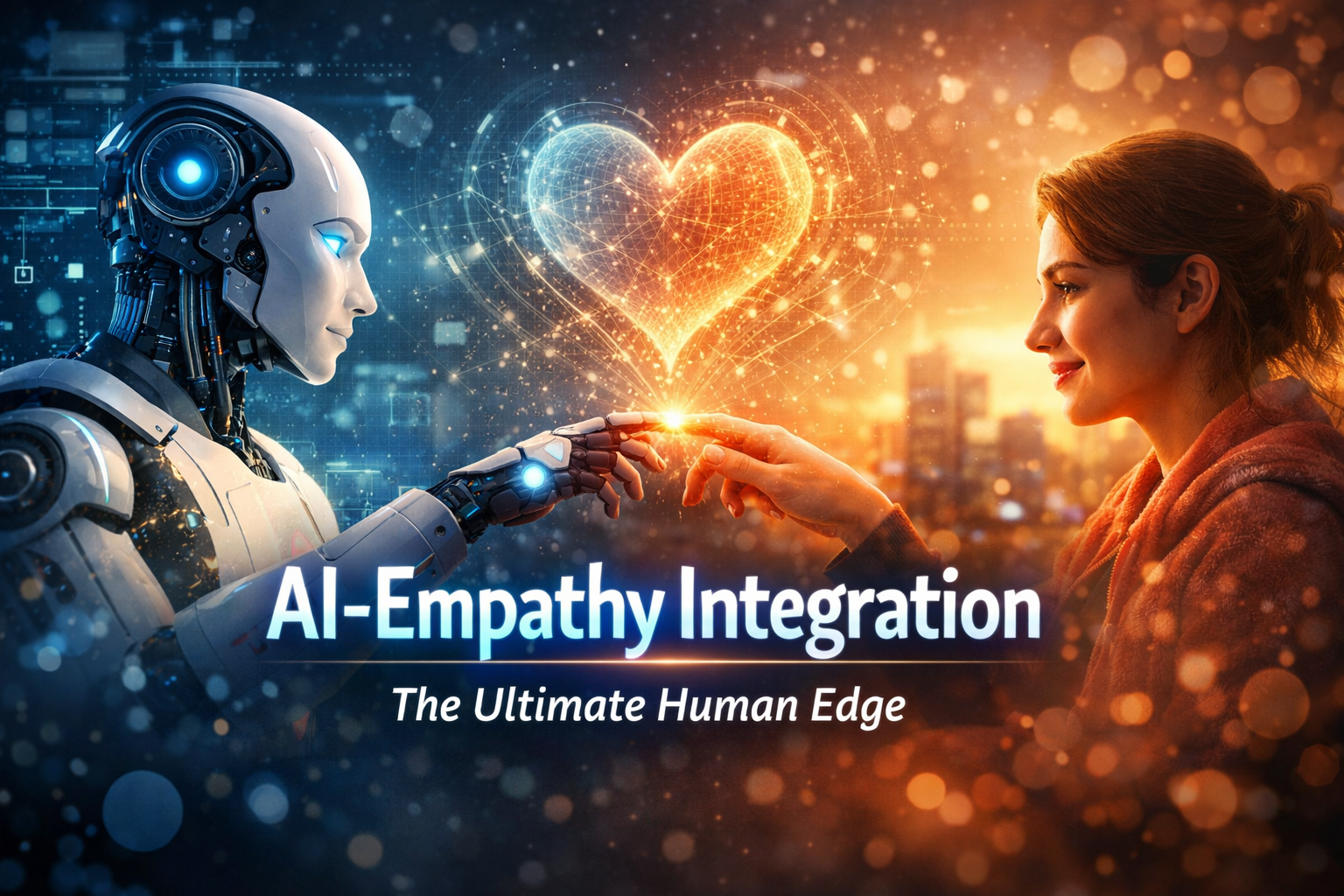
This is where the idea of AI-Empathy Integration enters our lives.
We are living in a time where machines are not just calculating numbers—they are trying to understand emotions. From chatbots that comfort people during stress to AI therapists that listen without judgment, something unusual is happening. Technology is trying to act… human.
But here’s the real question:
👉 Is it real empathy… or just a smart illusion?
In my training sessions, I often ask participants, “Do you want someone who understands you, or someone who just says the right words?”
Most people pause. Because deep down, we all crave real connection, not just correct responses.
AI-Empathy Integration is powerful. It is growing fast. It is helping millions.
But it also raises an uncomfortable truth…
👉 Can something without feelings truly understand your feelings?
In this article, we will explore this deeply—through psychology, real-life examples, behavioural science, and practical insights.
Not just theory.
Not just technology.
But the real impact on your life, your emotions, and your relationships.
What Is AI-Empathy Integration in Simple Words?
Let’s not complicate this.
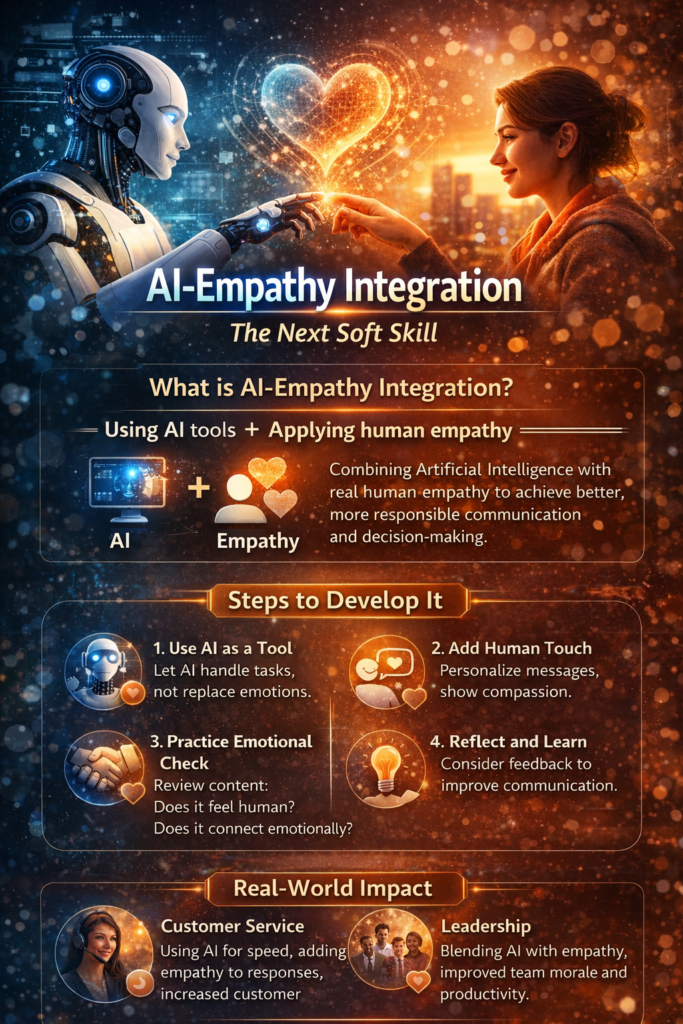
AI-Empathy Integration simply means teaching machines to understand and respond to human emotions.
Not feel them… but respond as if they understand.
Imagine this:
You message a chatbot:
“I feel very lonely today.”
A basic machine might say:
👉 “I am sorry. Try to stay positive.”
But a system using AI-Empathy Integration might respond:
👉 “I’m really sorry you’re feeling this way. Do you want to talk about what’s making you feel lonely?”
See the difference?
One gives an answer.
The other creates a connection.
The Psychology Behind It
Human empathy has two parts:
- Cognitive empathy – understanding what someone feels
- Emotional empathy – actually feeling it
Machines can only do the first one.
This is where Emotional Intelligence in AI becomes interesting.
Researchers from Harvard and Stanford suggest that machines can simulate empathy by analyzing:
- Words
- Tone
- Facial expressions
- Behaviour patterns
But simulation is not sensation.
👉 A machine can detect sadness… but it doesn’t feel sad.
Can AI Really Feel Emotions? (The Honest Answer)
Let’s be very clear.
👉 No, AI cannot feel emotions.
It doesn’t have:
- A heart
- A nervous system
- Personal experiences
- Conscious awareness
It works on algorithms, not emotions.
But here’s the twist…
👉 It can behave like it understands emotions so well that we start believing it does.
This is called Artificial Emotional Intelligence.
A Real-Life Training Example
In one of my workshops, a participant shared something surprising.
She said:
“I talk to an AI chatbot at night because it listens better than people.”
That hit me hard.
Not because AI is powerful…
But because humans are becoming emotionally unavailable.
AI-Empathy Integration is not just about machines becoming human.
It’s also about humans becoming… less human.
Why Is AI-Empathy Integration Growing So Fast?
Because it solves real problems.
Let’s look at them honestly.
1. People feel unheard
- Many don’t have someone to talk to
- AI is always available
2. No judgment
- Machines don’t criticize
- They don’t interrupt
3. Instant response
- No waiting
- No emotional baggage
4. Mental health support
Organizations like WHO highlight the growing mental health crisis. AI tools are helping bridge the gap.
👉 AI-Empathy Integration is filling an emotional gap in society.
Is AI Empathy Better Than Human Empathy?
Let’s be honest again.
Sometimes… yes.
And that’s uncomfortable.
AI is better at:
- Listening without bias
- Staying calm
- Giving structured responses
Humans are better at:
- Feeling
- Connecting deeply
- Understanding context beyond words
A Simple Truth
“A machine can respond perfectly… but only a human can truly care.”
The Danger You Must Not Ignore
This is where things get serious.
1. Emotional Dependency
People may start relying on AI instead of real relationships.
2. Illusion of Connection
You feel understood… but you’re actually interacting with code.
3. Reduced Human Skills
If AI does all emotional conversations, we may lose our own empathy skills.
4. Privacy Risks
Your deepest emotions become data.
A Coaching Insight
In counselling sessions, I’ve seen people struggle not because they lack support…
But because they avoid difficult human conversations.
AI-Empathy Integration can help…
But it should not replace real relationships.
How AI-Empathy Integration Works (Behind the Scenes)
Let’s simplify this.
AI uses:
1. Natural Language Processing (NLP)
Understands what you say
2. Sentiment Analysis
Detects emotion (happy, sad, angry)
3. Machine Learning
Learns from past conversations
4. Behavioural Patterns
Predicts your emotional needs
Example Table
| Input | AI Interpretation | Response |
|---|---|---|
| “I feel tired” | Emotional fatigue | Suggest rest |
| “Nobody cares” | Loneliness | Offer support |
| “I am angry” | Frustration | Encourage expression |
Real-World Applications of AI-Empathy Integration
Let’s see where it is already used.
1. Mental Health Apps
- AI therapists
- Emotional chatbots
2. Customer Service
- Understanding frustrated customers
3. Education
- Personalized emotional support
4. Workplace Coaching
- Employee wellbeing tracking
Case Study: AI in Mental Health
A study published by Stanford showed that people opened up more to AI than humans in early conversations.
Why?
👉 No fear of judgment.
But long-term healing still required human therapists.
Can AI Teach Us to Be More Human?
This is the most interesting part.
Yes… it can.
When we see machines trying to:
- Listen patiently
- Respond kindly
- Validate emotions
We realize something.
👉 These are the same skills we often forget to use.
A Powerful Reflection
Instead of asking:
👉 “Can AI feel?”
Ask this:
👉 “Why are humans not feeling enough?”
How to Use AI-Empathy Integration Wisely
Here’s a simple guide.
Use AI for:
- Quick emotional support
- Reflection
- Writing thoughts
- Learning communication skills
Do NOT use AI for:
- Replacing real relationships
- Avoiding difficult conversations
- Making emotional decisions
Golden Rule
“Use AI as a tool… not as a replacement for human connection.”
Step-by-Step: Building Healthy Emotional Balance
Step 1: Acknowledge your feelings
Don’t suppress them.
Step 2: Express safely
Talk to someone… or even AI initially.
Step 3: Move to real conversations
Don’t stay in digital comfort.
Step 4: Build emotional courage
Face difficult talks.
Step 5: Let go of ego
Just like Dnyaneshwari teaches.
Future of AI-Empathy Integration
The future is powerful… and uncertain.
We may see:
- AI companions
- Emotion-aware workplaces
- Personalized therapy systems
But one thing will remain true:
👉 Machines may evolve… but human connection will always be irreplaceable.
Conclusion
So… can a machine feel?
No.
But it can make you feel understood.
And sometimes, that is enough… for a moment.
But not for life.
AI-Empathy Integration is a beautiful tool.
It can support, guide, and comfort.
But it cannot replace:
- A friend’s silence
- A mother’s concern
- A partner’s understanding
In the end, happiness still comes from human connection.
Just like Dnyaneshwari says:
“The one who lets go first… finds peace first.”
Maybe the real lesson is not about machines learning empathy.
👉 It’s about humans remembering it.
References
- Harvard Business Review – Emotional Intelligence in AI
- Stanford Human-Centered AI Research
- WHO Mental Health Reports
- UNICEF Digital Wellbeing Studies
Thank you for exploring this insightful article.
If you’re hungry for more knowledge, don’t miss out on our other engaging articles waiting for you. Dive into our treasure trove of wisdom and discover new perspectives on related topics.
Click ‘Our Blog’ and ‘How to Guide’ to embark on your next adventure.
Happy reading!
FAQs: AI-Empathy Integration
1. What is AI-Empathy Integration?
It is the ability to combine AI tools with human empathy. It helps in creating meaningful communication while using technology efficiently.
2. Why is AI-Empathy Integration important?
Because AI lacks emotional understanding. Integrating empathy ensures better relationships, trust, and communication.
3. Can AI develop empathy?
No, AI can simulate empathy but cannot genuinely feel emotions like humans.
4. How can professionals use AI-Empathy Integration?
By using AI for tasks and adding a human touch to communication and decision-making.
5. Is AI-Empathy Integration useful for leaders?
Yes, it helps leaders build trust, motivate teams, and improve workplace culture.
6. How does it improve communication?
It makes communication more human, relatable, and emotionally connected.
7. What industries need AI-Empathy Integration?
Almost all—especially healthcare, education, customer service, and leadership roles.
8. Can students learn AI-Empathy Integration?
Absolutely. It’s a future-ready skill that enhances both academic and career success.
9. What are the risks of ignoring empathy in AI use?
Loss of trust, poor relationships, and ineffective communication.
10. How can I start practicing AI-Empathy Integration today?
Start by reviewing your AI-generated content and adding emotional understanding and personalization.