
Table of Contents
Introduction:
I have sat in classrooms, training rooms, and even at my own desk and thought, “I’ll start in five minutes.”
And in some way… That five minutes turns into two hours.
If I’m being real with you, procrastination isn’t laziness. It’s something deeper. Emotional. Psychological.
And once you understand that, everything changes.
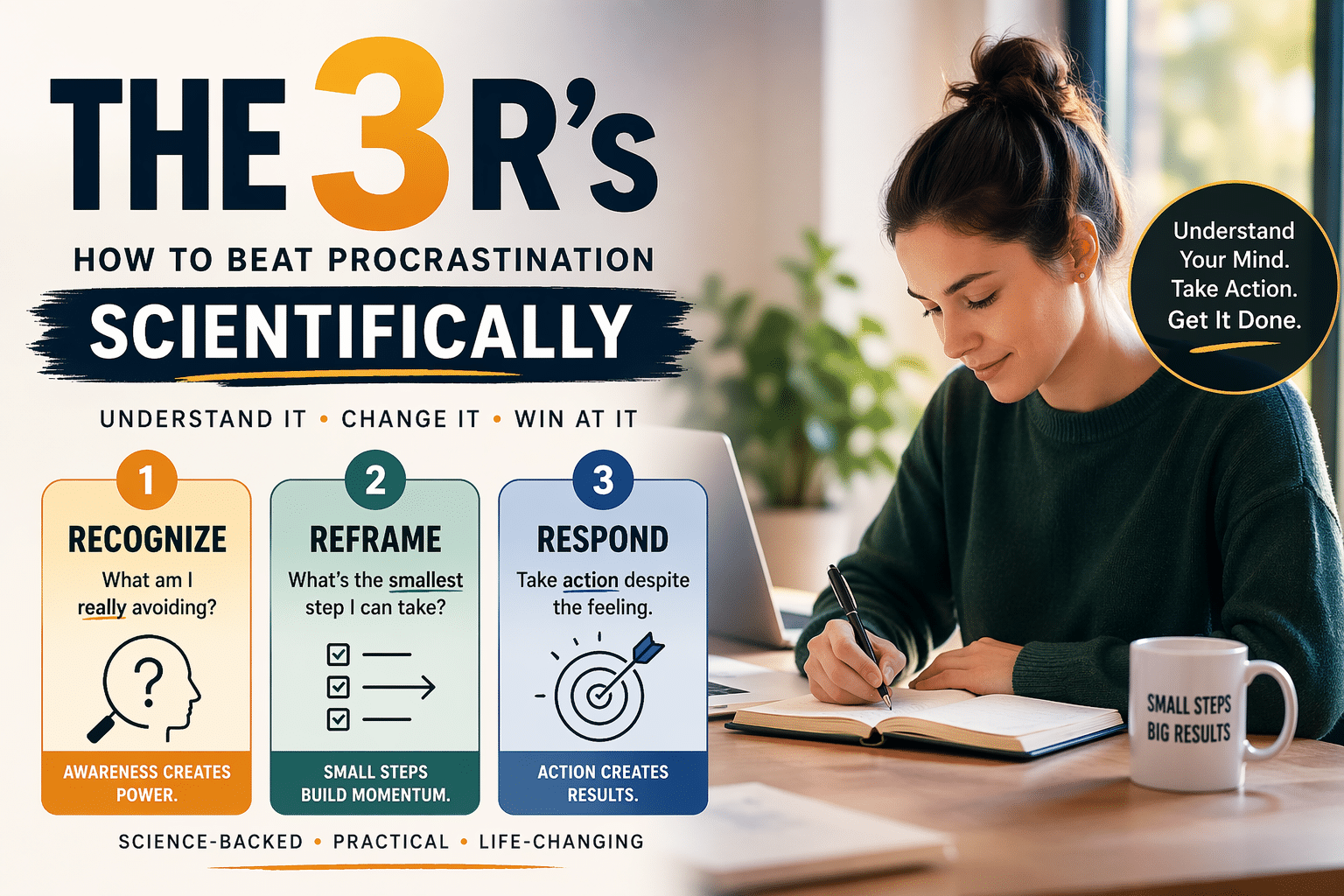
This article isn’t about pushing yourself harder. It’s about understanding how to beat procrastination scientifically using a simple but powerful framework: the 3 R’s — Recognize, Reframe, and Respond.
What Does Science Say About Procrastination?
Before we jump into the solution, let’s understand the problem.
Research shows procrastination is linked to emotional regulation, not time management. According to studies from institutions like Stanford and the American Psychological Association, we procrastinate to avoid discomfort — not because we don’t have time.
👉 In simple words:
We delay tasks because they feel uncomfortable, not because they’re difficult.
And honestly… that hits hard.
The 3 R’s Method: How to Beat Procrastination Scientifically
This is where things get interesting.
Instead of forcing discipline, the 3 R’s approach works with your brain, not against it.
1. Recognize — “What am I really avoiding?”
This might sound simple… but it’s not easy.
Most people think they’re procrastinating on a task.
But in reality, they’re avoiding a feeling.
Ask yourself:
- Am I feeling overwhelmed?
- Am I afraid of failure?
- Am I bored or uninterested?
In one of my training sessions, a participant kept delaying a report. When we dug deeper, it wasn’t the report—it was fear of criticism.
And honestly… that changed everything for him.
👉 Awareness reduces resistance.
2. Reframe — “What’s the smallest step I can take?”
Here’s where science really helps.
Your brain hates big, vague tasks.
But it’s okay with small, clear actions.
Instead of saying
❌ “I need to complete this project.”
Say:
✅ “I will write the first paragraph.”
This technique is backed by behavioral psychology—breaking tasks reduces cognitive load.
Try this:
- Turn big tasks into micro-actions
- Focus on starting, not finishing
Because once you start… momentum kicks in.
3. Respond—”Take action despite the feeling”
This is the hardest part.
Because you’re not waiting for motivation anymore.
You’re acting even when you don’t feel like it.
And honestly… this is where growth happens.
Psychologists call this “opposite “action”—doing the task despite emotional resistance.
A simple rule:
👉 “Do it for 5 minutes.”
That’s it.
Most of the time, you’ll continue.
And even if you don’t—you’ve broken the cycle.
Why the 3 R’s Actually Work (Science Behind It)
Let’s connect the dots.
- Recognize → Activates self-awareness (prefrontal cortex)
- Reframe → Reduces overwhelm (cognitive restructuring)
- Respond → Builds action habit (behavioral activation)
Experts like Daniel Goleman emphasize emotional intelligence as key to behavior change. And honestly, procrastination is just a lack of emotional regulation.
How to Beat Procrastination Scientifically in Daily Life
Let’s make this practical.
Morning Routine Trick
Before starting your day, ask:
👉 “What’s one uncomfortable task I will start today?”
Not finish. Just start.
The 2-Minute Rule
If something takes less than 2 minutes… do it immediately.
This builds momentum.
Environment Matters More Than Motivation
Remove distractions:
- Keep phone away
- Use a clean workspace
- Set a timer
Small changes. Big impact.
Real Talk: Why Motivation is Overrated
This might sound harsh…
But waiting for motivation is the biggest trap.
In my experience as a trainer, the most successful people don’t feel motivated all the time.
They just… show up.
Even when it’s messy. Even when it’s uncomfortable.
Resources
- Insights on procrastination from American Psychological Association
- Research-backed strategies by Stanford University Behavior Design Lab
- Emotional intelligence concepts by Daniel Goleman
Conclusion:
If you’ve been searching for how to beat procrastination scientifically, here’s the truth:
It’s not about forcing yourself.
It’s about understanding yourself.
Recognize the emotion.
Reframe the task.
Respond with action.
And slowly… things start moving.
Not perfectly. But consistently.
And honestly… that’s enough.
FAQ’s on How to Beat Procrastination Scientifically
What is the scientific way to stop procrastination?
The scientific way involves understanding emotional triggers, breaking tasks into small steps, and taking action despite discomfort using behavioral techniques like the 3 R’s.
Why do people procrastinate even when they know it’s bad?
Procrastination is linked to emotional avoidance, not laziness. People delay tasks to avoid stress, fear, or discomfort.
How can I start a task when I don’t feel motivated?
Start with just 5 minutes. This reduces resistance and helps build momentum, making it easier to continue.
What are the 3 R’s method for procrastination?
It stands for Recognize (identify emotions), Reframe (simplify the task), and Respond (take action anyway).
Can emotional intelligence help reduce procrastination?
Yes, managing emotions effectively helps you overcome avoidance and take action more consistently.
Is procrastination a mental health issue?
It can be linked to anxiety, stress, or low self-esteem, but it’s mainly a behavioral pattern that can be changed.
How do I stop procrastinating daily?
Focus on small tasks, remove distractions, and commit to starting rather than finishing.
Does breaking tasks really help?
Yes, smaller tasks reduce overwhelm and make it easier for the brain to initiate action.
What is the 2-minute rule?
If a task takes less than 2 minutes, do it immediately to build productivity habits.
How long does it take to overcome procrastination?
It varies, but consistent small actions daily can show improvement within a few weeks.