
The Silent Language of the Digital World
Have you ever sent a simple message like “Okay.” and instantly worried… Did I sound rude? Was I too cold?
Welcome to the world of Digital Non-Verbal Cues—the invisible signals that shape how your words are felt, not just read.
In face-to-face communication, we rely heavily on body language, tone of voice, eye contact, and gestures. But what happens when communication shifts to screens? Emails, WhatsApp messages, Zoom calls, Slack chats—suddenly, the physical cues disappear. Yet, communication doesn’t become neutral. Instead, it evolves.
That’s where Digital Non-Verbal Cues come into play.
These cues include typing speed, punctuation, emoji use, message timing, capitalization, formatting, and even silence. They silently convey emotions, intent, authority, and relationship dynamics. In fact, according to research in communication psychology, over 60% of perceived meaning in communication comes from non-verbal elements—even in digital spaces, our brains try to fill in the gaps.
As a trainer and communication coach, I’ve seen countless professionals struggle not because of what they said—but how it was interpreted digitally. One corporate leader I worked with nearly damaged a key client relationship simply because his short, abrupt emails were perceived as dismissive.
This guide will help you understand, decode, and master Digital Non-Verbal Cues so you can:
- Build stronger relationships online
- Avoid misunderstandings
- Communicate with clarity and emotional intelligence
- Increase your professional influence
“In the digital world, how you say it matters more than what you say.”
Let’s dive into this powerful, often overlooked skill.
Step1: Understanding Digital Non-Verbal Communication
What Are Digital Non-Verbal Cues?
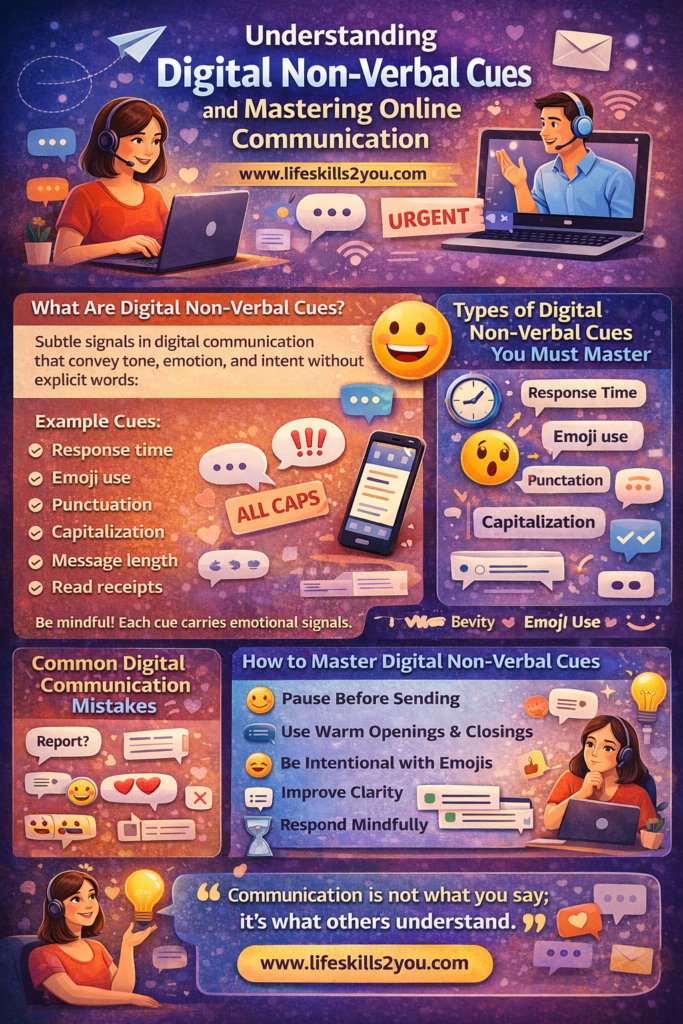
Digital Non-Verbal Cues are the subtle signals embedded in digital communication that convey tone, emotion, and intent without explicit words.
Examples of Digital Non-Verbal Cues
- Message length (short vs detailed)
- Response time
- Use of emojis 😊
- Punctuation (!!! vs .)
- Capitalization (ALL CAPS = shouting)
- Formatting (bold, spacing, bullet points)
- Read receipts and seen indicators
These are part of digital body language, a concept widely discussed in modern communication psychology and highlighted in research from platforms like Harvard Business Review on virtual communication effectiveness.
Why Digital Non-Verbal Cues Matter More Than Ever
In today’s remote and hybrid work culture, Digital Non-Verbal Cues are often the only signals people rely on.
Psychological Impact
Our brains are wired to interpret tone and emotion. When cues are missing, we:
- Assume negative intent
- Misinterpret neutrality as rudeness
- Fill gaps based on past experiences
Key Insight
Silence in digital communication is not neutral—it is interpreted.
Step2: Types of Digital Non-Verbal Cues You Must Master
1. Timing as a Communication Signal
Response Time Matters
- Immediate reply → Interest, urgency
- Delayed reply → Disinterest or disrespect
Real-Life Example 1
A manager I coached delayed responses to team messages. Employees assumed he was ignoring them, leading to disengagement. Once he improved response timing, team morale improved significantly.
2. Punctuation and Tone
The Power of a Period
- “Thanks.” → Cold
- “Thanks!” → Warm
- “Thanks 😊” → Friendly
Micro-differences, massive impact
These subtle Digital Non-Verbal Cues can completely change emotional interpretation.
3. Emojis and Emotional Context
Emotional Amplifiers
Emojis act as tone indicators:
- 😊 → Friendly
- 👍 → Agreement (or sometimes passive acknowledgment)
- 😐 → Neutral or awkward
Real-Life Example 2
A client used “👍” frequently. His team perceived it as dismissive. Switching to short responses improved clarity and connection.
4. Message Length and Structure
Short vs Long Messages
- Short → Efficient or rude
- Long → Detailed or overwhelming
Best Practice
Use:
- Bullet points
- Clear spacing
- Logical flow
These improve clarity in communication and reduce misinterpretation.
5. Capitalization and Formatting
Hidden Emotional Signals
- ALL CAPS → Aggressive
- lowercase → casual
- Bold text → emphasis
Use formatting intentionally
Formatting is a strong Digital Non-Verbal Cue that signals importance.
Step 3: Common Mistakes in Digital Communication
Mistake 1: Overusing Brevity
Short messages often lack warmth.
Example
“Send report.”
vs
“Hi, could you please send the report when you get a chance?”
Mistake 2: Ignoring Emotional Tone
Many professionals focus only on content, ignoring emotional intelligence in communication.
Mistake 3: Misusing Emojis
Too many emojis can reduce professionalism.
Mistake 4: Delayed Responses
Silence can damage trust faster than criticism.
Step 4: Applying Digital Non-Verbal Cues in Real Life
Case Study 1: Corporate Leader Transformation
A senior executive struggled with team engagement. His emails were:
- Short
- Direct
- Emotionally flat
Intervention
We improved his Digital Non-Verbal Cues:
- Added greetings
- Used positive tone
- Included appreciation
Result
- 40% increase in team satisfaction
- Better collaboration
Case Study 2: Freelancer Client Communication
A freelancer lost clients due to poor messaging tone.
Fix
- Used structured messages
- Added polite language
- Improved response time
Outcome
- Increased repeat clients
Case Study 3: Remote Team Miscommunication
A global team faced conflicts due to tone misunderstandings.
Solution
Training on Digital Non-Verbal Cues.
Result
- Reduced conflicts
- Improved clarity
Step 5: Science Behind Digital Non-Verbal Cues
Behavioural Psychology Perspective
According to communication studies and WHO-backed emotional intelligence frameworks:
- Humans rely on contextual cues
- Absence of cues increases cognitive load
You can explore more about emotional communication at WHO Emotional Wellbeing Resources.
The “Negativity Bias” Effect
People tend to interpret neutral messages negatively.
Example
“Noted.” → Often perceived as passive-aggressive
Step 6: How to Master Digital Non-Verbal Cues (Action Plan)
1. Pause Before Sending
Ask:
- How will this be interpreted?
- Is my tone clear?
2. Use Warm Openings and Closings
Examples:
- “Hope you’re doing well”
- “Appreciate your help”
3. Match Tone with Context
- Formal → Emails
- Casual → Chats
4. Be Intentional with Emojis
Use sparingly in professional settings.
5. Improve Clarity
Use:
- Bullet points
- Clear instructions
6. Respond Mindfully
Even a quick acknowledgment helps.
Step 7: Motivational Insight
“Communication is not what you say; it’s what others understand.”
Mastering Digital Non-Verbal Cues is not just a skill—it’s a competitive advantage in the modern world.
Conclusion
In a world dominated by screens, Digital Non-Verbal Cues are your hidden language of influence. They shape perception, build trust, and define relationships.
By becoming aware of these subtle signals, you can:
- Communicate with clarity
- Avoid misunderstandings
- Build stronger professional and personal connections
Remember, every message you send carries more than words—it carries you.
Thank you for exploring this insightful article.
If you’re hungry for more knowledge, don’t miss out on our other engaging articles waiting for you. Dive into our treasure trove of wisdom and discover new perspectives on related topics.
Click ‘Our Blog’ and ‘How to Guide’ to embark on your next adventure.
Happy reading!
FAQs: Digital Non-Verbal Cues
1. What are Digital Non-Verbal Cues?
They are subtle signals like emojis, timing, punctuation, and formatting that convey tone and emotion in digital communication.
2. Why are Digital Non-Verbal Cues important?
They help prevent misunderstandings and improve clarity, especially in remote communication.
3. Can emojis be used professionally?
Yes, but in moderation. They should match the context and audience.
4. How does response time affect communication?
Quick responses show engagement, while delays may signal disinterest.
5. What is digital body language?
It refers to how tone and intent are expressed through digital behavior.
6. Why do people misinterpret messages online?
Because of lack of physical cues and the brain’s tendency toward negative assumptions.
7. How can I improve my digital communication?
Focus on clarity, tone, structure, and timely responses.
8. Are short messages always bad?
No, but they can seem abrupt if not balanced with politeness.
9. What role does emotional intelligence play?
It helps you understand how your message will be perceived.
10. Can Digital Non-Verbal Cues impact career growth?
Absolutely. Strong communication skills improve leadership, teamwork, and influence.