The concept of clarity in communication: Comprehensive Guide.

Clarity in Communication: The Key to Effective Interactions

Clarity in communication is essential for fostering strong relationships, enhancing productivity, and achieving success in both personal and professional settings. Clarity in Communication ensures that messages are understood as intended, minimizing confusion and improving interactions. πŸ˜ŠπŸ“’βœ…

β€œThe most important thing in communication is to hear what isn’t being said.”

Β Peter Drucker

The Importance of Clarity in Communication πŸŽ―πŸ’‘πŸ—£οΈ

Strengthening Relationships β€οΈπŸ€πŸ’¬

Clear communication nurtures healthy relationships by reducing misunderstandings and conflicts. Whether in personal or professional interactions, articulating thoughts and emotions effectively builds trust and mutual understanding.

Boosting Productivity πŸ“ˆπŸš€πŸ› οΈ

In workplaces, Communication Clarity accelerates productivity by ensuring that employees understand their tasks, objectives, and expectations. When instructions are precise, teams work efficiently, reducing errors and delays.

Enhancing Leadership πŸ‘‘πŸŽ€πŸŒŸ

Great leaders excel in Clarity in Communication. Their ability to convey vision, strategies, and expectations in a concise manner motivates teams, fosters collaboration, and drives success.

Aiding Decision-Making πŸ§ πŸ“Šβœ…

Clarity in Communication plays a vital role in decision-making by presenting information succinctly. When facts and options are well-structured, individuals can make informed choices without unnecessary complexity.

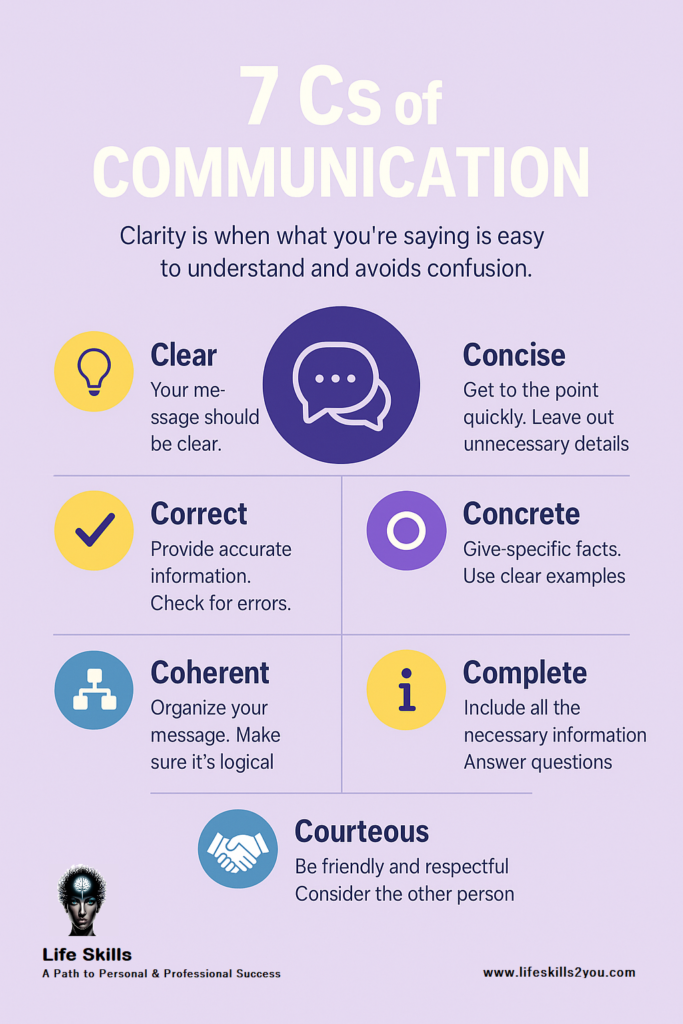
The 7 C’s of Communication πŸ†πŸ“πŸ”

Effective communication is guided by seven fundamental principles known as the 7 C’s. These principles help ensure that messages are clear, concise, and impactful.

1. Clarity πŸŒŸπŸ’‘βœ”οΈ

Messages should be clear and easy to understand, leaving no room for misinterpretation.

2. Conciseness βœ‚οΈπŸ“ŒπŸ“’

Keep communication brief and to the point, avoiding unnecessary words or details.

3. Correctness βœ…πŸ“–βœοΈ

Ensure that the information shared is accurate, error-free, and grammatically correct.

4. Completeness πŸ“‹βœ”οΈπŸ“Š

Provide all necessary information so that the recipient has everything required to understand and respond.

5. Coherence πŸ”„πŸ”—πŸ“š

Structure messages logically, maintaining a smooth flow of ideas.

6. Courtesy πŸ˜ŠπŸ™πŸ’¬

Use polite language and consider the recipient’s perspective to maintain a respectful tone.

7. Consideration β€οΈπŸ€”πŸ‘‚

Understand the needs, emotions, and background of the audience while communicating.

3. Achieving Clarity in Communication: Techniques and Strategies πŸŽ―πŸ› οΈπŸ“’

Mastering Clarity in Communication requires consistent practice and the application of effective techniques. Here are some key strategies to enhance clarity in communication:

Simplify Complex Concepts πŸ§©πŸ“–πŸ”

Break down intricate ideas into easily digestible components. Use relatable examples and analogies to bridge the gap between complexity and comprehension.

Organize Your Thoughts πŸ—‚οΈπŸ§ πŸ“Œ

Before communicating, structure your thoughts logically. A well-organized message ensures that each point seamlessly leads to the next, improving overall coherence.

Choose Your Words Wisely πŸ—£οΈβœοΈπŸ“’

Word choice significantly impacts Clarity in Communication. Use precise and concise language while avoiding jargon and technical terms when speaking to non-experts.

Practice Active Listening πŸ‘‚πŸŽ―πŸ€

Effective communication is a two-way process. Active listeningβ€”focusing on the speaker, asking clarifying questions, and paraphrasingβ€”ensures mutual understanding.

Use Visual Aids πŸ“ŠπŸ“ŒπŸŽ¨

In presentations, visuals such as slides, charts, and diagrams reinforce messages and enhance audience comprehension.

How I Learned to Speak With More CLARITY

Clarity in Professional Communication πŸ’ΌπŸ“’βœ…

In professional environments, Clarity in Communication fosters collaboration, efficiency, and workplace success.

Providing Clear Instructions πŸ“œβœ…πŸ“Œ

When giving instructions, be specific and detailed to eliminate ambiguity. Clearly outline steps and expectations to ensure smooth execution.

Effective Email Communication βœ‰οΈπŸ“–πŸ“Œ

Written workplace communication demands Clarity in Communication. Structure emails logically, use bullet points for easy readability, and highlight key takeaways.

Offering Transparent Feedback πŸŽ―πŸ—£οΈπŸ“Š

Constructive feedback should be clear and actionable. Avoid vague comments and focus on specific areas for improvement.

Conflict Resolution βš–οΈπŸ€πŸ’¬

Clarity in Communication is essential when resolving conflicts. Clearly articulate concerns, listen actively, and propose solutions that all parties can understand and accept.

Clarity in Personal Relationships β€οΈπŸ—£οΈπŸ’‘

Applying Clarity in Communication in personal interactions strengthens connections and minimizes misinterpretations.

Expressing Emotions Clearly πŸ’–πŸ—£οΈπŸ˜Š

Openly communicating emotions fosters deeper relationships. Clearly articulating feelings and concerns ensures messages are received as intended.

During disagreements, prioritize Clarity in Communication. Express your viewpoint clearly, listen attentively, and collaborate to find common ground.

Bridging Cultural Differences πŸŒπŸ‘‚πŸ’¬

Cross-cultural communication requires heightened clarity. Be mindful of language barriers and adapt communication styles to enhance mutual understanding.

The Role of Clarity in Public Speaking πŸŽ€πŸ“’βœ¨

Public speaking demands Clarity in Communication to captivate audiences and convey messages effectively.

Structuring Speeches Properly πŸ“πŸŽ―πŸ“’

Organize speeches with a clear introduction, well-defined key points, and smooth transitions to ensure audience engagement.

Delivering Messages Effectively πŸŽ™οΈπŸ”ŠπŸ˜Š

Beyond words, delivery plays a crucial role. Maintain steady pacing, use expressive gestures, and modulate your voice for emphasis.

Connecting with the Audience πŸ€πŸ‘‚πŸ“’

Tailor speeches to align with the audience’s understanding. Use relatable language and examples to make messages more impactful.

References:
For further insights on communication skills, I recommend exploring articles on reputable website likeΒ Udemy. Additionally, you can enrich your understanding by watching empowering YouTube videos from channels like TED Talks.

In a world flooded with information, achieving clarity in communication is paramount. It transcends verbal exchanges, touching every aspect of our lives – from personal relationships to professional success. By understanding the essence of clarity and implementing effective strategies, you empower yourself to be a better communicator. Embrace clarity and watch as your interactions flourish, connections deepen, and your influence grows.

Frequently Asked Questions (FAQs) about the concept of clarity in communication

Q1: How does clarity in communication impact interpersonal relationships?

Ans: Clarity minimizes misunderstandings, fostering trust and deeper connections between individuals.

Q2: Can clarity in communication be achieved in non-verbal communication?

Ans: Yes, clarity extends to non-verbal cues such as body language and facial expressions.

Q3: What’s the connection between clarity in communication and effective leadership?

Ans: Effective leaders communicate clearly, inspiring and motivating their teams toward success.

Q4: How can I improve clarity in my writing?

Ans: Simplify complex ideas, organize your content logically, and choose precise vocabulary to enhance clarity.

Q5: Is clarity more important than brevity in communication?

Ans: While brevity is valuable, clarity should never be compromised. Clear communication trumps all

Q6: How does clarity contribute to conflict resolution?

Ans: Clear communication during conflicts helps parties understand each other’s perspectives and find common ground.


Conflict Resolution: Proven Strategies for Effective Solutions

In a world where interactions and relationships are integral to both personal and professional success, conflicts are inevitable. However, how we navigate and resolve these conflicts can significantly impact the quality of our relationships and the outcomes we achieve. Welcome to a comprehensive guide on Resolving Conflicts Constructively. Here are with a wealth of proven strategies that not only aid in effective conflict resolution but also empower individuals and teams to foster stronger connections.

Understanding Conflict: A Prerequisite to Resolution

Before diving into the strategies that can revolutionize your conflict resolution approach, it’s essential to grasp the essence of conflict itself. Conflict is a natural result of diverse perspectives, needs, and desires colliding. It often arises due to miscommunication, unmet expectations, or differing viewpoints. By acknowledging the inevitability of conflict, you can approach resolution with a positive and solution-oriented mindset.

The Power of Active Listening

At the heart of every successful conflict resolution lies the art of active listening. This skill involves more than just hearing words; it encompasses understanding the emotions, concerns, and motivations behind them. When engaged in a conflict, make a conscious effort to truly listen to the other party without interrupting or formulating your response. This empathetic approach not only validates their feelings but also opens doors to effective dialogue.

Constructive Communication: Bridging the Gap

Communication is the cornerstone of conflict resolution. Adopting a constructive communication style can transform a potentially heated exchange into a productive conversation. Focus on using β€œI” statements to express your feelings and needs, fostering a non-confrontational environment. Encourage the other party to do the same, promoting understanding and empathy.

Collaborative Problem-Solving: A Win-Win Approach

One of the most powerful conflict resolution strategies is collaborative problem-solving. Instead of viewing the conflict as a win-lose situation, approach it as an opportunity for mutual growth. Sit down with the other party and brainstorm solutions together. This not only ensures that both perspectives are considered but also paves the way for innovative and effective resolutions.

Emotional Intelligence: Mastering Your Emotions

Emotions often run high during conflicts, which can hinder rational decision-making. Developing emotional intelligence allows you to manage your own emotions and understand those of others. Self-awareness enables you to identify your triggers and reactions, while empathy empowers you to comprehend the emotions driving the other party. By maintaining emotional balance, you can navigate conflicts with grace and composure.

Seeking Mediation: A Neutral Ground

In cases where conflicts escalate or involve multiple parties, seeking mediation can provide a neutral and controlled environment for resolution. A trained mediator facilitates communication, ensures all perspectives are heard, and guides the parties toward a mutually satisfactory solution. Mediation often leads to quicker and more enduring resolutions, preserving relationships and preventing further escalation.

The Role of Compromise

Compromise is a powerful tool in conflict resolution, allowing both parties to find middle ground. It’s important to approach compromise with a willingness to give and take. Identify the core issues at hand and prioritize them, allowing for flexibility on less crucial matters. Through a balanced and fair compromise, you can reach solutions that address both parties’ needs.

Learning and Growth: Lessons from Conflict

Every conflict presents an opportunity for personal and professional growth. Reflection on the conflict and its resolution can provide valuable insights into your communication style, triggers, and areas for improvement. Encourage open and honest feedback from the other party, and be willing to learn from the experience. By continuously refining your conflict resolution skills, you contribute to a harmonious and productive environment.

Conclusion

In a world where conflicts are a natural part of human interactions, mastering the art of resolving them constructively is a valuable skill that transcends personal and professional spheres. Through active listening, constructive communication, collaborative problem-solving, emotional intelligence, and a willingness to learn and compromise, you can transform conflicts into opportunities for growth and connection.

Remember, effective conflict resolution isn’t about avoiding conflicts altogether; it’s about navigating them with respect, empathy, and a commitment to finding solutions that benefit all parties involved.

Mastering Effective Communication: Tips for Better Conversations

In a world where communication reigns supreme, mastering effective communication skills is an indispensable asset that can significantly enhance your personal and professional life. Whether you’re navigating complex business negotiations, nurturing relationships, or simply engaging in everyday conversations, the power of effective communication cannot be underestimated. Communication plays a vital role in personal and professional sphere, and here is with comprehensive insights and invaluable tips to help you become a master communicator.

The Art of Active Listening

Active listening is the cornerstone of effective communication. It involves not just hearing the words spoken but truly understanding the emotions, concerns, and intentions behind them. When engaged in a conversation, devote your full attention to the speaker. Maintain eye contact, nod in agreement, and show genuine interest in what they’re saying. By doing so, you not only foster a deeper connection but also gain insights that can guide your responses.

Clarity and Conciseness

Clarity and conciseness go hand in hand when it comes to effective communication. Crafting your messages with precision eliminates misunderstandings and ensures your point is conveyed accurately. Avoid using jargon or convoluted language that may confuse your audience. Instead, opt for clear and straightforward words that resonate with your listeners.

Non-Verbal Communication

It’s often said that actions speak louder than words, and this couldn’t be truer in the realm of communication. Non-verbal cues, such as facial expressions, gestures, and body language, can convey emotions and attitudes that words might not capture. Maintaining an open posture, offering a firm handshake, and smiling warmly can instantly create a positive impression and establish rapport.

Empathy and Understanding

Empathy forms the bedrock of effective communication. Putting yourself in someone else’s shoes allows you to understand their perspective, feelings, and needs. When engaged in a conversation, show empathy by acknowledging the other person’s emotions and validating their experiences. This not only builds trust but also encourages open and honest dialogue.

Constructive Feedback

Providing and receiving feedback is an essential aspect of communication, especially in professional settings. When offering feedback, focus on the specific behavior or outcome rather than making it personal. Constructive feedback should be actionable, highlighting areas for improvement while recognizing strengths. On the receiving end, approach feedback with an open mind, viewing it as an opportunity for growth.

Adaptability in Communication Styles

Effective communicators are versatile and adapt their communication style to suit different situations and audiences. Whether you’re addressing colleagues, clients, or friends, tailor your language, tone, and content to resonate with your listeners. This adaptability enhances understanding and engagement, ensuring your message is received positively.

Conflict Resolution

Conflict is inevitable in any human interaction, but how it’s managed can make or break relationships. Master communicators approach conflicts with patience, active listening, and a focus on finding common ground. By addressing concerns calmly and seeking solutions collaboratively, you can transform conflicts into opportunities for growth and strengthened relationships.

Storytelling as a Communication Tool

Storytelling transcends cultures and generations, making it a powerful tool for effective communication. Weaving relevant anecdotes and narratives into your conversations can capture your audience’s attention and make complex concepts more relatable. A well-told story has the ability to evoke emotions, drive home key messages, and create a lasting impact.

Digital Communication Etiquette

In today’s digital age, mastering effective communication extends to the virtual realm. When communicating through emails, texts, or social media, practice proper etiquette. Use clear subject lines, maintain a professional tone, and avoid misinterpretation by choosing your words carefully. Emojis and exclamation points can add warmth, but use them judiciously to maintain professionalism.

Continuous Learning and Improvement

Effective communication is a skill that can always be refined and improved. Keep learning by seeking feedback, attending communication workshops, and studying successful communicators. Stay updated on communication trends and technologies to remain relevant in an ever-evolving landscape.

In conclusion, mastering effective communication is a journey that requires dedication, self-awareness, and a genuine desire to connect with others. By honing your active listening skills, fostering empathy, adapting to different communication styles, and embracing continuous learning, you can become a master communicator who navigates conversations with finesse and creates meaningful connections.

How to maintain healthy relationship?

Maintaining a healthy relationship requires effort, communication, and mutual respect from both parties involved. If you are thinking about How to maintain healthy relationship? Here are some general tips to help you maintain a healthy relationship:

  1. Effective communication: Transparent and sincere communication forms the foundation of all thriving relationships. Express your thoughts, feelings, and needs clearly, and actively listen to your partner. Avoid assumptions and try to resolve conflicts through calm and respectful discussions.
  2. Mutual respect: Treat your partner with respect and expect the same in return. Respect their boundaries, opinions, and individuality. Avoid belittling, criticizing, or controlling behaviours, and encourage a supportive and nurturing environment.
  3. Quality time together: Devote meaningful moments to your significant other, participating in pursuits that bring joy to you both. This can strengthen your bond and create positive memories. Make an effort to prioritize each other amidst busy schedules and maintain a healthy balance between personal and relationship time.
  4. Trust and honesty: Trust plays a crucial role in fostering a robust and thriving relationship. Be honest and transparent with your partner and trust them in return. Trust builds over time through consistent and reliable behaviour. If trust is broken, work together to rebuild it through open communication and addressing underlying issues.
  5. Support and empathy: Show empathy and support for your partner’s dreams, goals, and challenges. Celebrate their successes and offer a helping hand during difficult times. Emotional support, understanding, and validation can strengthen your connection and foster a deeper bond.
  6. Individuality and personal space: Encourage each other’s personal growth and maintain individual interests and hobbies. Honor one another’s requirement for personal room and moments of solitude. Remember, a healthy relationship allows for independence while maintaining a strong connection.
  7. Compromise and forgiveness: Relationships require compromise and understanding. Be open to finding middle ground and discovering resolutions that benefit both parties. Cultivate the ability to pardon each other’s errors and release any lingering resentments. Clinging onto former grievances has the potential to taint a relationship.
  8. Intimacy and romance: Keep the spark alive in your relationship through physical affection, intimacy, and romance. Show affection, express love, and make an effort to keep the romance alive. Small gestures of love and appreciation can make a significant difference.

Remember, every relationship is unique, and it’s essential to tailor these tips to fit your specific situation. Regularly assess your relationship, address any concerns or issues promptly, and continue to invest time and effort into nurturing a healthy and fulfilling connection.

Exit mobile version