Table of Contents
Introduction
Have you ever said “yes” at work when your mind was screaming “no”?
You agree to extra tasks, stay late without complaint, avoid difficult conversations, and constantly try to keep everyone happy. On the outside, you look like the “ideal employee.” But inside? You feel drained, undervalued, and sometimes even resentful.
If this feels familiar, you’re not alone.
Many professionals struggle with people-pleasing behavior at work, especially in environments where approval feels tied to job security, promotions, or team acceptance. It often starts with good intentions—being helpful, cooperative, and dependable. But over time, it turns into a pattern where your own needs take a backseat.
And that’s exactly why learning how to stop being a people pleaser at work is not just a personal growth goal—it’s a professional necessity.
From a psychological perspective, people-pleasing is deeply connected to fear of rejection, low self-worth, and conditioning from past experiences. In workplace settings, it gets reinforced through praise for compliance rather than contribution.
As a trainer working with corporate teams and individuals, I’ve seen this pattern repeatedly. One of my clients, a mid-level manager, once told me:
“I thought being liked would make me successful. But all it did was make me invisible.”
That statement stayed with me.
Because the truth is—when you constantly prioritize others, you slowly lose your voice.
This article is not about becoming rude or selfish. It’s about becoming assertive, respected, and emotionally balanced. You’ll learn practical strategies, psychological insights, and real-life examples to help you break free.
If you’re ready to stop overcommitting, start setting boundaries, and finally reclaim your professional identity, let’s dive into how to stop being a people pleaser at work—step by step.
Understanding People-Pleasing at Work
What Does It Mean to Be a People Pleaser at Work?
Being a people pleaser at work means consistently prioritizing others’ needs, expectations, and approval over your own limits, values, or well-being.
Common signs include:
- Saying yes to everything—even when overwhelmed
- Avoiding conflict at any cost
- Struggling to say no to colleagues or bosses
- Seeking constant validation
- Feeling guilty when you prioritize yourself
This behavior is often mistaken for being “nice” or “team-oriented.” While learning How to Stop Being a People Pleaser at Work below is the diffrence between both:
| Healthy Collaboration | People Pleasing |
|---|---|
| Mutual respect | Self-sacrifice |
| Clear boundaries | No boundaries |
| Assertive communication | Passive compliance |
| Balanced workload | Overwork and burnout |
Why Do People Become People Pleasers at Work?
Understanding the “why” is the first step in learning how to stop being a people pleaser at work.
1. Fear of Rejection or Conflict
Many people fear being disliked or excluded. This leads to avoiding difficult conversations.
2. Need for Approval
If your self-worth is tied to others’ opinions, you’ll constantly seek validation.
3. Childhood Conditioning
People who grew up in environments where approval was conditional often carry this pattern into adulthood.
4. Workplace Culture
Some organizations reward compliance more than creativity, reinforcing people-pleasing behavior.
The Hidden Cost of People Pleasing
At first glance, people pleasing seems harmless—even beneficial. But the long-term effects can be damaging:
- Burnout and exhaustion
- Lack of recognition
- Decreased confidence
- Resentment towards colleagues
- Career stagnation
“You can’t pour from an empty cup.”
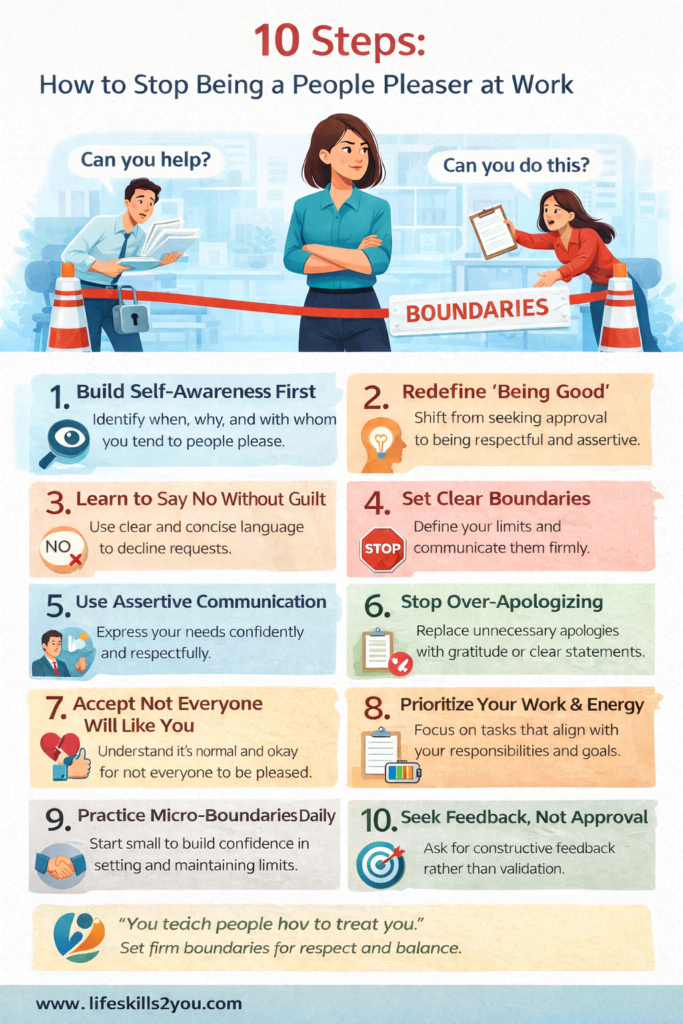
How to Stop Being a People Pleaser at Work (Step-by-Step Guide)

Now let’s get practical.
1. Build Self-Awareness First
You can’t change what you don’t notice.
Start observing:
- When do you say yes reluctantly?
- Who do you struggle to say no to?
- What emotions come up—fear, guilt, anxiety?
Exercise:
Write down 3 recent situations where you said yes but wanted to say no.
This awareness is the foundation of how to stop being a people pleaser at work.
2. Redefine What “Being Good” Means
Many people equate being good with being agreeable.
But in reality:
- Being good ≠ saying yes always
- Being good = being honest, reliable, and clear
Shift your mindset from:
👉 “I must be liked”
to
👉 “I must be respected”
3. Learn the Art of Saying No (Without Guilt)
This is the most important skill.
Here are simple ways to say no:
- “I’d love to help, but I’m currently at capacity.”
- “I can take this up next week, not today.”
- “I’m focusing on priority tasks right now.”
Pro Tip:
You don’t need to over-explain.
“No is a complete sentence.”
4. Set Clear Boundaries
Boundaries are not walls. They are guidelines.
Types of boundaries at work:
- Time boundaries (leaving work on time)
- Task boundaries (not taking extra workload)
- Emotional boundaries (not absorbing others’ stress)
When you consistently set boundaries, people start respecting them.
5. Use Assertive Communication
Assertiveness is the middle ground between passive and aggressive.
Passive:
“I’ll do it…” (even if overwhelmed)
Aggressive:
“I’m not doing this!”
Assertive:
“I can’t take this right now, but I can help later.”
Learning assertiveness is key to mastering how to stop being a people pleaser at work.
6. Stop Over-Apologizing
Do you say “sorry” too often?
Replace:
- “Sorry for the delay” → “Thank you for your patience”
- “Sorry, I can’t” → “I won’t be able to take this on”
This small shift builds confidence.
7. Accept That Not Everyone Will Like You
This is uncomfortable—but freeing.
You are not here to please everyone.
You are here to:
- Contribute
- Grow
- Add value
“Respect lasts longer than approval.”
You have accept that Accept That Not Everyone Will Like You while learning how to stop being a people pleaser at work.
8. Prioritize Your Work and Energy
Before saying yes, ask:
- Is this aligned with my role?
- Do I have time?
- What will I sacrifice if I say yes?
This clarity helps you make better decisions.
9. Practice Micro-Boundaries Daily
Start small:
- Decline one unnecessary request
- Speak up once in a meeting
- Take a proper lunch break
Understand that Small wins build confidence is the key lesson from how to stop being a people pleaser at work.
10. Seek Feedback, Not Approval
Instead of:
👉 “Did I do well?”
Ask:
👉 “What can I improve?”
This shift reduces dependency on validation.
Case Study – How to Stop Being a People Pleaser at Work.: From People Pleaser to Confident Professional
One of my trainees, Anita (name changed), worked in HR.
She:
- Took on extra work
- Avoided confrontation
- Stayed late daily
Result?
She was exhausted—and overlooked for promotion.
During coaching, we worked on:
- Boundary setting
- Assertive communication
- Confidence building
Within 3 months:
- She started saying no
- Delegated tasks
- Spoke up in meetings
Outcome?
She was promoted.
Her words:
“When I stopped trying to please everyone, people finally started taking me seriously.”
How Do You Set Boundaries Without Damaging Relationships?
This is a common fear.
Here’s the truth:
Healthy boundaries improve relationships.
Tips:
- Be polite but firm
- Communicate clearly
- Be consistent
- Avoid emotional reactions
Example:
“I understand this is important, but I won’t be able to take it today.”
How Do I Stop Being Too Nice at Work?
Being nice is not the problem. Being overly accommodating is.
Replace:
- Niceness → Authenticity
- Compliance → Clarity
- Fear → Confidence
Ask yourself:
“Am I being kind—or am I avoiding discomfort?”
How Do You Say No Professionally at Work?
Use this 3-step formula:
- Acknowledge
- Decline
- Offer alternative (optional)
Example:
“I understand this is urgent, but I’m currently focused on deadlines. I can help tomorrow.”
Psychological Frameworks Behind People Pleasing
1. Cognitive Behavioral Theory (CBT)
Your thoughts influence behavior.
Thought: “If I say no, they’ll dislike me.”
Reality: Most people respect boundaries.
Ref : Cognitive Behavior Therapy – StatPearls – NCBI Bookshelf – NIH
2. Self-Determination Theory
Humans need:
- Autonomy
- Competence
- Relatedness
People pleasing reduces autonomy.
Ref: Self-Determination Theory – an overview
3. Transactional Analysis
Many people operate from a “Pleaser Child Ego State.”
Goal: Move to “Adult Ego State” → logical, balanced decisions.
Daily Habits to Break People-Pleasing Patterns
- Practice saying no once a day
- Reflect on your decisions
- Track your energy levels
- Celebrate small wins
- Journal your thoughts
Motivational Reminders
- “You teach people how to treat you.”
- “Boundaries are self-respect in action.”
- “You don’t need to earn your worth.”
Conclusion
Learning how to stop being a people pleaser at work is not about changing who you are—it’s about reclaiming your voice.
You don’t need to stop being kind.
You need to stop abandoning yourself.
When you:
- Set boundaries
- Communicate clearly
- Value your time
You become:
- More confident
- More respected
- More fulfilled
And most importantly—you become yourself.
Thank you for exploring this insightful article on How to Stop Being a People Pleaser at Work.
If you’re hungry for more knowledge, don’t miss out on our other engaging articles waiting for you. Dive into our treasure trove of wisdom and discover new perspectives on related topics.
Click ‘Our Blog’ and ‘How to Guide’ to embark on your next adventure.
Happy reading!
FAQs on How to Stop Being a People Pleaser at Work
1. Why am I a people pleaser at work?
People-pleasing often comes from fear of rejection, low self-esteem, or past conditioning. In workplaces, it gets reinforced when compliance is rewarded. Understanding your triggers is the first step toward change.
2. Is being a people pleaser bad for your career?
Yes, in the long run. While it may make you seem cooperative, it can lead to burnout, lack of recognition, and missed leadership opportunities.
3. How can I say no without feeling guilty?
Start by reminding yourself that saying no is not selfish—it’s necessary. Use polite, clear language and avoid over-explaining.
4. Can people pleasing be unlearned?
Absolutely. With awareness, practice, and assertiveness skills, you can break this pattern over time.
5. How do I set boundaries with my boss?
Be respectful but firm. Clearly communicate your workload and priorities. Offer alternatives instead of outright refusal when possible.
6. What are signs I am a people pleaser?
Overcommitting, avoiding conflict, seeking approval, and feeling guilty for saying no are common signs.
7. Will people dislike me if I stop people pleasing?
Some may resist initially, but most will respect your clarity and confidence.
8. How long does it take to change this habit?
It varies, but consistent effort over a few weeks can create noticeable change.
9. Can being assertive damage relationships?
No. Healthy assertiveness improves communication and builds mutual respect.
10. What is the first step to stop people pleasing?
Awareness. Start noticing when and why you say yes when you want to say no.