How to Stop Being a People Pleaser at Work?

Table of Contents

Introduction

Have you ever said “yes” at work when your mind was screaming “no”?

You agree to extra tasks, stay late without complaint, avoid difficult conversations, and constantly try to keep everyone happy. On the outside, you look like the “ideal employee.” But inside? You feel drained, undervalued, and sometimes even resentful.

If this feels familiar, you’re not alone.

Many professionals struggle with people-pleasing behavior at work, especially in environments where approval feels tied to job security, promotions, or team acceptance. It often starts with good intentions—being helpful, cooperative, and dependable. But over time, it turns into a pattern where your own needs take a backseat.

And that’s exactly why learning how to stop being a people pleaser at work is not just a personal growth goal—it’s a professional necessity.

From a psychological perspective, people-pleasing is deeply connected to fear of rejection, low self-worth, and conditioning from past experiences. In workplace settings, it gets reinforced through praise for compliance rather than contribution.

As a trainer working with corporate teams and individuals, I’ve seen this pattern repeatedly. One of my clients, a mid-level manager, once told me:

“I thought being liked would make me successful. But all it did was make me invisible.”

That statement stayed with me.

Because the truth is—when you constantly prioritize others, you slowly lose your voice.

This article is not about becoming rude or selfish. It’s about becoming assertive, respected, and emotionally balanced. You’ll learn practical strategies, psychological insights, and real-life examples to help you break free.

If you’re ready to stop overcommitting, start setting boundaries, and finally reclaim your professional identity, let’s dive into how to stop being a people pleaser at work—step by step.


Understanding People-Pleasing at Work

What Does It Mean to Be a People Pleaser at Work?

Being a people pleaser at work means consistently prioritizing others’ needs, expectations, and approval over your own limits, values, or well-being.

Common signs include:

  • Saying yes to everything—even when overwhelmed
  • Avoiding conflict at any cost
  • Struggling to say no to colleagues or bosses
  • Seeking constant validation
  • Feeling guilty when you prioritize yourself

This behavior is often mistaken for being “nice” or “team-oriented.” While learning How to Stop Being a People Pleaser at Work below is the diffrence between both:

Healthy CollaborationPeople Pleasing
Mutual respectSelf-sacrifice
Clear boundariesNo boundaries
Assertive communicationPassive compliance
Balanced workloadOverwork and burnout

Why Do People Become People Pleasers at Work?

Understanding the “why” is the first step in learning how to stop being a people pleaser at work.

1. Fear of Rejection or Conflict

Many people fear being disliked or excluded. This leads to avoiding difficult conversations.

2. Need for Approval

If your self-worth is tied to others’ opinions, you’ll constantly seek validation.

3. Childhood Conditioning

People who grew up in environments where approval was conditional often carry this pattern into adulthood.

4. Workplace Culture

Some organizations reward compliance more than creativity, reinforcing people-pleasing behavior.


The Hidden Cost of People Pleasing

At first glance, people pleasing seems harmless—even beneficial. But the long-term effects can be damaging:

  • Burnout and exhaustion
  • Lack of recognition
  • Decreased confidence
  • Resentment towards colleagues
  • Career stagnation

“You can’t pour from an empty cup.”


How to Stop Being a People Pleaser at Work (Step-by-Step Guide)

Now let’s get practical.

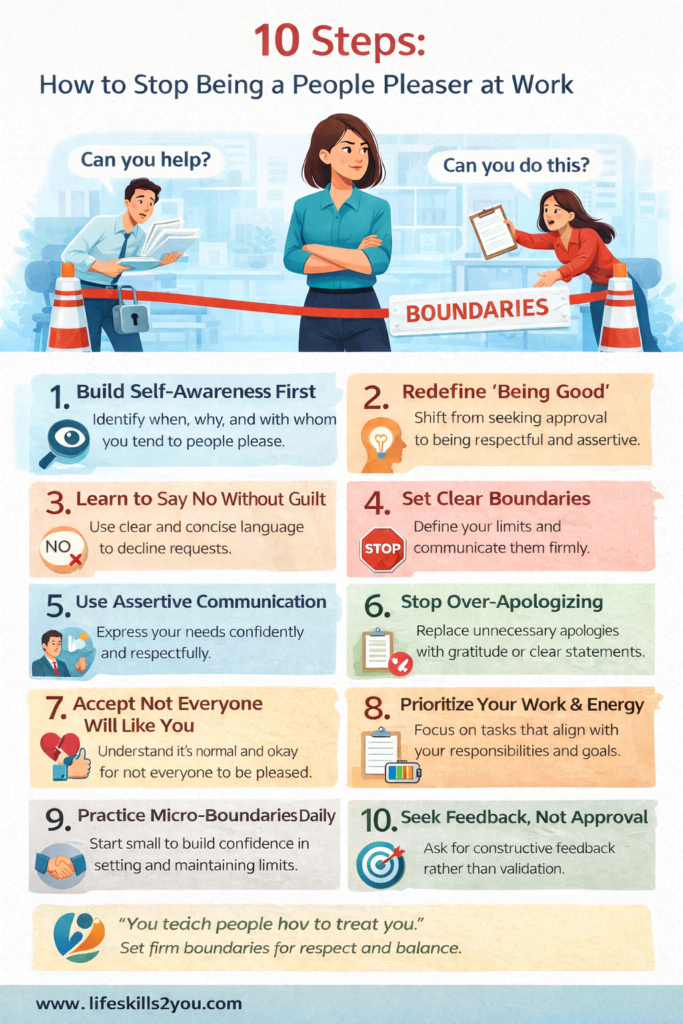
1. Build Self-Awareness First

You can’t change what you don’t notice.

Start observing:

  • When do you say yes reluctantly?
  • Who do you struggle to say no to?
  • What emotions come up—fear, guilt, anxiety?

Exercise:
Write down 3 recent situations where you said yes but wanted to say no.

This awareness is the foundation of how to stop being a people pleaser at work.


2. Redefine What “Being Good” Means

Many people equate being good with being agreeable.

But in reality:

  • Being good ≠ saying yes always
  • Being good = being honest, reliable, and clear

Shift your mindset from:
👉 “I must be liked”
to
👉 “I must be respected”


3. Learn the Art of Saying No (Without Guilt)

This is the most important skill.

Here are simple ways to say no:

  • “I’d love to help, but I’m currently at capacity.”
  • “I can take this up next week, not today.”
  • “I’m focusing on priority tasks right now.”

Pro Tip:
You don’t need to over-explain.

“No is a complete sentence.”


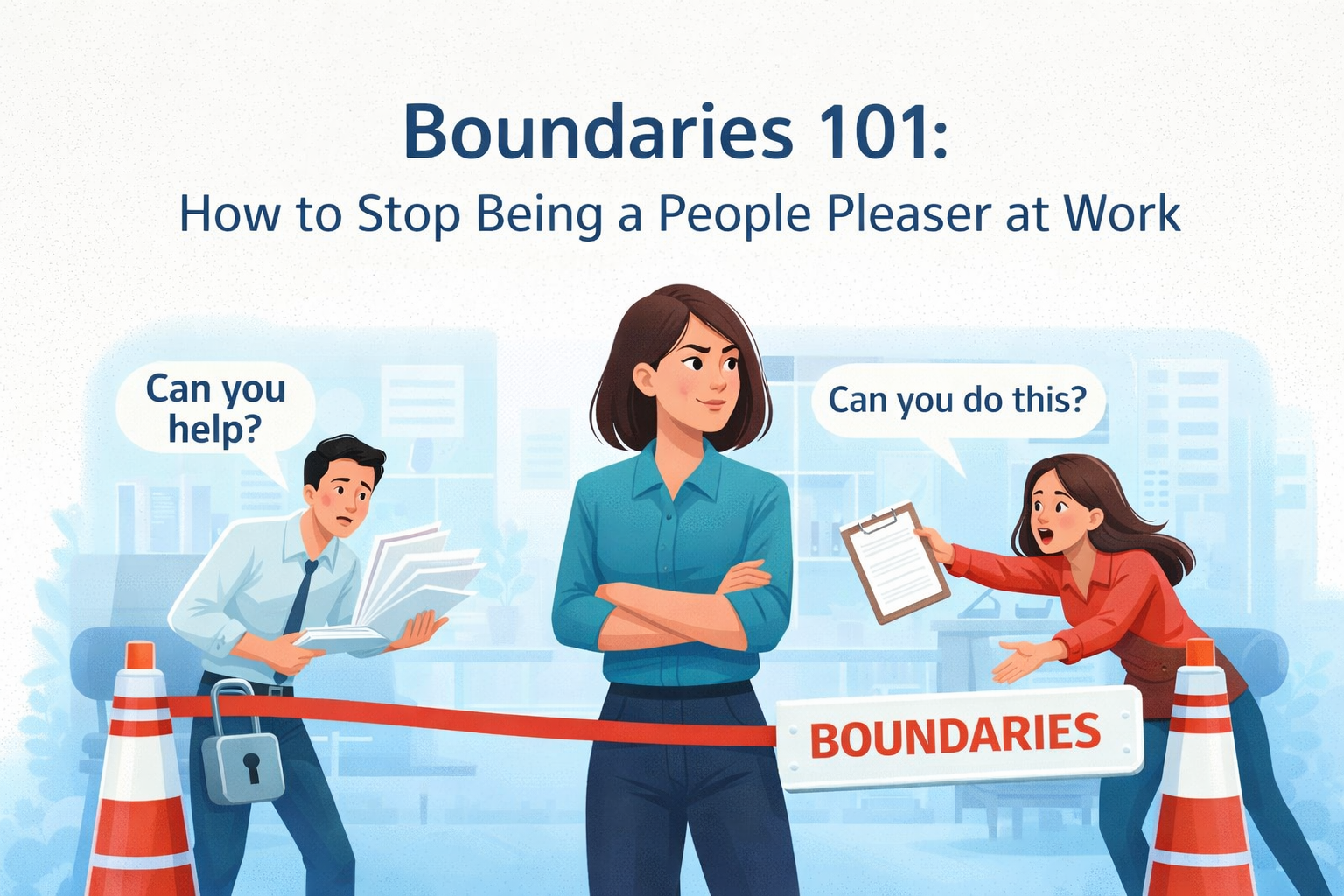
4. Set Clear Boundaries

Boundaries are not walls. They are guidelines.

Types of boundaries at work:

  • Time boundaries (leaving work on time)
  • Task boundaries (not taking extra workload)
  • Emotional boundaries (not absorbing others’ stress)

When you consistently set boundaries, people start respecting them.


5. Use Assertive Communication

Assertiveness is the middle ground between passive and aggressive.

Passive:

“I’ll do it…” (even if overwhelmed)

Aggressive:

“I’m not doing this!”

Assertive:

“I can’t take this right now, but I can help later.”

Learning assertiveness is key to mastering how to stop being a people pleaser at work.


6. Stop Over-Apologizing

Do you say “sorry” too often?

Replace:

  • “Sorry for the delay” → “Thank you for your patience”
  • “Sorry, I can’t” → “I won’t be able to take this on”

This small shift builds confidence.


7. Accept That Not Everyone Will Like You

This is uncomfortable—but freeing.

You are not here to please everyone.

You are here to:

  • Contribute
  • Grow
  • Add value

“Respect lasts longer than approval.”

You have accept that Accept That Not Everyone Will Like You while learning how to stop being a people pleaser at work.


8. Prioritize Your Work and Energy

Before saying yes, ask:

  • Is this aligned with my role?
  • Do I have time?
  • What will I sacrifice if I say yes?

This clarity helps you make better decisions.


9. Practice Micro-Boundaries Daily

Start small:

  • Decline one unnecessary request
  • Speak up once in a meeting
  • Take a proper lunch break

Understand that Small wins build confidence is the key lesson from how to stop being a people pleaser at work.


10. Seek Feedback, Not Approval

Instead of:
👉 “Did I do well?”

Ask:
👉 “What can I improve?”

This shift reduces dependency on validation.


Case Study – How to Stop Being a People Pleaser at Work.: From People Pleaser to Confident Professional

One of my trainees, Anita (name changed), worked in HR.

She:

  • Took on extra work
  • Avoided confrontation
  • Stayed late daily

Result?
She was exhausted—and overlooked for promotion.

During coaching, we worked on:

Within 3 months:

  • She started saying no
  • Delegated tasks
  • Spoke up in meetings

Outcome?
She was promoted.

Her words:

“When I stopped trying to please everyone, people finally started taking me seriously.”


How Do You Set Boundaries Without Damaging Relationships?

This is a common fear.

Here’s the truth:
Healthy boundaries improve relationships.

Tips:

  • Be polite but firm
  • Communicate clearly
  • Be consistent
  • Avoid emotional reactions

Example:
“I understand this is important, but I won’t be able to take it today.”


How Do I Stop Being Too Nice at Work?

Being nice is not the problem. Being overly accommodating is.

Replace:

  • Niceness → Authenticity
  • Compliance → Clarity
  • Fear → Confidence

Ask yourself:
“Am I being kind—or am I avoiding discomfort?”


How Do You Say No Professionally at Work?

Use this 3-step formula:

  1. Acknowledge
  2. Decline
  3. Offer alternative (optional)

Example:
“I understand this is urgent, but I’m currently focused on deadlines. I can help tomorrow.”


Psychological Frameworks Behind People Pleasing

1. Cognitive Behavioral Theory (CBT)

Your thoughts influence behavior.

Thought: “If I say no, they’ll dislike me.”
Reality: Most people respect boundaries.

Ref : Cognitive Behavior Therapy – StatPearls – NCBI Bookshelf – NIH


2. Self-Determination Theory

Humans need:

  • Autonomy
  • Competence
  • Relatedness

People pleasing reduces autonomy.

Ref: Self-Determination Theory – an overview


3. Transactional Analysis

Many people operate from a “Pleaser Child Ego State.”

Goal: Move to “Adult Ego State” → logical, balanced decisions.


Daily Habits to Break People-Pleasing Patterns

  • Practice saying no once a day
  • Reflect on your decisions
  • Track your energy levels
  • Celebrate small wins
  • Journal your thoughts

Motivational Reminders

  • “You teach people how to treat you.”
  • “Boundaries are self-respect in action.”
  • “You don’t need to earn your worth.”

Conclusion

Learning how to stop being a people pleaser at work is not about changing who you are—it’s about reclaiming your voice.

You don’t need to stop being kind.
You need to stop abandoning yourself.

When you:

  • Set boundaries
  • Communicate clearly
  • Value your time

You become:

  • More confident
  • More respected
  • More fulfilled

And most importantly—you become yourself.


Thank you for exploring this insightful article on How to Stop Being a People Pleaser at Work.
If you’re hungry for more knowledge, don’t miss out on our other engaging articles waiting for you. Dive into our treasure trove of wisdom and discover new perspectives on related topics.
Click Our Blog and How to Guide to embark on your next adventure.
Happy reading!


FAQs on How to Stop Being a People Pleaser at Work

1. Why am I a people pleaser at work?

People-pleasing often comes from fear of rejection, low self-esteem, or past conditioning. In workplaces, it gets reinforced when compliance is rewarded. Understanding your triggers is the first step toward change.

2. Is being a people pleaser bad for your career?

Yes, in the long run. While it may make you seem cooperative, it can lead to burnout, lack of recognition, and missed leadership opportunities.

3. How can I say no without feeling guilty?

Start by reminding yourself that saying no is not selfish—it’s necessary. Use polite, clear language and avoid over-explaining.

4. Can people pleasing be unlearned?

Absolutely. With awareness, practice, and assertiveness skills, you can break this pattern over time.

5. How do I set boundaries with my boss?

Be respectful but firm. Clearly communicate your workload and priorities. Offer alternatives instead of outright refusal when possible.

6. What are signs I am a people pleaser?

Overcommitting, avoiding conflict, seeking approval, and feeling guilty for saying no are common signs.

7. Will people dislike me if I stop people pleasing?

Some may resist initially, but most will respect your clarity and confidence.

8. How long does it take to change this habit?

It varies, but consistent effort over a few weeks can create noticeable change.

9. Can being assertive damage relationships?

No. Healthy assertiveness improves communication and builds mutual respect.

10. What is the first step to stop people pleasing?

Awareness. Start noticing when and why you say yes when you want to say no.

AI-Empathy Integration: The Ultimate Human Edge

Table of Contents


Introduction

While reading the Dnyaneshwari, a simple but powerful thought stood out: Don’t stay mad at anyone for too long.

It sounds so human, right? So emotional. So real.

Now pause for a moment and ask yourself…
Can a machine ever understand this?

Can a machine feel your anger, your silence, your hurt… and gently tell you, “Let it go, it will bring you peace”?

This is where the idea of AI-Empathy Integration enters our lives.

We are living in a time where machines are not just calculating numbers—they are trying to understand emotions. From chatbots that comfort people during stress to AI therapists that listen without judgment, something unusual is happening. Technology is trying to act… human.

But here’s the real question:
👉 Is it real empathy… or just a smart illusion?

In my training sessions, I often ask participants, “Do you want someone who understands you, or someone who just says the right words?”
Most people pause. Because deep down, we all crave real connection, not just correct responses.

AI-Empathy Integration is powerful. It is growing fast. It is helping millions.
But it also raises an uncomfortable truth…

👉 Can something without feelings truly understand your feelings?

In this article, we will explore this deeply—through psychology, real-life examples, behavioural science, and practical insights.

Not just theory.
Not just technology.
But the real impact on your life, your emotions, and your relationships.


What Is AI-Empathy Integration in Simple Words?

Let’s not complicate this.

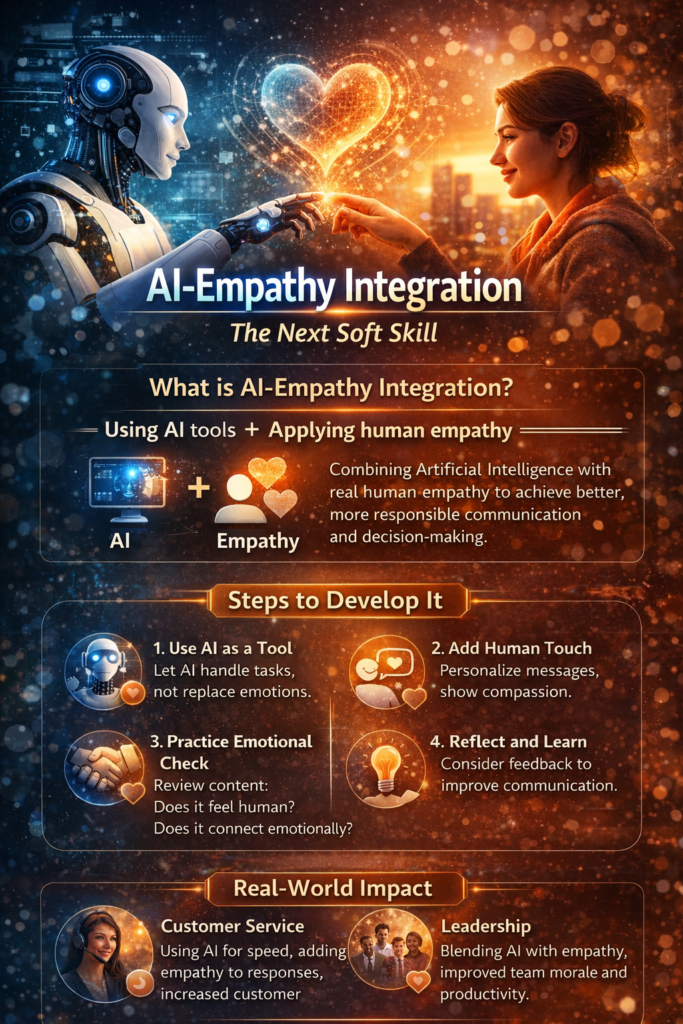
AI-Empathy Integration simply means teaching machines to understand and respond to human emotions.

Not feel them… but respond as if they understand.

Imagine this:

You message a chatbot:
“I feel very lonely today.”

A basic machine might say:
👉 “I am sorry. Try to stay positive.”

But a system using AI-Empathy Integration might respond:
👉 “I’m really sorry you’re feeling this way. Do you want to talk about what’s making you feel lonely?”

See the difference?

One gives an answer.
The other creates a connection.


The Psychology Behind It

Human empathy has two parts:

  • Cognitive empathy – understanding what someone feels
  • Emotional empathy – actually feeling it

Machines can only do the first one.

This is where Emotional Intelligence in AI becomes interesting.

Researchers from Harvard and Stanford suggest that machines can simulate empathy by analyzing:

  • Words
  • Tone
  • Facial expressions
  • Behaviour patterns

But simulation is not sensation.

👉 A machine can detect sadness… but it doesn’t feel sad.


Can AI Really Feel Emotions? (The Honest Answer)

Let’s be very clear.

👉 No, AI cannot feel emotions.

It doesn’t have:

  • A heart
  • A nervous system
  • Personal experiences
  • Conscious awareness

It works on algorithms, not emotions.

But here’s the twist…

👉 It can behave like it understands emotions so well that we start believing it does.

This is called Artificial Emotional Intelligence.


A Real-Life Training Example

In one of my workshops, a participant shared something surprising.

She said:
“I talk to an AI chatbot at night because it listens better than people.”

That hit me hard.

Not because AI is powerful…
But because humans are becoming emotionally unavailable.

AI-Empathy Integration is not just about machines becoming human.
It’s also about humans becoming… less human.


Why Is AI-Empathy Integration Growing So Fast?

Because it solves real problems.

Let’s look at them honestly.

1. People feel unheard

  • Many don’t have someone to talk to
  • AI is always available

2. No judgment

  • Machines don’t criticize
  • They don’t interrupt

3. Instant response

  • No waiting
  • No emotional baggage

4. Mental health support

Organizations like WHO highlight the growing mental health crisis. AI tools are helping bridge the gap.

👉 AI-Empathy Integration is filling an emotional gap in society.


Is AI Empathy Better Than Human Empathy?

Let’s be honest again.

Sometimes… yes.

And that’s uncomfortable.

AI is better at:

  • Listening without bias
  • Staying calm
  • Giving structured responses

Humans are better at:

  • Feeling
  • Connecting deeply
  • Understanding context beyond words

A Simple Truth

“A machine can respond perfectly… but only a human can truly care.”


The Danger You Must Not Ignore

This is where things get serious.

1. Emotional Dependency

People may start relying on AI instead of real relationships.

2. Illusion of Connection

You feel understood… but you’re actually interacting with code.

3. Reduced Human Skills

If AI does all emotional conversations, we may lose our own empathy skills.

4. Privacy Risks

Your deepest emotions become data.


A Coaching Insight

In counselling sessions, I’ve seen people struggle not because they lack support…
But because they avoid difficult human conversations.

AI-Empathy Integration can help…
But it should not replace real relationships.


How AI-Empathy Integration Works (Behind the Scenes)

Let’s simplify this.

AI uses:

1. Natural Language Processing (NLP)

Understands what you say

2. Sentiment Analysis

Detects emotion (happy, sad, angry)

3. Machine Learning

Learns from past conversations

4. Behavioural Patterns

Predicts your emotional needs


Example Table

InputAI InterpretationResponse
“I feel tired”Emotional fatigueSuggest rest
“Nobody cares”LonelinessOffer support
“I am angry”FrustrationEncourage expression

Real-World Applications of AI-Empathy Integration

Let’s see where it is already used.

1. Mental Health Apps

  • AI therapists
  • Emotional chatbots

2. Customer Service

  • Understanding frustrated customers

3. Education

  • Personalized emotional support

4. Workplace Coaching

  • Employee wellbeing tracking

Case Study: AI in Mental Health

A study published by Stanford showed that people opened up more to AI than humans in early conversations.

Why?

👉 No fear of judgment.

But long-term healing still required human therapists.


Can AI Teach Us to Be More Human?

This is the most interesting part.

Yes… it can.

When we see machines trying to:

  • Listen patiently
  • Respond kindly
  • Validate emotions

We realize something.

👉 These are the same skills we often forget to use.


A Powerful Reflection

Instead of asking:
👉 “Can AI feel?”

Ask this:
👉 “Why are humans not feeling enough?”


How to Use AI-Empathy Integration Wisely

Here’s a simple guide.

Use AI for:

Do NOT use AI for:

  • Replacing real relationships
  • Avoiding difficult conversations
  • Making emotional decisions

Golden Rule

“Use AI as a tool… not as a replacement for human connection.”


Step-by-Step: Building Healthy Emotional Balance

Step 1: Acknowledge your feelings

Don’t suppress them.

Step 2: Express safely

Talk to someone… or even AI initially.

Step 3: Move to real conversations

Don’t stay in digital comfort.

Step 4: Build emotional courage

Face difficult talks.

Step 5: Let go of ego

Just like Dnyaneshwari teaches.


Future of AI-Empathy Integration

The future is powerful… and uncertain.

We may see:

  • AI companions
  • Emotion-aware workplaces
  • Personalized therapy systems

But one thing will remain true:

👉 Machines may evolve… but human connection will always be irreplaceable.


Conclusion

So… can a machine feel?

No.

But it can make you feel understood.

And sometimes, that is enough… for a moment.

But not for life.

AI-Empathy Integration is a beautiful tool.
It can support, guide, and comfort.

But it cannot replace:

  • A friend’s silence
  • A mother’s concern
  • A partner’s understanding

In the end, happiness still comes from human connection.

Just like Dnyaneshwari says:

“The one who lets go first… finds peace first.”

Maybe the real lesson is not about machines learning empathy.

👉 It’s about humans remembering it.


References


Thank you for exploring this insightful article.
If you’re hungry for more knowledge, don’t miss out on our other engaging articles waiting for you. Dive into our treasure trove of wisdom and discover new perspectives on related topics.
Click ‘Our Blog’ and ‘How to Guide’ to embark on your next adventure.
Happy reading!

FAQs: AI-Empathy Integration

1. What is AI-Empathy Integration?

It is the ability to combine AI tools with human empathy. It helps in creating meaningful communication while using technology efficiently.

2. Why is AI-Empathy Integration important?

Because AI lacks emotional understanding. Integrating empathy ensures better relationships, trust, and communication.

3. Can AI develop empathy?

No, AI can simulate empathy but cannot genuinely feel emotions like humans.

4. How can professionals use AI-Empathy Integration?

By using AI for tasks and adding a human touch to communication and decision-making.

5. Is AI-Empathy Integration useful for leaders?

Yes, it helps leaders build trust, motivate teams, and improve workplace culture.

6. How does it improve communication?

It makes communication more human, relatable, and emotionally connected.

7. What industries need AI-Empathy Integration?

Almost all—especially healthcare, education, customer service, and leadership roles.

8. Can students learn AI-Empathy Integration?

Absolutely. It’s a future-ready skill that enhances both academic and career success.

9. What are the risks of ignoring empathy in AI use?

Loss of trust, poor relationships, and ineffective communication.

10. How can I start practicing AI-Empathy Integration today?

Start by reviewing your AI-generated content and adding emotional understanding and personalization.

A Non-Violent Communication Guide for Couples: Conflict Resolution

Introduction: When Love Meets Conflict

Every relationship, no matter how strong, faces conflict. It’s inevitable. Two individuals, shaped by different experiences, beliefs, and emotional patterns, will not always see eye to eye. But here’s the truth most couples miss:

Conflict is not the problem. The way we communicate during conflict is.

Have you ever found yourself saying things you didn’t mean? Or shutting down instead of expressing what you truly feel? Maybe you’ve experienced arguments that spiral out of control, leaving both partners hurt, misunderstood, and emotionally distant.

This is where A Non-Violent Communication Guide for Couples becomes a life-changing approach.

Developed by psychologist Marshall Rosenberg, Non-Violent Communication (NVC) is a powerful framework rooted in empathy, emotional awareness, and conscious expression. It shifts conversations from blame and criticism to understanding and connection.

In my years as a trainer working with couples and individuals, I’ve seen one simple truth repeatedly:

Couples don’t break because of problems—they break because of poor communication patterns.

This article is not just theory. It combines behavioral science, real-life coaching insights, and practical tools that you can apply immediately.

By the end, you’ll learn how to:

  • Turn arguments into meaningful conversations
  • Express needs without hurting your partner
  • Listen deeply and build emotional safety
  • Strengthen your bond—even during disagreements

Let’s dive into A Non-Violent Communication Guide for Couples and transform the way you connect.


Understanding Non-Violent Communication (NVC)

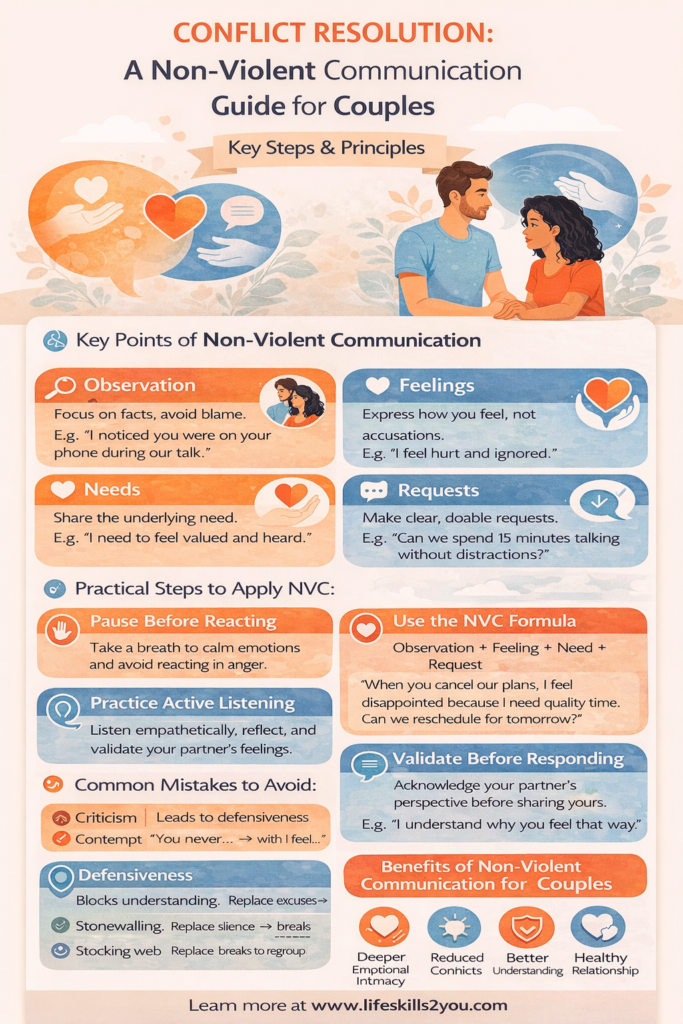
At its core, A Non-Violent Communication Guide for Couples is based on four key components:

1. Observation (Without Judgment)

Instead of blaming:

  • ❌ “You never listen to me!”
  • ✅ “When I was talking, I noticed you were on your phone.”

👉 This removes defensiveness and creates clarity.

2. Feelings (Not Accusations)

  • ❌ “You make me angry.”
  • ✅ “I feel hurt and ignored.”

👉 You own your emotions instead of projecting them.

3. Needs (The Root Cause)

Every feeling is connected to a need.

  • Need for respect
  • Need for attention
  • Need for appreciation

👉 Most conflicts are unmet needs in disguise.

4. Requests (Not Demands)

  • ❌ “You should care more!”
  • ✅ “Can we spend 15 minutes daily talking without distractions?”

👉 Clear, actionable, and respectful.


Why Couples Struggle with Communication

Even intelligent, loving couples struggle. Why?

1. Emotional Triggers

Your reactions are often rooted in past experiences.

2. Ego Defense Mechanisms

Blame, criticism, and withdrawal protect the ego—but damage the relationship.

3. Lack of Emotional Vocabulary

Many people simply don’t know how to express feelings clearly.

4. Assumptions & Mind Reading

“If they loved me, they would understand.”

This belief destroys clarity.


The Psychology Behind Non-Violent Communication

Research from Harvard Medical School and Gottman Institute shows:

  • Criticism triggers defensiveness
  • Defensiveness blocks connection
  • Emotional safety increases relationship satisfaction

👉 A Non-Violent Communication Guide for Couples aligns with Emotional Intelligence (EQ) and Attachment Theory.

Key Insight:

“Behind every angry reaction is an unmet need.”


Step-by-Step: Applying A Non-Violent Communication Guide for Couples

Step 1: Pause Before Reacting

In training sessions, I always teach:

“Respond. Don’t react.”

Take 10 seconds. Breathe. Reset.


Step 2: Use the NVC Formula

Observation + Feeling + Need + Request

Example:

“When you cancel our plans (observation), I feel disappointed (feeling) because I value quality time (need). Can we reschedule for tomorrow? (request)”


Step 3: Practice Active Listening

Listening is not waiting to speak.

It means:

  • Maintaining eye contact
  • Not interrupting
  • Reflecting back

👉 “What I hear you saying is…”


Step 4: Validate Before Responding

You don’t have to agree—but you must acknowledge.

“I understand why you feel that way.”

This builds emotional safety.


Step 5: Avoid Toxic Communication Patterns

❌ Criticism
❌ Contempt
❌ Defensiveness
❌ Stonewalling

(These are called Gottman’s Four Horsemen)


Real-Life Case Study (From Training Experience)

A couple I coached had constant arguments over “time.”

  • Wife felt neglected
  • Husband felt pressured

Using A Non-Violent Communication Guide for Couples, we reframed:

Before:
“You never spend time with me!”

After:
“I feel lonely because I need connection. Can we plan one evening together weekly?”

👉 Result:

  • Reduced arguments by 70%
  • Increased emotional intimacy
  • Improved mutual understanding

Powerful Communication Scripts for Couples

When You Feel Ignored

“I feel unseen when I’m talking and don’t get a response. Can we talk without distractions?”

When You Feel Angry

“I’m feeling frustrated because I need clarity. Can we discuss this calmly?”

When You Need Support

“I feel overwhelmed. I need support right now—can you help me?”


Common Mistakes Couples Make (And Fixes)

MistakeWhy It FailsBetter Approach
BlamingTriggers defenseUse “I feel…”
GeneralizingCreates conflictBe specific
SilenceBuilds resentmentExpress needs
DemandingCauses resistanceMake requests

Benefits of A Non-Violent Communication Guide for Couples

  • 💛 Deeper emotional intimacy
  • 💛 Reduced conflicts
  • 💛 Better understanding
  • 💛 Stronger trust
  • 💛 Long-term relationship satisfaction

Motivational Insight

“In every argument, there are two sides—and one opportunity for growth.”


Advanced Techniques for Deeper Connection

1. Emotional Check-Ins

Ask daily:

  • “How are you feeling today?”

2. Weekly Relationship Meetings

Discuss:

  • What worked
  • What didn’t
  • What can improve

3. Empathy Practice

Try to feel what your partner feels.


Scientific Backing & References

  • Marshall Rosenberg – Nonviolent Communication Model
  • Gottman Institute – Relationship Research
  • Harvard Health Publishing – Emotional Intelligence
  • WHO – Mental health and relationships
  • UNICEF – Communication frameworks

Conclusion: Transform Conflict into Connection

Conflict is not the enemy. Silence, misunderstanding, and ego are.

A Non-Violent Communication Guide for Couples teaches us something powerful:

“When we change the way we communicate, we change the quality of our relationships.”

Start small:

  • Listen more
  • Blame less
  • Express clearly
  • Connect deeply

Your relationship doesn’t need perfection—it needs understanding.

Thank you for exploring this insightful article.
If you’re hungry for more knowledge, don’t miss out on our other engaging articles waiting for you. Dive into our treasure trove of wisdom and discover new perspectives on related topics.
Click Our Blog and How to Guide to embark on your next adventure.
Happy reading!


FAQs: A Non-Violent Communication Guide for Couples

1. What is Non-Violent Communication in relationships?

It’s a communication approach that focuses on empathy, understanding, and expressing needs without blame or criticism. It helps couples resolve conflicts peacefully.

2. Can NVC really reduce conflicts?

Yes. Studies show that empathetic communication reduces defensiveness and increases connection, leading to fewer and healthier conflicts.

3. How long does it take to see results?

With consistent practice, couples often notice improvements within a few weeks.

4. Is NVC difficult to learn?

Initially, it requires awareness and practice, but it becomes natural over time.

5. What if my partner doesn’t cooperate?

Start with yourself. Communication patterns often shift when one partner changes.

6. Can NVC help in long-distance relationships?

Absolutely. Clear and empathetic communication is even more important in distance-based relationships.

7. Does NVC mean avoiding conflict?

No. It means handling conflict constructively.

8. Is NVC backed by science?

Yes. It aligns with emotional intelligence, psychology, and behavioral research.

9. Can NVC improve emotional intimacy?

Yes. It builds trust, openness, and deeper connection.

10. How can I practice daily?

Use the 4-step formula: Observation, Feeling, Need, Request.

Your Guide to Digital Non-Verbal Cues

The Silent Language of the Digital World

Have you ever sent a simple message like “Okay.” and instantly worried… Did I sound rude? Was I too cold?

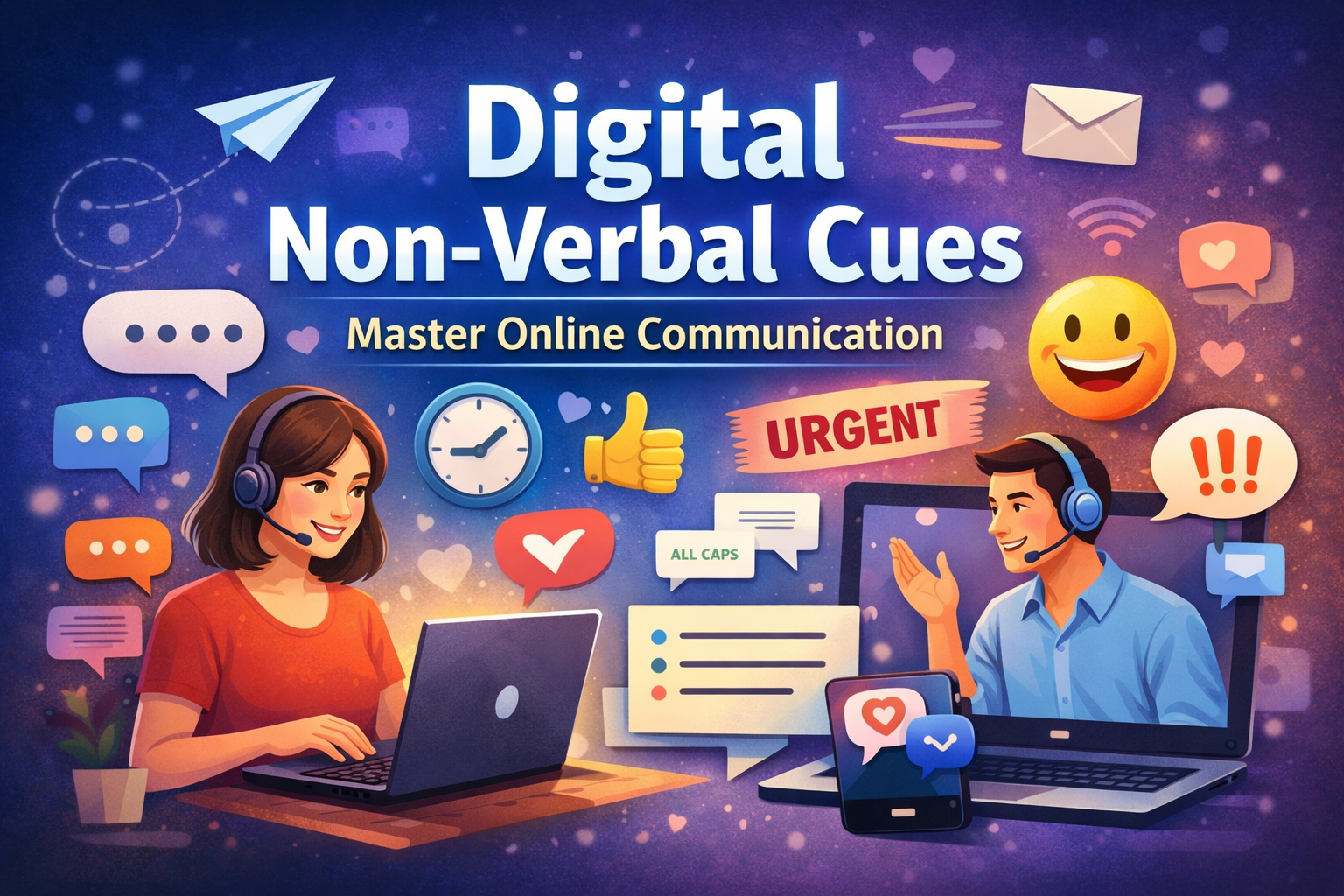
Welcome to the world of Digital Non-Verbal Cues—the invisible signals that shape how your words are felt, not just read.

In face-to-face communication, we rely heavily on body language, tone of voice, eye contact, and gestures. But what happens when communication shifts to screens? Emails, WhatsApp messages, Zoom calls, Slack chats—suddenly, the physical cues disappear. Yet, communication doesn’t become neutral. Instead, it evolves.

That’s where Digital Non-Verbal Cues come into play.

These cues include typing speed, punctuation, emoji use, message timing, capitalization, formatting, and even silence. They silently convey emotions, intent, authority, and relationship dynamics. In fact, according to research in communication psychology, over 60% of perceived meaning in communication comes from non-verbal elements—even in digital spaces, our brains try to fill in the gaps.

As a trainer and communication coach, I’ve seen countless professionals struggle not because of what they said—but how it was interpreted digitally. One corporate leader I worked with nearly damaged a key client relationship simply because his short, abrupt emails were perceived as dismissive.

This guide will help you understand, decode, and master Digital Non-Verbal Cues so you can:

  • Build stronger relationships online
  • Avoid misunderstandings
  • Communicate with clarity and emotional intelligence
  • Increase your professional influence

“In the digital world, how you say it matters more than what you say.”

Let’s dive into this powerful, often overlooked skill.


Step1: Understanding Digital Non-Verbal Communication

What Are Digital Non-Verbal Cues?

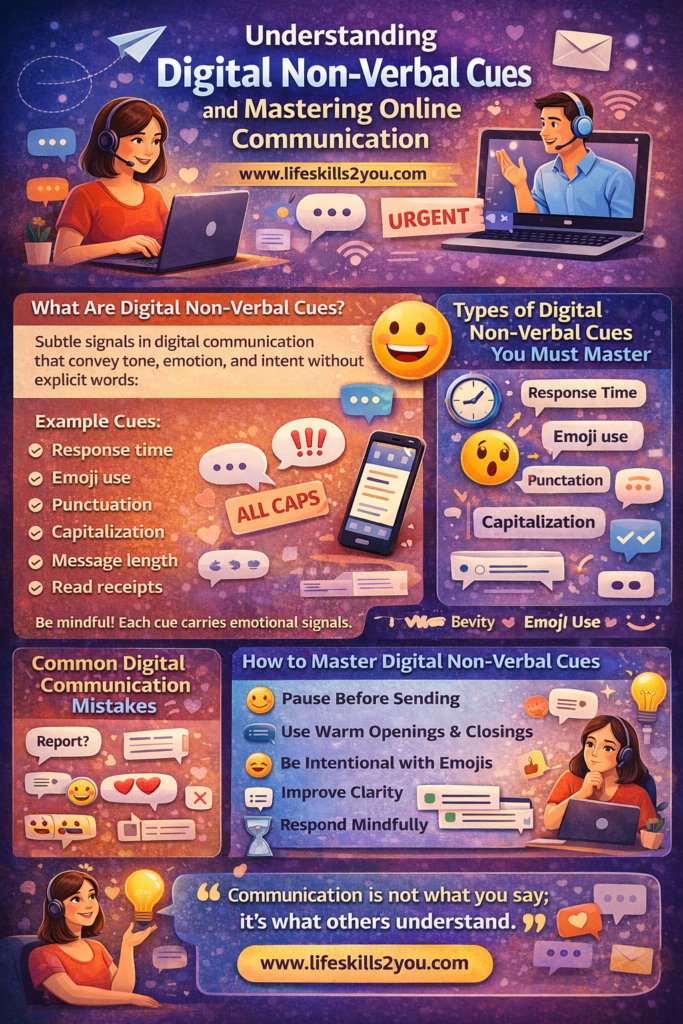
Digital Non-Verbal Cues are the subtle signals embedded in digital communication that convey tone, emotion, and intent without explicit words.

Examples of Digital Non-Verbal Cues

  • Message length (short vs detailed)
  • Response time
  • Use of emojis 😊
  • Punctuation (!!! vs .)
  • Capitalization (ALL CAPS = shouting)
  • Formatting (bold, spacing, bullet points)
  • Read receipts and seen indicators

These are part of digital body language, a concept widely discussed in modern communication psychology and highlighted in research from platforms like Harvard Business Review on virtual communication effectiveness.


Why Digital Non-Verbal Cues Matter More Than Ever

In today’s remote and hybrid work culture, Digital Non-Verbal Cues are often the only signals people rely on.

Psychological Impact

Our brains are wired to interpret tone and emotion. When cues are missing, we:

  • Assume negative intent
  • Misinterpret neutrality as rudeness
  • Fill gaps based on past experiences
Key Insight

Silence in digital communication is not neutral—it is interpreted.


Step2: Types of Digital Non-Verbal Cues You Must Master

1. Timing as a Communication Signal

Response Time Matters

  • Immediate reply → Interest, urgency
  • Delayed reply → Disinterest or disrespect

Real-Life Example 1

A manager I coached delayed responses to team messages. Employees assumed he was ignoring them, leading to disengagement. Once he improved response timing, team morale improved significantly.


2. Punctuation and Tone

The Power of a Period

  • “Thanks.” → Cold
  • “Thanks!” → Warm
  • “Thanks 😊” → Friendly
Micro-differences, massive impact

These subtle Digital Non-Verbal Cues can completely change emotional interpretation.


3. Emojis and Emotional Context

Emotional Amplifiers

Emojis act as tone indicators:

  • 😊 → Friendly
  • 👍 → Agreement (or sometimes passive acknowledgment)
  • 😐 → Neutral or awkward

Real-Life Example 2

A client used “👍” frequently. His team perceived it as dismissive. Switching to short responses improved clarity and connection.


4. Message Length and Structure

Short vs Long Messages

  • Short → Efficient or rude
  • Long → Detailed or overwhelming

Best Practice

Use:

  • Bullet points
  • Clear spacing
  • Logical flow

These improve clarity in communication and reduce misinterpretation.


5. Capitalization and Formatting

Hidden Emotional Signals

  • ALL CAPS → Aggressive
  • lowercase → casual
  • Bold text → emphasis

Use formatting intentionally

Formatting is a strong Digital Non-Verbal Cue that signals importance.


Step 3: Common Mistakes in Digital Communication

Mistake 1: Overusing Brevity

Short messages often lack warmth.

Example

“Send report.”
vs
“Hi, could you please send the report when you get a chance?”


Mistake 2: Ignoring Emotional Tone

Many professionals focus only on content, ignoring emotional intelligence in communication.


Mistake 3: Misusing Emojis

Too many emojis can reduce professionalism.


Mistake 4: Delayed Responses

Silence can damage trust faster than criticism.


Step 4: Applying Digital Non-Verbal Cues in Real Life

Case Study 1: Corporate Leader Transformation

A senior executive struggled with team engagement. His emails were:

  • Short
  • Direct
  • Emotionally flat

Intervention

We improved his Digital Non-Verbal Cues:

  • Added greetings
  • Used positive tone
  • Included appreciation

Result

  • 40% increase in team satisfaction
  • Better collaboration

Case Study 2: Freelancer Client Communication

A freelancer lost clients due to poor messaging tone.

Fix

  • Used structured messages
  • Added polite language
  • Improved response time

Outcome

  • Increased repeat clients

Case Study 3: Remote Team Miscommunication

A global team faced conflicts due to tone misunderstandings.

Solution

Training on Digital Non-Verbal Cues.

Result

  • Reduced conflicts
  • Improved clarity

Step 5: Science Behind Digital Non-Verbal Cues

Behavioural Psychology Perspective

According to communication studies and WHO-backed emotional intelligence frameworks:

  • Humans rely on contextual cues
  • Absence of cues increases cognitive load

You can explore more about emotional communication at WHO Emotional Wellbeing Resources.


The “Negativity Bias” Effect

People tend to interpret neutral messages negatively.

Example

“Noted.” → Often perceived as passive-aggressive


Step 6: How to Master Digital Non-Verbal Cues (Action Plan)

1. Pause Before Sending

Ask:

  • How will this be interpreted?
  • Is my tone clear?

2. Use Warm Openings and Closings

Examples:

  • “Hope you’re doing well”
  • “Appreciate your help”

3. Match Tone with Context

  • Formal → Emails
  • Casual → Chats

4. Be Intentional with Emojis

Use sparingly in professional settings.


5. Improve Clarity

Use:

  • Bullet points
  • Clear instructions

6. Respond Mindfully

Even a quick acknowledgment helps.


Step 7: Motivational Insight

“Communication is not what you say; it’s what others understand.”

Mastering Digital Non-Verbal Cues is not just a skill—it’s a competitive advantage in the modern world.


Conclusion

In a world dominated by screens, Digital Non-Verbal Cues are your hidden language of influence. They shape perception, build trust, and define relationships.

By becoming aware of these subtle signals, you can:

  • Communicate with clarity
  • Avoid misunderstandings
  • Build stronger professional and personal connections

Remember, every message you send carries more than words—it carries you.

Thank you for exploring this insightful article.
If you’re hungry for more knowledge, don’t miss out on our other engaging articles waiting for you. Dive into our treasure trove of wisdom and discover new perspectives on related topics.
Click Our Blog and How to Guide to embark on your next adventure.
Happy reading!


FAQs: Digital Non-Verbal Cues

1. What are Digital Non-Verbal Cues?

They are subtle signals like emojis, timing, punctuation, and formatting that convey tone and emotion in digital communication.

2. Why are Digital Non-Verbal Cues important?

They help prevent misunderstandings and improve clarity, especially in remote communication.

3. Can emojis be used professionally?

Yes, but in moderation. They should match the context and audience.

4. How does response time affect communication?

Quick responses show engagement, while delays may signal disinterest.

5. What is digital body language?

It refers to how tone and intent are expressed through digital behavior.

6. Why do people misinterpret messages online?

Because of lack of physical cues and the brain’s tendency toward negative assumptions.

7. How can I improve my digital communication?

Focus on clarity, tone, structure, and timely responses.

8. Are short messages always bad?

No, but they can seem abrupt if not balanced with politeness.

9. What role does emotional intelligence play?

It helps you understand how your message will be perceived.

10. Can Digital Non-Verbal Cues impact career growth?

Absolutely. Strong communication skills improve leadership, teamwork, and influence.

Empower Your Career: Mastering Active Listening Techniques

Introduction

In the contemporary bustling realm of professional engagements, the paramount importance of effective communication skills cannot be overstated. Amidst these vital competencies, the practice of active listening emerges as a foundational skill, exerting a profound influence on the trajectory of one’s career. The mastery of active listening not only serves to augment interpersonal dynamics but also assumes the role of a catalyst in positioning individuals as invaluable assets within the fabric of any given team or organization. Within the confines of this discourse, we shall embark upon an exploration of the transformative potency inherent in the act of active listening, discerning its potential to propel one’s career trajectory onto a trajectory of unprecedented growth and development.

Understanding the Essence of Active Listening

Active listening is more than just hearing words; it involves a deep level of engagement and understanding between individuals. At its core, active listening is about being fully present and attuned to the speaker, both verbally and non-verbally. It requires not only hearing what is being said but also comprehending the underlying emotions, intentions, and perspectives behind the words.

Engaging Fully with the Speaker

Active listening begins with giving the speaker your undivided attention. This means putting aside distractions, such as smartphones or internal thoughts, and focusing solely on the person speaking. By maintaining eye contact, nodding, and using affirmative gestures, you signal to the speaker that you are actively engaged and receptive to their message.

Understanding Verbal and Non-Verbal Cues

Effective active listening goes beyond listening to words; it involves interpreting non-verbal cues such as facial expressions, body language, and tone of voice. These cues provide valuable insights into the speaker’s emotions and attitudes, allowing you to grasp the full meaning behind their words.

Demonstrating Empathy and Understanding

Empathy lies at the heart of active listening. It involves putting yourself in the speaker’s shoes, acknowledging their feelings, and responding with compassion and understanding. By demonstrating empathy, you create a supportive and non-judgmental environment where the speaker feels valued and validated.

Responding Thoughtfully

Active listening is a two-way process that requires thoughtful responses from the listener. This may involve paraphrasing or summarizing what the speaker has said to ensure mutual understanding. Asking clarifying questions and providing feedback also demonstrate your commitment to fully comprehending the speaker’s message.

Creating Meaningful Connections

Ultimately, active listening is about building meaningful connections and fostering trust and rapport with others. When individuals feel heard, understood, and respected, they are more likely to open up and engage in meaningful dialogue. This paves the way for productive collaborations, effective problem-solving, and stronger relationships both in the workplace and beyond.

Cultivating a Culture of Listening

In organizations, fostering a culture of active listening is essential for promoting teamwork, innovation, and employee satisfaction. Leaders play a crucial role in modeling and reinforcing active listening behaviors, creating an environment where every voice is heard and valued.

active listening is a fundamental skill that transcends mere hearing; it is a dynamic and transformative process that enriches communication, fosters understanding, and strengthens relationships. By mastering the essence of active listening, individuals can unlock a wealth of opportunities for personal and professional growth.

Techniques for Practicing Active Listening

Active listening is a skill that can be honed through consistent practice and dedication. By employing specific techniques, you can enhance your ability to engage deeply with others and foster meaningful connections. Here are some actionable strategies to help you master the art of active listening:

Give Your Full Attention

In today’s digital age, distractions abound, making it challenging to stay fully present in conversations. When practicing active listening, make a conscious effort to eliminate distractions and focus entirely on the speaker. Put away your phone, close unnecessary tabs on your computer, and create a conducive environment for attentive listening. Maintain eye contact with the speaker, nod occasionally to signal understanding, and use affirmative gestures to convey your engagement. By giving your undivided attention, you demonstrate respect and appreciation for the speaker’s message.

Listen Without Judgment

One of the cornerstones of active listening is suspending judgment and approaching conversations with an open mind. Avoid jumping to conclusions or formulating responses prematurely. Instead, strive to create a safe and non-judgmental space where the speaker feels comfortable expressing themselves authentically. Practice empathy by putting yourself in the speaker’s shoes and striving to understand their perspective without bias. Remember that everyone has their own unique experiences and viewpoints, and true understanding requires empathy and acceptance.

Reflect and Clarify

Effective communication hinges on mutual understanding, which can be facilitated through reflection and clarification. After the speaker has shared their thoughts, take a moment to paraphrase what you’ve heard in your own words. This demonstrates active engagement and allows the speaker to confirm or clarify their message if necessary. Additionally, use open-ended questions to delve deeper into the speaker’s thoughts and feelings. Avoid interrogative or leading questions that may inhibit open dialogue. Instead, aim to foster a collaborative exchange of ideas through thoughtful inquiry.

Empathize with Empathy

Empathy lies at the heart of active listening, enabling you to connect with others on a deeper emotional level. As you listen to the speaker’s words, pay attention to their tone of voice, body language, and facial expressions. Practice active empathy by acknowledging the speaker’s feelings and validating their experiences. You don’t have to agree with everything they say, but demonstrating empathy fosters trust and strengthens the interpersonal bond. Remember that empathy is not just about understanding; it’s about showing compassion and support for the speaker’s journey.

To get more insights like this article put your email and subscribe.

  1. Give Your Full Attention: In today’s digital age, distractions abound, making it challenging to stay fully present in conversations. When practicing active listening, make a conscious effort to eliminate distractions and focus entirely on the speaker. Put away your phone, close unnecessary tabs on your computer, and create a conducive environment for attentive listening. Maintain eye contact with the speaker, nod occasionally to signal understanding, and use affirmative gestures to convey your engagement. By giving your undivided attention, you demonstrate respect and appreciation for the speaker’s message.
  2. Listen Without Judgment: One of the cornerstones of active listening is suspending judgment and approaching conversations with an open mind. Avoid jumping to conclusions or formulating responses prematurely. Instead, strive to create a safe and non-judgmental space where the speaker feels comfortable expressing themselves authentically. Practice empathy by putting yourself in the speaker’s shoes and striving to understand their perspective without bias. Remember that everyone has their own unique experiences and viewpoints, and true understanding requires empathy and acceptance.
  3. Reflect and Clarify: Effective communication hinges on mutual understanding, which can be facilitated through reflection and clarification. After the speaker has shared their thoughts, take a moment to paraphrase what you’ve heard in your own words. This demonstrates active engagement and allows the speaker to confirm or clarify their message if necessary. Additionally, use open-ended questions to delve deeper into the speaker’s thoughts and feelings. Avoid interrogative or leading questions that may inhibit open dialogue. Instead, aim to foster a collaborative exchange of ideas through thoughtful inquiry.
  4. Empathize with Empathy: Empathy lies at the heart of active listening, enabling you to connect with others on a deeper emotional level. As you listen to the speaker’s words, pay attention to their tone of voice, body language, and facial expressions. These non-verbal cues offer valuable insights into their emotions and underlying concerns. Practice active empathy by acknowledging the speaker’s feelings and validating their experiences. You don’t have to agree with everything they say, but demonstrating empathy fosters trust and strengthens the interpersonal bond. Remember that empathy is not just about understanding; it’s about showing compassion and support for the speaker’s journey.

By incorporating these techniques into your daily interactions, you can cultivate a reputation as a skilled and empathetic communicator. Active listening not only enriches your personal relationships but also enhances your professional effectiveness. Invest time and effort into mastering these techniques, and watch as your communication skills flourish, opening doors to new opportunities and deeper connections.

Active listening is more than just hearing words; it’s about tuning into the speaker’s emotions, intentions, and unspoken messages. It’s a dance of empathy, curiosity, and genuine connection.

Relevent : To know more about Active Listening Techniques you may go through Verywellminds Article "7 Active Listening Techniques For Better Communication"

Integrating Active Listening into Your Career Growth Strategy

Your career growth strategy is like a roadmap guiding you towards your professional goals. Integrating active listening into this strategy enhances every aspect of your journey, from building relationships to problem-solving and leadership development. Let’s delve into the details of how you can effectively incorporate active listening into your career growth plan:

1. Seek Feedback and Self-Reflection

One of the first steps in integrating active listening into your career strategy is to actively seek feedback on your listening skills. Request input from colleagues, supervisors, or mentors about how effectively you engage in conversations and understand others’ perspectives. Reflect on this feedback and identify areas where you can improve. Self-awareness is key to personal and professional growth, and acknowledging areas for development sets the foundation for improvement.

2. Lead by Example

As you progress in your career, your actions speak volumes. By exemplifying active listening in your interactions with others, you set a positive example for your colleagues and team members. Practice attentive listening during meetings, one-on-one discussions, and brainstorming sessions. Demonstrate empathy, ask clarifying questions, and show genuine interest in others’ viewpoints. Your commitment to active listening fosters a culture of collaboration and mutual respect within your workplace.

3. Invest in Training and Development

Just as you invest time and effort into honing technical skills relevant to your profession, consider allocating resources to enhance your communication and listening abilities. Attend workshops, seminars, or online courses focused on communication, emotional intelligence, and active listening. These opportunities provide valuable insights, practical strategies, and opportunities for hands-on practice. By continuously investing in your professional development, you sharpen your competitive edge and expand your skill set.

4. Practice Curiosity and Open-Mindedness

An integral part of active listening is maintaining a curious and open-minded attitude towards others’ perspectives. Approach conversations with a genuine desire to learn and understand, rather than to simply respond or assert your own opinions. Ask open-ended questions that encourage dialogue and exploration of ideas. Embrace diversity of thought and be receptive to viewpoints that differ from your own. Cultivating a mindset of curiosity and openness fosters innovation, creativity, and meaningful connections in your professional relationships.

5. Implement Feedback Loops and Continuous Improvement

Integrating active listening into your career growth strategy is an ongoing process that requires consistent effort and reflection. Establish feedback loops within your professional network to solicit input on your communication and listening skills regularly. Actively seek opportunities to apply feedback and refine your approach to active listening. Celebrate successes and learn from challenges, using each experience as a stepping stone towards becoming a more effective communicator and leader.

By incorporating these strategies into your career growth plan, you harness the transformative power of active listening to propel your professional journey forward. From building strong relationships to fostering innovation and leadership development, active listening serves as a cornerstone skill that amplifies your impact and unlocks new opportunities for success. Embrace the journey of self-discovery and continuous improvement, and watch as your career flourishes with each attentive ear and open heart.

Additional Strategies for Integrating Active Listening into Your Career Growth Plan

In addition to the foundational strategies outlined earlier, there are several additional tactics you can incorporate into your career growth plan to further enhance your active listening skills and maximize their impact on your professional journey:

1. Cultivate Empathy and Emotional Intelligence

Empathy is the ability to understand and share the feelings of others, and it is closely intertwined with active listening. By cultivating empathy and emotional intelligence, you deepen your connections with colleagues, clients, and stakeholders. Practice putting yourself in others’ shoes, acknowledging their emotions, and responding with compassion and understanding. Recognize that effective communication is not just about conveying information but also about acknowledging and validating others’ feelings and experiences.

2. Develop Non-Verbal Communication Awareness

Active listening extends beyond verbal communication; it also involves attentively observing and interpreting non-verbal cues such as body language, facial expressions, and tone of voice. Develop your awareness of non-verbal communication signals to gain deeper insights into others’ thoughts and feelings. Pay attention to subtle cues such as posture shifts, eye contact, and gestures, which can provide valuable context and enhance your understanding of the speaker’s message.

3. Practice Mindfulness and Presence

Mindfulness involves being fully present in the moment without judgment or distraction, and it is a powerful tool for enhancing active listening. Incorporate mindfulness practices into your daily routine, such as meditation, deep breathing exercises, or simply taking moments of intentional pause throughout your day. Cultivate a mindset of presence and attentiveness in your interactions, allowing you to engage more fully with others and respond thoughtfully to their needs and concerns.

4. Foster a Culture of Psychological Safety

Psychological safety refers to the belief that one can speak up, take risks, and express ideas or concerns without fear of reprisal or judgment. As you integrate active listening into your career growth plan, strive to create an environment of psychological safety within your workplace or team. Encourage open communication, respect diverse perspectives, and actively solicit input from all members. By fostering a culture where everyone feels valued and heard, you create fertile ground for collaboration, innovation, and collective success.

5. Leverage Technology for Enhanced Communication

In today’s digital age, technology offers a plethora of tools and platforms that can facilitate and enhance communication. Explore technological solutions such as video conferencing, instant messaging, or collaboration software that support active listening and engagement. Use features such as chat functions, polling tools, or virtual whiteboards to encourage participation and feedback in virtual meetings or remote work environments. Embrace technology as a means to connect and communicate effectively, regardless of geographical or logistical barriers.

6. Engage in Active Listening Exercises and Role-Playing

To strengthen your active listening skills, engage in purposeful exercises and role-playing scenarios that simulate real-life communication challenges. Partner with colleagues or mentors to practice active listening techniques in a safe and supportive environment. Experiment with different listening styles, such as reflective listening or empathetic listening, and solicit feedback on your effectiveness. Incorporate active listening exercises into team meetings, training sessions, or professional development workshops to promote skill-building and collaborative learning.

7. Commit to Lifelong Learning and Growth

Finally, recognize that active listening, like any skill, requires ongoing practice and refinement. Commit to lifelong learning and growth by seeking out opportunities to expand your knowledge, deepen your understanding, and refine your communication abilities. Stay curious, stay humble, and stay open to feedback and new perspectives. Embrace challenges as opportunities for growth, and approach each interaction as a chance to learn and improve. By fostering a mindset of continuous learning and development, you position yourself for long-term success and fulfillment in your career.

Incorporating these additional strategies into your career growth plan will further amplify the impact of active listening on your professional journey. By cultivating empathy, developing non-verbal communication awareness, practicing mindfulness, fostering psychological safety, leveraging technology, engaging in active listening exercises, and committing to lifelong learning, you position yourself as a dynamic and influential communicator and leader. Embrace these strategies as catalysts for personal and professional growth, and watch as your career flourishes with each attentive ear and open heart.

Attention Readers!
As you dive into our blog post on active listening techniques, we encourage you to remember that mastering this skill requires practice. Just as a musician hones their craft through consistent rehearsal, active listening improves with dedicated effort.
So, as you absorb the insights and strategies shared here, consider how you can apply them in your daily interactions. Take the time to actively engage with others, listen attentively, and strive to understand deeply.
Remember, like any skill worth mastering, the more you practice active listening, the more proficient you’ll become

Conclusion: Unlock Your Career Potential with Active Listening

In conclusion, mastering active listening is not just a valuable skill; it’s a catalyst for career advancement and personal growth. By honing your ability to listen attentively, empathize deeply, and communicate effectively, you position yourself as a dynamic and influential presence in any professional setting. Embrace the strategies outlined in this article and embark on a journey of self-discovery and professional success.

Thank you for exploring this insightful article. If you’re hungry for more knowledge, don’t miss out on our other engaging articles waiting for you. Dive into our treasure trove of wisdom and discover new perspectives on related topics. Click ‘Our Blog‘ and ‘How to Guide‘ to embark on your next adventure. Happy reading!

Exit mobile version