Signs You Lack Self-Awareness: 7 Blinding Truths You Must Know

Introduction

Discover key signs you lack self-awareness and learn science-backed strategies to improve emotional intelligence, relationships, and personal growth.

Have you ever walked away from a conversation and wondered, “Why do people react to me this way?” Or felt stuck in the same patterns no matter how hard you try to change? If so, you’re not alone. In my 12+ years as a life skills trainer and personal development coach, I’ve seen one recurring issue that quietly sabotages success, confidence, and relationships: a lack of self-awareness.

Most people believe they are self-aware. In fact, a study by organizational psychologist Dr. Tasha Eurich found that 95% of people think they’re self-aware — but only 10–15% actually are.
That shocking gap is where frustration, conflict, emotional stress, and stalled personal growth are born.

When you don’t recognize your emotions, blind spots, weaknesses, or behavioural patterns, you end up repeating the same cycles — sometimes for years. You may misread situations, misunderstand people, fail to grow, or unknowingly push others away. These patterns aren’t rooted in laziness or lack of intelligence — they are rooted in blindness.

And that’s why understanding the signs you lack self-awareness is a transformative first step.
Not to judge yourself.
Not to feel guilty.
But to finally illuminate the behaviour patterns blocking your growth so you can break free.

In this comprehensive, psychology-backed guide, we’ll dive deep into the 7 Blinding Signs You Lack Self-Awareness (And What to Do About It). You’ll find:

✔ Real-life coaching examples
✔ Behaviour science insights
✔ Emotional intelligence frameworks
✔ Easy, actionable steps
✔ Motivational quotes

By the end of this article, you’ll not only understand your blind spots — you’ll know exactly how to rise above them with clarity, emotional strength, and renewed personal power.

Let’s begin.


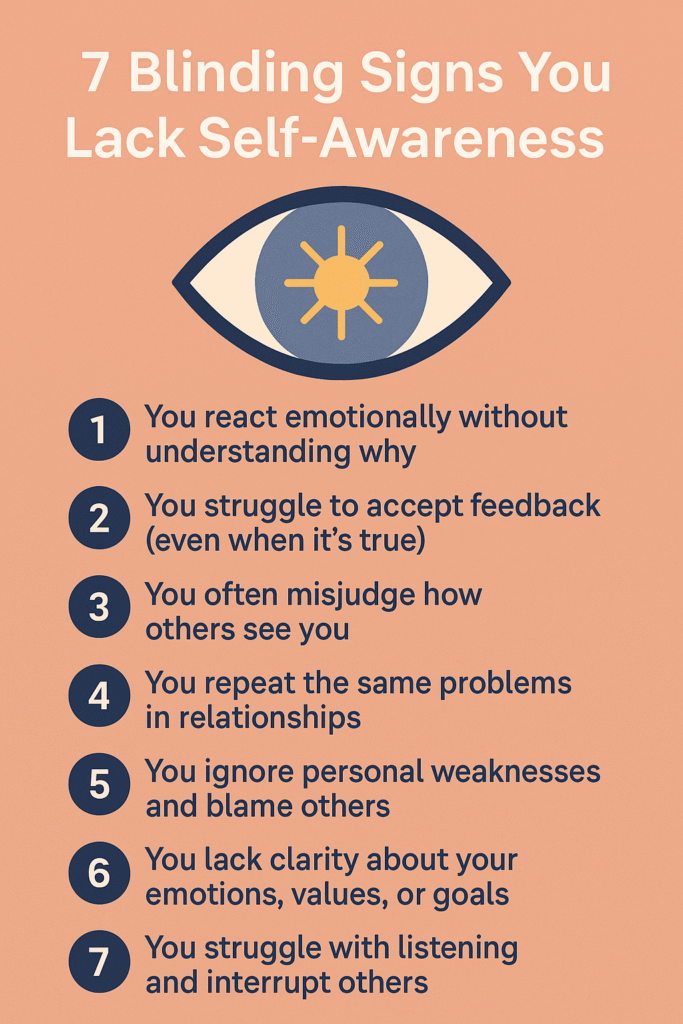
1. You React Emotionally Without Understanding Why

One of the strongest signs you lack self-awareness is reacting impulsively without recognizing the emotional trigger. This happens when your internal world controls you instead of the other way around.

Why This Happens (The Psychology Behind It)

According to the cognitive-behavioural model, emotions arise from thoughts — but when those thoughts are unconscious, the emotion feels “sudden” and uncontrollable.

You may feel:

  • Angry without knowing why
  • Anxious without a clear reason
  • Irritated even in small interactions
  • Defensive during feedback
  • Hurt by neutral comments

This happens because your brain is operating on automatic emotional scripts rooted in past experiences.

Real-Life Example (Client Story)

During a corporate training session, I worked with a manager, let’s call her Priya. She often snapped at her team but insisted she was “just stressed.”
After coaching, she realized she felt threatened whenever someone questioned her ideas — not because they were wrong, but because she grew up being criticized harshly at home.

Her emotional reactions had nothing to do with her team — but everything to do with her past.

What to Do

  • Name the emotion
  • Ask: “What triggered me?”
  • Track emotional patterns in a journal
  • Pause for 10 seconds before reacting
  • Use the CBT technique: Thought → Feeling → Behaviour

Motivational Quote:


“You cannot change what you refuse to acknowledge.”


2. You Struggle to Accept Feedback (Even When It’s True)

Do you feel attacked when someone gives you suggestions? Do you justify, argue, or shut down?
This is one of the most common signs you lack self-awareness — especially in professional settings.

Why Feedback Feels Like a Threat

According to Harvard Business Review, the brain interprets negative feedback as a threat to identity.
The less self-aware you are, the stronger the threat response.

Real-Life Example

A young entrepreneur I coached would get offended anytime investors or team members gave feedback. He believed feedback meant he wasn’t good enough.
Once he reframed feedback as data — not judgment — he started growing fast.

What to Do

  • Remind yourself: Feedback is information
  • Ask clarifying questions instead of defending
  • Thank the person
  • Implement one small action from the feedback
  • Evaluate patterns across repeated feedback

3. You Often Misjudge How Others See You

One of the most eye-opening signs you lack self-awareness is the disconnect between how you think others perceive you vs. how they actually do.

People who lack self-awareness often believe:

  • They are good communicators (but seem rude)
  • They are calm (but appear cold)
  • They are confident (but come across arrogant)
  • They are helpful (but seem controlling)

This “self-other gap” is part of social psychology’s reflected appraisal theory, which explains that we form our identity based on how we think others see us — but we often misinterpret it.

Real-Life Example

During a leadership training, one participant believed he was an “approachable leader.”
But 7/10 employees said they were afraid to speak to him because of his strict tone.

This was a powerful wake-up moment that helped him transform his leadership style.

What to Do

  • Ask 3 trusted people: “How do I show up?”
  • Use anonymous surveys (great for work)
  • Record yourself speaking and observe body language
  • Accept that perception is reality in relationships

4. You Repeat the Same Problems in Relationships

If you keep experiencing:

  • The same arguments
  • The same breakups
  • The same miscommunications
  • The same emotional patterns

…these are strong signs you lack self-awareness in relationships.

Behaviour Science Explanation

People repeat relational patterns because of subconscious attachment styles, learned behaviour, and emotional wounds.

Without self-awareness:

  • You attract similar partners
  • You make similar mistakes
  • You hold the same beliefs
  • You respond with the same emotional habits

Real-Life Example

A coaching client kept dating emotionally unavailable partners. She insisted, “All men are the same.”
Through deep introspection, she realized she herself feared intimacy — so she subconsciously chose partners who couldn’t get close.

What to Do

  • Identify recurring patterns
  • Understand your attachment style
  • Track emotional triggers
  • Seek emotional intelligence training
  • Learn reflective communication

5. You Ignore Personal Weaknesses and Blame Others

People who lack self-awareness often externalize problems:

“It wasn’t my fault.”
“They misunderstood me.”
“I didn’t do anything wrong.”

This avoidance protects the ego — but destroys growth.

Psychological Insight

This is linked to the self-serving bias, a cognitive bias where you credit yourself for successes and blame others for failures.

Real-Life Example

I once coached a team leader who blamed poor team results on “lazy team members.”
But after a performance audit, he discovered the real issue was his unclear communication and lack of follow-up.

This realization changed everything.

What to Do

  • Ask: “What part of this is in my control?”
  • Identify your role in every conflict
  • Accept that weakness ≠ failure
  • Use self-assessment tools (Johari Window, MBTI, EI scales)

6. You Lack Clarity About Your Emotions, Values, or Goals

If you don’t know:

  • What you want
  • What motivates you
  • What drains you
  • What your values are
  • What direction you’re moving in

…these are powerful signs you lack self-awareness.

Why This Happens

Many people live on autopilot — influenced by society, family expectations, and comparison culture.

Without clarity:

  • Decisions feel heavy
  • Motivation drops
  • Purpose feels missing
  • Emotional confusion increases

Real-Life Story

A young professional I worked with jumped from job to job feeling unfulfilled.
He thought something was wrong with his career — but the real issue was that he didn’t know his values.
Once we identified his core values (creativity, autonomy, impact), he finally found a career that fit him.

What to Do

  • Write your top 5 values
  • Reflect weekly on emotional highs and lows
  • Journal: “What do I want?”
  • Set 90-day goals
  • Conduct a monthly self-audit

7. You Struggle With Listening and Interrupt Others

Poor listening is one of the strongest signs you lack self-awareness because it shows a lack of presence.

Why This Happens

People interrupt because they are:

  • Preparing responses
  • Seeking validation
  • Feeling insecure
  • Distracted
  • Avoiding discomfort

Real-Life Example

During communication training, I met a participant who constantly interrupted others without realizing it.
Once she watched a recording of herself, she was shocked — and immediately started improving.

What to Do

  • Pause 2 seconds before responding
  • Listen to understand, not respond
  • Take notes during conversations
  • Validate what the other person said
  • Use the “Tell me more” technique

To Get More insights You Maye Refer This External Resources

✔ Harvard Business Review – “Self-Awareness Can Help Leaders More Than an MBA”
https://hbr.org
✔ Positive Psychology’s guide on self-awareness
https://positivepsychology.com


Conclusion

Self-awareness isn’t a skill you master once — it is a lifelong journey. The more you understand your thoughts, emotions, triggers, patterns, and relational behaviours, the more power you gain over your life.
By recognizing these 7 blinding signs you lack self-awareness, you open the door to stronger relationships, clearer goals, emotional freedom, and lasting personal growth.

Remember:
Self-awareness is not about judging yourself — it’s about discovering yourself.

Every great leader, communicator, and emotionally intelligent person began with a single brave step: the willingness to look within.

If you commit to even one strategy from this guide, you’ll notice powerful changes in the way you think, feel, and connect with others.

Thank you for exploring this insightful article.
If you’re hungry for more knowledge, don’t miss out on our other engaging articles waiting for you. Dive into our treasure trove of wisdom and discover new perspectives on related topics.
Click ‘Our Blog and How to Guide to embark on your next adventure.
Happy reading!


FAQs On Signs You Lack Self-Awareness: 7 Blinding Truths You Must Know

1. What is self-awareness in simple terms?

Self-awareness is the ability to understand your thoughts, emotions, behaviours, and how they influence your life and relationships. It’s the foundation of emotional intelligence.

2. Why do most people lack self-awareness?

Because emotions and behaviours are often unconscious. People operate on autopilot, shaped by conditioning, habits, and emotional wounds.

3. How do I know if I lack self-awareness?

Look for patterns like repeating conflicts, emotional overreactions, defensiveness, miscommunication, or not understanding your triggers.

4. Can self-awareness be learned?

Absolutely. With reflection, feedback, journaling, mindfulness, and emotional intelligence training, self-awareness improves significantly.

5. Why does feedback hurt?

Feedback threatens your identity. When self-awareness is low, the ego feels attacked, leading to defensiveness.

6. How do I become more self-aware daily?

Practice mindfulness, ask for feedback, journal emotions, pause before reacting, and track behaviour patterns.

7. Is self-awareness related to mental health?

Yes. Higher self-awareness improves emotional regulation, reduces stress, and builds resilience.

8. Can self-awareness improve relationships?

Definitely. When you understand your triggers and behaviour patterns, communication, trust, and empathy naturally strengthen.

9. What tools help develop self-awareness?

CBT worksheets, emotional journals, values assessments, feedback surveys, coaching, meditation, and personality tools.

10. How long does it take to develop self-awareness?

It varies — but consistent practice can show visible improvements within weeks.

Self-Care Checklist For Emotional Overload: The Ultimate Power Guide

Introduction

A practical self-care checklist for emotional overload to reset your mind and calm your emotions fast. Learn simple steps to regain control and clarity.

Have you ever had one of those days where everything feels too loud, too heavy, or too much? When your emotions crash over you like a wave you didn’t see coming — leaving you overwhelmed, exhausted, or even numb?

If so, you’re not alone. Emotional overload is becoming increasingly common in today’s hyperconnected world. Our minds juggle notifications, deadlines, family responsibilities, social expectations, unexpected events, and the constant pressure to “keep it together.” Eventually, something inside us just… snaps.

You pause. You sigh. You mentally whisper, “I can’t do this anymore.”

This is exactly where a self-care checklist for emotional overload becomes your lifeline — not a luxury, but a survival tool. A compass that helps you navigate chaos, reclaim your calm, and reconnect with your inner steadiness.

In this guide, we’ll walk through The Self-Care Checklist to Beat Emotional Overload in 15 Minutes — a simple, realistic, and deeply effective structure that helps you pause, reset, and breathe again. Whether you’re feeling drained, scattered, overstimulated, or simply “not like yourself,” this checklist gives you a way back.

You’ll learn:

  • Why emotional overload happens
  • How to quickly reset your mind and body
  • Simple 15-minute practices you can do anywhere
  • Real-life examples from people who learned to manage emotional overwhelm
  • A practical, personalized checklist you can follow daily
  • Powerful motivational reminders to stay grounded

And here’s the best part — this guide doesn’t require fancy tools, long meditation sessions, or a perfect environment. These strategies work even in the middle of a busy day, a stressful moment, or a chaotic week.

Emotional overload isn’t a failure. It’s a signal.
A message from your mind and body saying:

“Pause. You deserve care too.”

Let’s explore how you can listen to that message with intention — and take back control of your emotional space.


Related : The Ultimate Guide to Emotional Intelligence


Understanding Emotional Overload — Why It Happens & What It Means

Emotional overload doesn’t appear out of nowhere. It’s the result of accumulated stress, unprocessed feelings, interrupted boundaries, and persistent mental overstimulation. You might notice it in the form of:

  • Sudden irritability
  • Emotional numbness
  • Difficulty concentrating
  • Feeling drained even after resting
  • Anxiety or panic sensations
  • Crying without a clear reason
  • Overthinking everything at once

In simple terms, your internal capacity gets maxed out.

The Brain’s Emergency Mode

When too many emotional signals fire at once, your brain shifts into survival mode. Logic takes a back seat. Your nervous system speeds up. Your thoughts spin.

This is not weakness — it’s biology.

A powerful reminder:

“Your body isn’t breaking down. It’s breaking through the noise.”

Understanding emotional overload is the first step to taking back your power.


The Self-Care Checklist to Beat Emotional Overload in 15 Minutes

This is the heart of our guide — your personalized, science-backed self-care checklist for emotional overload that resets your mind in minutes.

It includes:

  1. Grounding your body
  2. Decluttering your emotions
  3. Recharging your energy
  4. Restoring your mental clarity
  5. Reconnecting with yourself

Each step is designed to take 2–3 minutes, making it easy to complete even during the busiest days.


✔️ Step 1: Pause & Breathe — The Nervous System Reset

Take a deep breath. Yes, the simplest step is also the most powerful.

Breathing techniques like box breathing, 4-7-8 breathing, or slow diaphragmatic breathing instantly calm your nervous system. Research on mindful breathing (see resources at Greater Good Science Center and Verywell Mind) confirms its ability to reduce emotional intensity.

Try this:

  • Inhale 4 seconds
  • Hold 2 seconds
  • Exhale 6 seconds

Repeat 5 times.

Your shoulders loosen. Your jaw relaxes. Your mind resets.

Emotional overload often pushes your nervous system into a fight-or-flight state. Your heart races. Your thoughts scatter. Your body tightens. This is where intentional breathing becomes a superpower — a direct signal to your brain that you’re safe.

Here’s something powerful:

“When you control your breath, you control your inner weather.”

Yes — your breath is your anchor. It grounds you in the present moment, pulling you out of emotional noise and reconnecting you to your center.

Real-Life Example #1 – Neha’s “2-Minute Reset”

Neha, a full-time working mom, often felt overwhelmed between work calls, school deadlines, and home responsibilities. She started using a simple 2-minute breathing reset:

  • Close eyes
  • Inhale for 4
  • Hold for 2
  • Exhale for 6

She repeated this cycle five times wherever she was — her car, bathroom, living room, anywhere. Within a week, she said she felt “less explosive and more in control.”

This breathing step is the opening gateway of your bold — self-care checklist for emotional overload because it resets your physiology before you reset your thoughts.


✔️ Step 2: Name What You Feel — Emotional Labelling

Once your breathing softens your internal chaos, the second step is identifying your emotions. Labeling emotions helps reduce their intensity. This is not wishful thinking; multiple studies highlighted by the Greater Good Science Center show that naming your feelings decreases amygdala activation — the part of your brain responsible for emotional reactions.

Try this list:

  • “I feel overwhelmed.”
  • “I feel anxious.”
  • “I feel pressured.”
  • “I feel disappointed.”
  • “I feel unsupported.”

No judgment. No fixing. Just awareness.

Why this works:
Your brain relaxes when it has clarity. Unnamed emotional overload feels like drowning. Named emotions feel like waves you can see coming.

Real-Life Example #2 – Rohan’s Hidden Pressure

Rohan, a young entrepreneur, had frequent emotional shutdowns during work. He thought he was “just stressed,” but when he started labeling emotions, he discovered deeper layers:

  • Pressure to succeed
  • Fear of failing
  • Guilt for not resting
  • Exhaustion from multitasking

This step allowed him to sit with clarity instead of confusion.

Labeling is a powerful component of the bold — self-care checklist for emotional overload, turning emotional fog into emotional understanding.


✔️ Step 3: Physical Release — Let Your Body Let Go

Emotions live inside your body. Anxiety tightens your chest. Sadness weighs down your shoulders. Stress curls your stomach. That’s why physical release is a vital part of The Self-Care Checklist to Beat Emotional Overload in 15 Minutes.

Quick 2-minute releases:

  • Shake your hands vigorously for 30 seconds
  • Roll your shoulders in circles
  • Stretch your arms overhead
  • Squeeze your fists tight, then release
  • Do 10 slow neck rotations

These small movements send fresh oxygen through your body, releasing tension and unlocking energy stuck in your muscles.

Real-Life Example #3 – Sana’s Mid-Meeting Trick

Sana works in HR and often experiences emotional overload during long meetings. She began quietly squeezing her fists under the table and releasing them slowly. This small release reduced her stress spikes and helped her stay present.

Movement grounds you. Movement unfreezes your energy. Movement is medicine.


✔️ Step 4: Reconnect Through Sensory Grounding

When your emotions spiral, your senses can bring you back. This step helps balance your mind and body, making it a crucial part of the bold — self-care checklist for emotional overload.

Try the 5-4-3-2-1 grounding method:

  • 5 things you can see
  • 4 things you can touch
  • 3 things you can hear
  • 2 things you can smell
  • 1 thing you can taste

This technique is widely recommended by therapists and emotional wellness experts, including those cited on Verywell Mind.

Suddenly, you’re not in past regrets or future stress.
You’re right here — in the present.


✔️ Step 5: Micro-Journaling — Clear the Mental Traffic

You don’t need to write a full journal entry. Just unload your mental pressure in 30 seconds. Write:

  • What’s overwhelming me right now?
  • What do I need?
  • What is one small thing I can do?

This is not about being poetic. It’s about being honest.

This step declutters your emotional space and creates mental breathing room. When included as part of the bold — self-care checklist for emotional overload, journaling becomes a mental detox ritual.


✔️ Step 6: Do One Micro-Action of Self-Kindness

This could be:

  • Drinking a glass of water
  • Opening a window for fresh air
  • Washing your face
  • Listening to a calming song
  • Sitting in sunlight for 1 minute

These micro-actions pull your nervous system out of overwhelm and into ease.

Real-Life Example #4 – Vikram’s “Sunlight Break”

Vikram struggled with emotional overload during corporate workdays. He started walking to the balcony for 1 minute of sunlight every afternoon.

He explains, “It resets my brain faster than coffee.”


✔️ Step 7: Reframe Your Internal Dialogue

Overload often whispers:

  • “I should handle this better.”
  • “I’m failing.”
  • “Why am I so emotional?”

Transform it into:

  • “I’m doing my best.”
  • “This moment will pass.”
  • “My feelings are valid.”
  • “I’m allowed to rest.”

Self-talk is not cliché — it’s chemistry. It changes cortisol, motivation, and emotional resilience.


✔️ Step 8: Create a Boundary for the Next Hour

Emotional overload often comes from ignoring your own limits.

Ask:

  • What can I postpone?
  • What can I delegate?
  • What can I say no to?
  • What can wait until tomorrow?

Protecting your energy is not selfish. It’s strategic self-care.


✔️ Step 9: Reconnect With Your Body Rhythm (Hydrate, Breathe, Pause)

Humans are not robots. You need pauses. You need nourishment. You need oxygen.

This step reinforces physiological regulation so emotional overload doesn’t reappear later in the day.


✔️ Step 10: Affirm Your Emotional Strength

End your 15-minute checklist with:

“I am capable. I am growing. I am safe.”
“My emotions do not control me — I guide them.”

Affirmations rewire the emotional brain.


Why This 15-Minute self-care checklist for emotional overload Works (Science + Psychology)

Your bold — self-care checklist for emotional overload isn’t just a lifestyle trick. It’s built on how your brain, body, and nervous system work. Let’s break down the science so you understand why these small steps create such powerful emotional shifts.


1. It Interrupts the Emotional “Cascade Effect”

When you begin to feel overwhelmed, your nervous system releases stress hormones. If not interrupted, this becomes a cascade:

Trigger → Stress → Overthinking → Emotional flooding → Shutdown or explosion

The first 2–3 steps of your checklist interrupt this biological chain, giving you space to respond instead of react. Even a small break in the cycle can prevent emotional spirals.


2. It Activates the Parasympathetic Nervous System

Breathing, grounding, micro-journaling, and physical release all activate your rest-and-digest mode — the biological opposite of stress.

This is why:

  • Your shoulders drop
  • Your chest loosens
  • Your thoughts become clearer
  • You feel “lighter”

Your emotional intensity decreases because your brain senses safety.


3. It Creates Cognitive Distance From Your Emotions

When emotions feel close, they feel huge.

When you label them or write them down, you create distance, reducing their power. This technique is called affect labelling, widely studied at the UCLA Mindful Awareness Research Center and summarized beautifully on Greater Good Science Center.

Distance = control
Clarity = relief
Awareness = strength


4. It Reboots Your Mental Processing Power

Emotional overload reduces working memory — the mental space you use to think clearly.

Your bold — self-care checklist for emotional overload includes techniques that:

  • Clear mental clutter
  • Restore attention
  • Replace panic with clarity
  • Improve decision-making

It’s like “refreshing” your emotional browser.


5. It Rebuilds Emotional Resilience Daily

Self-care is not an emergency tool. It’s a resilience-building habit.

Every time you complete this checklist, you strengthen:

You’re not just calming your emotions — you’re reprogramming your emotional patterns for long-term strength.


Real-Life Stories — How This Self-Care Checklist For Emotional Overload Transformed Lives

Stories connect us. They make emotional overload feel less lonely and remind us that growth is possible.

Here are relatable examples you can see yourself in:


Example 1 – Priya’s Journey From Emotional Breakdown to Balance

Priya was a teacher juggling home responsibilities, online classes, and caring for her elderly parents. One morning, while preparing breakfast, she unexpectedly burst into tears. It wasn’t one big thing — it was the accumulation of hundreds of small pressures.

She found this bold — self-care checklist for emotional overload online and tried it for a week.

What changed?

  • She started pausing before reacting
  • Her emotional intensity reduced
  • She learned to say “no” without guilt
  • She stopped judging herself for feeling overwhelmed
  • She finally felt in control again

Priya said, “This checklist didn’t remove my stress, but it gave me a way to breathe inside it.”


Example 2 – The Overachiever Who Learned to Slow Down

Arvind, a high-performing engineering student, constantly pushed himself to meet academic expectations. Emotional overload became a regular part of his life — but he thought it was “normal.”

After implementing the bold — self-care checklist for emotional overload, he realized:

  • His body was constantly tense
  • His thoughts never paused
  • He was running on empty

The checklist became his daily grounding practice before studying.
Now he performs better because he takes breaks, not despite them.


Example 3 – The Introvert Who Was Drowning in Social Expectations

Maya felt overwhelmed by family gatherings, office events, and constant calls. As an introvert, emotional overload was part of her social life.

This checklist empowered her to:

  • Set boundaries
  • Take sensory breaks
  • Ground herself during conversations
  • Recover after demanding interactions

She now enjoys social events without losing herself.


Example 4 – The Corporate Leader With Silent Stress

Raj, a senior manager, looked “in control” on the outside but was internally exhausted — decision fatigue, team pressure, and constant problem-solving had overloaded him.

The checklist became his 15-minute leadership reset each morning.
He said it helped him “lead from calm instead of chaos.”


The Complete 15-Minute Self-Care Checklist — Quick Summary

Here’s the entire bold — self-care checklist for emotional overload in one simple glance:

1-minute steps (Total 15 minutes):

  1. Deep Breathing Reset (1 minute)
  2. Name Your Emotion (1 minute)
  3. Shake or Stretch (1 minute)
  4. Sensory Grounding (2 minutes)
  5. Micro-Journal (2 minutes)
  6. Drink Water or Change Position (1 minute)
  7. Reframe Your Self-Talk (2 minutes)
  8. Set a Micro-Boundary (2 minutes)
  9. Hydrate, Pause, Reset (2 minutes)
  10. Affirm Your Strength (1 minute)

Complete this checklist twice a day or whenever you feel overwhelmed.


Build Your Personalized Emotional Reset Plan

Everyone responds differently to emotional overload. So customize this checklist to your personality:

  • If you are highly sensitive: Add sensory breaks
  • If you overthink: Add grounding + journaling
  • If you get angry: Add breathing + physical release
  • If you get numb: Add movement + sunlight
  • If you shut down: Add self-talk + hydration

This makes the checklist uniquely yours.


🌿 CONCLUSION

Emotional overload doesn’t mean you’re weak—it means you’ve been strong for too long without a pause. It’s your mind and body asking for space, breath, and care. The bold — self-care checklist for emotional overload you’ve explored in this guide is more than a quick-fix routine; it’s a daily act of reclaiming your inner balance.

By following these simple yet powerful steps—breathing, grounding, labeling emotions, journaling, reframing self-talk, and setting boundaries—you create an internal environment where emotional clarity can grow. You shift from reacting to responding. From chaos to calm. From overwhelm to empowerment.

Remember: you don’t need an hour, a quiet room, or a perfect mindset to reset. Just 15 focused minutes can transform your emotional landscape.

So the next time life feels loud or heavy, trust this checklist. Return to your breath, reconnect with your senses, and remind yourself:

“I am capable, I am grounded, and I am safe.”

Your emotional well-being deserves priority—not someday, but today.


🚀 FIXED FINAL CALL TO ACTION (As Required)

Thank you for exploring this insightful article.
If you’re hungry for more knowledge, don’t miss out on our other engaging articles waiting for you. Dive into our treasure trove of wisdom and discover new perspectives on related topics.
Click ‘Our Blog’ and ‘How to Guide’ to embark on your next adventure.
Happy reading!


❓ FAQs: Self-Care Checklist for Emotional Overload

1. What is emotional overload?

Emotional overload happens when you experience more emotional input than your mind can manage. It leads to stress, fatigue, and difficulty thinking clearly. The self-care checklist for emotional overload helps interrupt this cycle.

2. How quickly does this checklist work?

Most people feel relief within 5–10 minutes, while completing the full 15-minute routine provides a deeper reset. Consistency increases long-term emotional resilience.

3. Can I use this checklist at work or in public spaces?

Absolutely. Every step—including breathing, grounding, and micro-journaling—can be done discreetly, making it perfect for high-pressure environments.

4. I can’t slow down my thoughts. What should I do first?

Start with breathing. It calms the nervous system, reducing mental speed so you can think more clearly. Then move on to sensory grounding.

5. How often should I use this self-care routine?

Use it anytime you feel overwhelmed. Many people apply the checklist morning and evening as a preventative emotional wellness practice.

6. Does journaling really help with emotional overload?

Yes. Even 30-second micro-journaling helps declutter your mind, gives clarity, and reduces emotional intensity. It’s one of the fastest ways to process feelings.

7. What if I don’t know how to identify my emotions?

Start with basics like: “I feel stressed,” “I feel tired,” or “I feel tense.” Over time, your emotional vocabulary will expand naturally.

8. Can this checklist help with anxiety too?

Yes. Many steps—like deep breathing, grounding, and sensory awareness—are also recommended for managing anxiety and panic sensations.

9. What if I don’t have 15 minutes?

Even 3 minutes of breathing + grounding can help. The full version simply provides a more complete emotional reset.

10. Is it normal to feel emotional while doing the checklist?

Yes. When your body finally relaxes, stored emotions may surface. This is healing. Let them move through you without judgment.

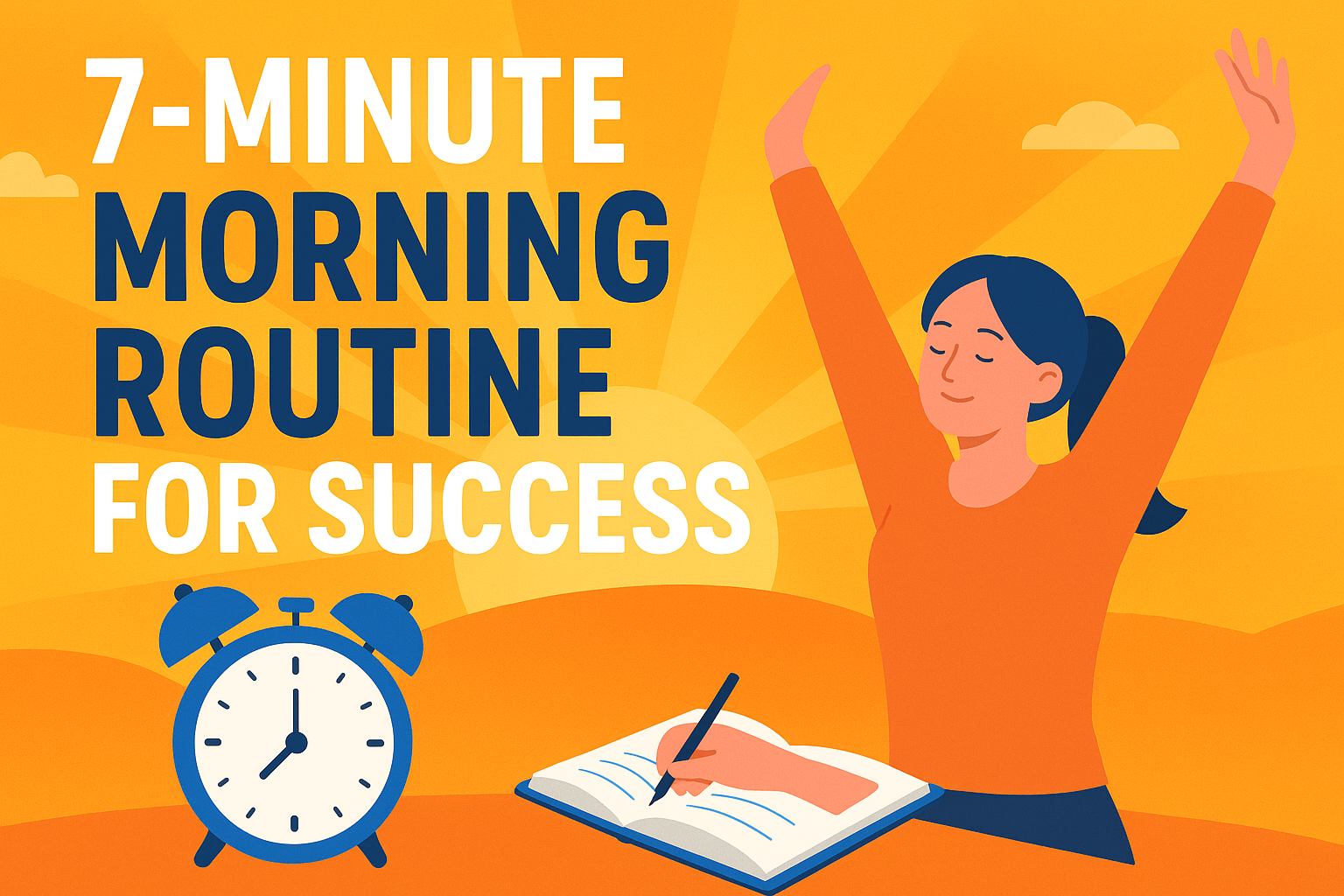
7-Minute Morning Routine for Personal Development

Morning routines have always been a hot topic among successful people. From CEOs to athletes, many attribute their daily wins to what they do first thing after waking up. But here’s the truth—not everyone has hours to meditate, journal, exercise, or read in the morning. Most of us are racing against the clock, juggling work, family, and personal commitments. That’s where the 7-minute morning routine steps in. It’s short, effective, and powerful enough to shape your day—and your future.

In this article, we’ll dive deep into why morning routines matter, how a 7-minute habit can outperform lengthy rituals, and step-by-step practices you can implement today. If you’ve been searching for the best morning routine for personal development, you’re about to discover a game-changer.


Why Morning Routines Matter for Personal Development

The way you start your morning sets the tone for everything that follows. Think of your brain as a smartphone battery—you plug it in at night, and in the morning, it’s fully charged. What you do in those first minutes determines whether you use that energy wisely or waste it.

Successful people don’t just roll out of bed and dive straight into chaos. They follow intentional rituals that prime their minds and bodies. These routines create mental clarity, build emotional resilience, and give them the edge needed to stay focused throughout the day.

The Psychology Behind Morning Habits

Morning routines tap into something psychologists call “habit stacking.” When you attach a small new habit to something you already do—like brushing your teeth or drinking water—it becomes easier to stick with. This principle explains why starting the day with even a 7-minute routine can create lasting change.

Neurologically, mornings are a fresh slate. The brain’s prefrontal cortex, which handles decision-making and focus, is most active in the early hours. This means the actions you take shortly after waking influence your thought patterns, mood, and productivity. By practicing mindfulness, gratitude, or light movement in the morning, you’re training your brain to operate from a state of calm and clarity rather than stress and distraction.

How Small Rituals Shape Big Success

Many people believe that massive results require massive effort. But in reality, it’s the small, repeated actions that compound over time. Consider this: a single glass of water doesn’t hydrate you for life, but drinking water daily sustains your health. In the same way, a short but powerful morning routine plants seeds that grow into long-term success.

For high achievers, consistency is everything. Whether you’re an entrepreneur, student, or professional, showing up every day with energy and focus is the key to outperforming the competition. Even just a few minutes spent centering yourself in the morning can mean the difference between reacting to your day and intentionally creating it.


Related: What Are the 10 Life Skills That Will Change Your Life?


The Science of a 7-Minute Morning Routine

Some people might doubt whether just 7 minutes can really make a difference. But science says yes. Studies on habit formation, neuroplasticity, and time management all prove that short, consistent actions often outperform longer, inconsistent ones.

Time Efficiency and Cognitive Boosts

Modern life is busy. Most of us don’t have two hours to dedicate to yoga, journaling, or reading every morning. However, research shows that even brief practices—like two minutes of stretching, one minute of deep breathing, or a short gratitude reflection—can significantly boost mental performance.

For example, Harvard researchers have found that two minutes of power posing can boost confidence and reduce stress hormones. Similarly, just five minutes of mindful breathing has been shown to lower anxiety and improve focus. Imagine what a balanced blend of these practices could do in only seven minutes.

The Power of Consistency Over Duration

Here’s a simple truth: it’s better to do a short routine daily than a long one occasionally. Think about exercising. One hour at the gym once a week won’t change your body. But ten minutes of daily movement will reshape your health over time. The same principle applies to morning routines.

Consistency wires your brain for success. The more you repeat a behavior, the stronger the neural connections become. A 7-minute routine, done every day, creates a rhythm that aligns your thoughts, emotions, and actions with your long-term goals.


Related: The Ultimate Guide to Time Management


Step 1 – One Minute of Mindful Breathing

If you’ve ever woken up with your mind racing—thinking about deadlines, meetings, or errands—you know how easy it is to start the day on the wrong note. That’s where mindful breathing comes in. In just one minute, you can calm your nervous system, quiet your thoughts, and anchor yourself in the present moment.

Why Breathwork Sets the Tone

Breathing is something we all do unconsciously, but when done with intention, it becomes a powerful tool. Research shows that slow, deep breathing activates the parasympathetic nervous system, also known as the “rest and digest” mode. This reduces cortisol (the stress hormone) and increases oxygen flow to the brain, giving you mental clarity.

For high achievers, this matters because stress is the enemy of focus. Starting your day with mindful breathing clears away the mental fog, lowers anxiety, and allows you to approach challenges with a sharper, calmer mindset.

Practical Breathing Techniques for Beginners

You don’t need to be a meditation expert to benefit from breathwork. Here are two simple one-minute techniques:

  1. Box Breathing (4-4-4-4 Method):
    • Inhale through your nose for 4 seconds.
    • Hold your breath for 4 seconds.
    • Exhale slowly for 4 seconds.
    • Hold again for 4 seconds.
      Repeat for one minute. This technique is used by Navy SEALs to stay calm under pressure.
  2. 4-7-8 Breathing:
    • Inhale deeply through your nose for 4 seconds.
    • Hold for 7 seconds.
    • Exhale slowly for 8 seconds.
      This method is excellent for reducing anxiety and setting a peaceful tone for the day.

The beauty of mindful breathing is that it requires no equipment, no preparation, and no special environment. You can do it sitting in bed, standing in front of a mirror, or even while sipping your morning water.


Step 2 – Two Minutes of Movement

After calming your mind, it’s time to wake up your body. High achievers know that energy is their most valuable asset, and movement is the fastest way to boost it. You don’t need a full workout—just two minutes of intentional movement can fire up your circulation, release endorphins, and switch your brain into “action mode.”

Quick Exercises to Energize Your Body

Here are a few options you can rotate between:

  • Jumping Jacks (30 seconds): Gets your heart pumping and oxygen flowing.
  • Bodyweight Squats (30 seconds): Strengthens your legs and improves blood flow.
  • Push-Ups (30 seconds): Activates your upper body and core.
  • Stretching (30 seconds): Loosens up stiff muscles and improves mobility.

This routine can be adjusted based on your fitness level. Even light stretches and neck rolls count—what matters is movement, not intensity.

How Movement Enhances Focus and Mood

Exercise, even in small doses, stimulates the release of dopamine and serotonin—two neurotransmitters linked to motivation and happiness. When you move first thing in the morning, you’re not just waking up your muscles—you’re priming your brain for productivity.

In fact, researchers from the University of Bristol found that employees who exercised before work reported improved concentration, sharper memory, and better problem-solving skills throughout the day. That’s why this 2-minute practice is such a powerful component of the best morning routine for personal development.


Step 3 – One Minute of Gratitude Practice

The third step in the 7-minute morning routine is all about rewiring your mindset. Gratitude isn’t just about being polite—it’s a mental habit that changes how you see the world. In just one minute, you can shift your focus from what’s missing to what’s already working in your life.

The Role of Gratitude in Mental Clarity

Gratitude activates the brain’s reward system, releasing dopamine and serotonin. This not only makes you feel good but also sharpens your focus. When you start your day appreciating what you have, you’re less likely to be distracted by negativity or overwhelm.

Psychologists have found that people who practice gratitude regularly experience less stress, better sleep, and stronger relationships. For high achievers, this emotional resilience is invaluable—it allows them to bounce back from setbacks and stay centered under pressure.

Simple Gratitude Rituals for Busy Professionals

Here are quick gratitude practices you can try in just one minute:

  • Three Blessings: Write down (or mentally note) three things you’re grateful for. They can be as simple as having a warm bed, good health, or a supportive friend.
  • Gratitude Visualization: Close your eyes and imagine one thing you’re grateful for in vivid detail—feel the emotions connected to it.
  • Gratitude Affirmation: Repeat a positive statement such as “I am grateful for this new day and the opportunities it brings.”

This small habit rewires your brain to look for the positives instead of obsessing over challenges. Over time, gratitude becomes a lens through which you view your entire life.


Step 4 – Two Minutes of Affirmations

If gratitude is about appreciating what you already have, affirmations are about creating the future you want. This step might feel awkward at first, but science backs it up. Speaking empowering words to yourself literally reprograms your subconscious mind. In just two minutes, affirmations can help you overcome self-doubt, strengthen confidence, and align your thoughts with your goals.

Why Affirmations Build Confidence and Direction

Our brains are wired to believe what we repeatedly tell them. When you wake up and start your day by affirming positive truths, you’re training your mind to expect success instead of failure. This practice is rooted in neuroplasticity—the brain’s ability to form new pathways based on repeated thoughts and behaviors.

High achievers often face imposter syndrome, pressure, and endless challenges. Affirmations serve as mental armor, reminding you that you’re capable, resilient, and deserving of success. Over time, these short statements influence not just how you think but also how you act.

Examples of Morning Affirmations

Here are powerful affirmations you can rotate daily:

  • “I am focused, disciplined, and ready to achieve my goals today.”
  • “Challenges are opportunities for growth, and I embrace them with confidence.”
  • “I am grateful for my progress and excited about my future.”
  • “I create success by taking small, consistent steps every day.”

The key is to say these affirmations out loud with energy and belief. You’re not just reciting words—you’re declaring your intention for the day.


Step 5 – One Minute of Goal Setting

Now that your mind and body are primed, it’s time to add clarity. Many people start their day reacting to emails, messages, and other people’s demands. But high achievers don’t operate like that. They start with intentionality by deciding what matters most before distractions take over.

The Power of Daily Goal Clarity

Studies show that people who set specific goals are 10 times more likely to achieve them than those who don’t. When you define what success looks like for your day, you eliminate decision fatigue and improve focus.

This doesn’t mean writing a 20-item to-do list. Instead, it’s about identifying your top one to three priorities—the tasks that, if completed, would make the day a success.

Practical One-Minute Goal Ritual

Here’s a quick method you can try:

  1. Grab a notebook or your phone.
  2. Write down your top three goals for the day.
  3. Rank them in order of importance.

For example:

  1. Finish project proposal draft.
  2. Call a potential client.
  3. Spend 30 minutes on personal development reading.

This ritual ensures you start the day with direction instead of distraction.


The Complete 7-Minute Morning Routine in Action

Let’s quickly recap how the routine flows:

  1. One Minute of Mindful Breathing – Calm your mind.
  2. Two Minutes of Movement – Energize your body.
  3. One Minute of Gratitude – Shift your mindset.
  4. Two Minutes of Affirmations – Build confidence.
  5. One Minute of Goal Setting – Gain clarity.

That’s it—seven minutes, yet powerful enough to transform your life when practiced consistently.

Think of it like sharpening your sword before going into battle. You wouldn’t want to face the challenges of the day unprepared. These small, intentional steps make sure you start strong, stay focused, and finish with energy.


Why High Achievers Swear by Short Routines

At this point, you might wonder: if short routines are so powerful, why do some people spend hours on morning rituals? The truth is, both long and short routines work—but the key is sustainability.

High achievers love short routines because:

  • They’re realistic. Even on busy days, seven minutes is doable.
  • They’re flexible. You can adapt the routine whether you’re at home, traveling, or staying in a hotel.
  • They’re consistent. It’s easier to stick to a short habit daily than to commit to a long one occasionally.

Over time, many people expand their routines. The 7-minute version serves as a foundation—once it becomes second nature, you can add journaling, meditation, reading, or exercise. But even if you never expand, these seven minutes are enough to create a massive difference.


How to Stay Consistent with Your 7-Minute Routine

The hardest part of building a new habit isn’t starting—it’s sticking with it. Consistency is where most people fail. But with a few strategies, you can turn this routine into a lifelong practice.

Tips for Making It Stick

  • Pair it with an existing habit. Do it right after brushing your teeth or making your bed.
  • Use a timer. Knowing it only takes seven minutes makes it easier to commit.
  • Prepare the night before. Keep a notebook, water, or yoga mat ready so there are no excuses.
  • Track your progress. Use a habit tracker app or mark off days on a calendar to stay motivated.

Overcoming Common Obstacles

Some mornings you’ll wake up tired, stressed, or in a rush. That’s normal. Instead of skipping the routine altogether, do a shorter version—just breathing and gratitude. The key is never to break the chain. Even two minutes of effort keeps the momentum alive.

Remember: consistency matters more than perfection.


The Long-Term Benefits of a 7-Minute Morning Routine

When people hear “7 minutes,” they often underestimate its potential impact. But just like a single drop of water can ripple across an entire pond, these few minutes ripple into every area of your life. Over weeks and months, the routine becomes less about the minutes you spend and more about the person you’re becoming.

Improved Mental Clarity and Focus

The breathing and gratitude practices sharpen your brain. Instead of starting your day in a rush or fog, you begin with presence and calm. This mental clarity allows you to prioritize better, make smarter decisions, and stay less reactive throughout the day.

Imagine walking into meetings with a composed mind instead of feeling frazzled. Or tackling your most important tasks without procrastination. That’s the mental upgrade this routine delivers.

Boosted Emotional Resilience

Gratitude and affirmations train you to look for the good instead of dwelling on the negative. Over time, you develop resilience—the ability to bounce back quickly from setbacks. High achievers thrive not because they never fail, but because they recover faster than most people. This morning routine gives you that bounce-back ability.

Increased Energy and Motivation

The two minutes of movement aren’t just about fitness—they’re about energy management. That physical spark keeps you from dragging through the morning. Add affirmations, and you’ve got a motivational cocktail that keeps you going long after your coffee wears off.

A Stronger Sense of Purpose

Daily goal setting ensures you’re not drifting aimlessly. Instead of letting the day happen to you, you’re making it happen. Over time, this builds a deeper sense of purpose. You’re no longer just busy—you’re intentional.


Common Mistakes to Avoid When Starting This Routine

As simple as it sounds, many people sabotage their own success with avoidable mistakes. Recognizing them early can save you from frustration.

Trying to Do Too Much Too Soon

The biggest trap is overcomplicating the routine. You don’t need a 10-step ritual or fancy equipment. The beauty of this method is its simplicity. Start with the basics and expand only if you want to—not because you feel pressured to.

Skipping on Busy Days

Ironically, the days you feel “too busy” are the days you need the routine most. Skipping breaks the consistency chain and makes it harder to restart. Instead, commit to at least the one-minute breathing exercise. That way, you never lose momentum.

Rushing Through Without Intention

This routine isn’t about checking boxes—it’s about being present. If you rush through affirmations without meaning the words, or scribble goals without thinking, you’re missing the point. Focus on quality, not speed.


Adapting the Routine to Your Lifestyle

The 7-minute morning routine is universal, but it’s also flexible. Whether you’re a student, a busy parent, or an entrepreneur, you can shape it to fit your life.

For Professionals

If your mornings are packed with meetings and deadlines, this routine helps you start grounded. Keep a notepad by your desk for quick goal-setting, and do the breathing exercise in your office chair before diving into emails.

For Students

Studying requires focus and memory retention. This routine gives you both. Try affirmations like, “I am capable of mastering new knowledge today,” and set daily goals like finishing one chapter or revising notes.

For Parents

Juggling family life often means putting yourself last. This short routine ensures you invest in yourself first—before the day’s chaos begins. You can even involve your kids by practicing gratitude together at the breakfast table.


The Connection Between Morning Routines and Success Stories

If you look at high achievers across industries, a common thread appears: intentional mornings. While not everyone uses the same routine, the principle remains consistent—they prime their minds and bodies before tackling the day.

The exact steps may vary, but the formula is the same: focus, energy, and clarity first—then business.

The 7-minute routine is essentially a condensed version of what the world’s most successful people are already doing. It proves you don’t need hours—you just need intention.


Conclusion: Small Steps, Big Transformation

The best morning routine for personal development isn’t the one that looks impressive on paper—it’s the one you can actually stick with. This 7-minute routine is powerful because it blends simplicity with impact.

With mindful breathing, movement, gratitude, affirmations, and goal-setting, you’re covering the essentials: body, mind, and purpose. Seven minutes may feel small in the moment, but over time, it rewires your brain, strengthens your habits, and transforms your results.

So tomorrow morning, instead of reaching for your phone or rushing into chaos, try this simple sequence. It might just be the tiny change that leads to your biggest breakthrough.


FAQs on 7-Minute Morning Routine for Personal Developm

Can a 7-minute morning routine really make a difference?

Yes! Short, consistent habits compound into big results over time. Even seven minutes daily creates clarity, focus, and energy that shapes your entire day.

Do I have to follow the exact order of steps?

Not at all. The order is designed for flow, but you can adapt it. The key is consistency, not perfection.

What if I only have 3 minutes?

Do the essentials: 1 minute of breathing, 1 minute of gratitude, and 1 minute of goal setting. It’s better to do less consistently than skip entirely.

Should I expand the routine once I’m consistent?

If you want to, yes. Many people naturally add journaling, reading, or longer workouts once the 7-minute habit is solid.

How long before I see results?

Some people feel immediate benefits like calmness and focus. Long-term transformations—such as better resilience and productivity—usually appear after a few weeks of daily practice.

Exit mobile version