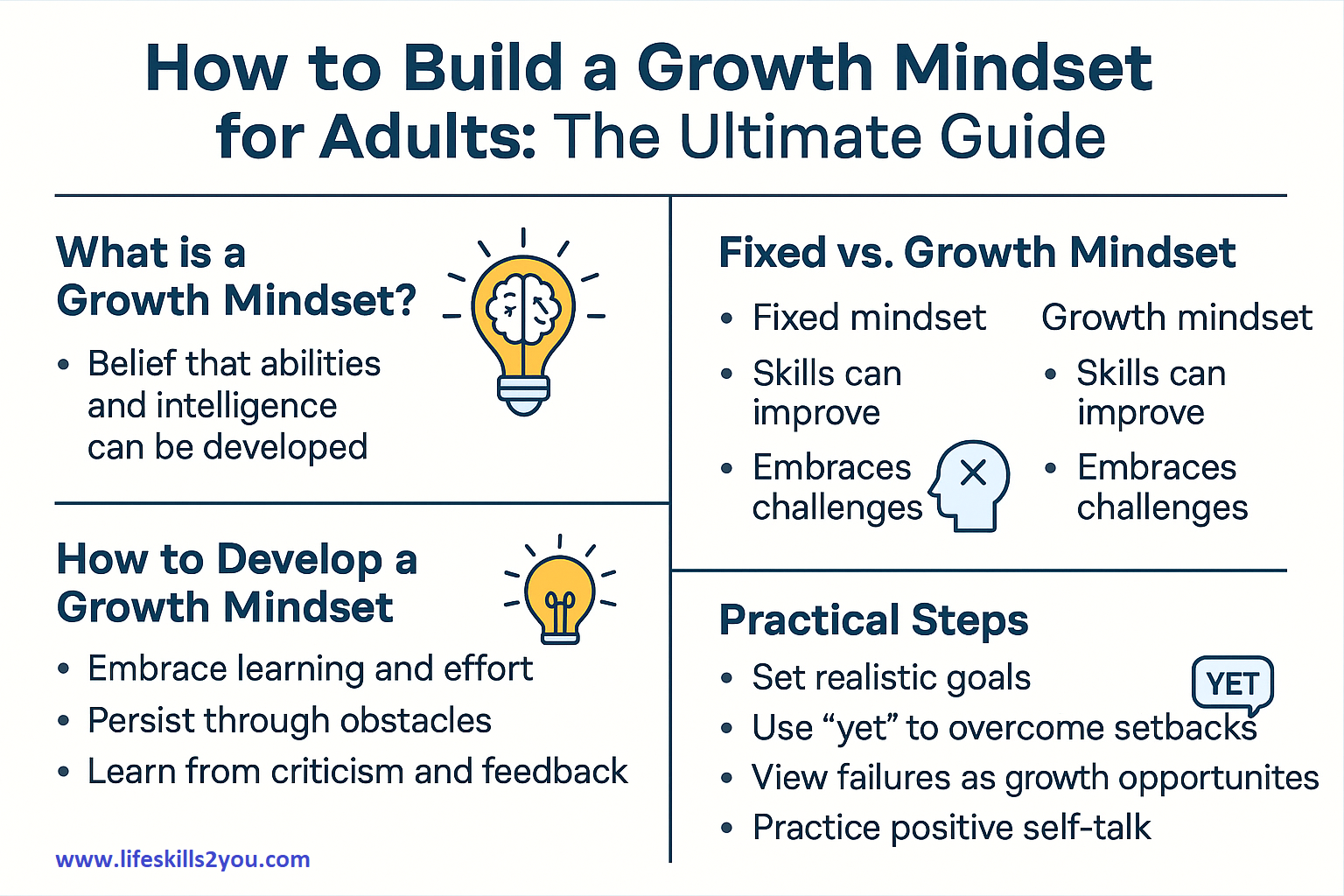
How to Build Personal Growth Mindset for Adults: The Ultimate Guide

Introduction

Learn how to build personal growth mindset for adults with practical strategies, science-backed tools, and real-life examples to elevate your personal growth.

Have you ever reached a point in life where growth felt harder than it used to be?
Maybe you’ve caught yourself saying things like:

  • “I’m just not good at this.”
  • “I’m too old to learn new skills.”
  • “People like me don’t change.”

If so, you’re not alone. Many adults carry invisible mental blocks shaped by childhood, early experiences, or repeated failures. But here’s the liberating truth: your abilities, intelligence, habits, and outcomes are not fixed. Modern psychology, neuroscience, and behavioural studies consistently reveal that adults can rewire their thinking and unlock higher potential at any age.

That’s where today’s topic becomes a life-changer: how to build personal growth mindset for adults.

Whether you’re trying to advance your career, lead your team better, improve your emotional resilience, or simply become a stronger version of yourself — developing personal growth mindset is the foundation for lasting transformation.

In my 12+ years as a life skills trainer, I’ve worked with professionals, entrepreneurs, rural self-help groups, government staff, and youth leaders. Across all these groups, one pattern is constant:
🌱 People who adopt personal growth mindset achieve better results, stay motivated longer, and handle challenges more effectively than those who don’t.

What makes the difference isn’t talent, luck, or intelligence — it’s mindset.

In this in-depth blueprint, you’ll learn:

  • The psychology behind mindset
  • Real-life stories of adults who transformed their lives
  • Science-backed tools from Stanford, Harvard & behavioural research
  • Step-by-step strategies to cultivate personal growth mindset starting today
  • A complete transformation system you can apply at home or work

This guide is written to be practical, human, and deeply relatable. You’ll not only understand the concept — you’ll feel confident implementing it.

Let’s begin your journey into The Best Blueprint for How to Build personal growth mindset for Adults.


🔶 Understanding the Psychology Behind Personal Growth Mindset

Before diving into The Best Blueprint for How to Build personal growth mindset for Adults, it’s essential to understand why your mindset shapes your reality. The term “growth mindset” originates from the pioneering research of Dr. Carol Dweck, a Stanford University psychologist known for her work on motivation and behaviour change. Her studies demonstrate that individuals who believe abilities can be developed achieve more than those who believe abilities are fixed.

But here’s something most people don’t talk about:

👉 Adults struggle more with shifting mindset than children
Why?
Because adults have decades of experiences, fears, conditioning, and emotional patterns built into their identity.

Your brain becomes comfortable with predictable routines.
Your nervous system associates change with risk.
And your habits quietly train you to stay where you are.

Yet neuroscience also reveals an empowering truth:
🧠 Adult neuroplasticity is real. Your brain can grow new pathways at any age.

Whether you’re 25, 45, or 75, the human brain can rewire, relearn, and rebuild confidence — if you follow the right process.

That’s exactly what the full blueprint below will help you do.


🔶 Signs You May Be Operating from a Fixed Mindset

Before learning how to build personal growth mindset for adults, check if any of these resonate with you. Awareness is the first step toward personal transformation.

1. You Avoid Challenges or Feel Drained by Them

Challenges feel like threats instead of opportunities. You might avoid tasks outside your comfort zone because you fear failure or judgement.

2. You Believe Talent Matters More Than Effort

If you’ve ever said,

  • “I’m not naturally good at this,”
  • “He’s talented; I’m not,”
    these are fixed-thinking patterns.

3. You Feel Defeated by Setbacks

Personal growth mindset sees mistakes as feedback.
A fixed mindset interprets them as personal inadequacy.

4. You Seek Approval Instead of Learning

If you prioritise looking smart over improving, you may be stuck in performance mode rather than learning mode.

5. You Take Criticism Personally

Feedback feels like an attack, not a tool for development.

If you relate to any of these, don’t worry — this article will teach you exactly how to break free from fixed mindset thinking and cultivate a resilient growth mindset instead.


🔶 The Best Blueprint for How to Build Personal Growth Mindset for Adults

Below is a complete, science-backed transformation system designed specifically for adults who want to reshape how they think, lead, grow, and live.

Each step includes behavioural science, coaching insights, real examples, and now-proven techniques.

Let’s dive in.


🔷 Step 1: Shift Your Mindset from Outcome to Learning

One of the core principles in how to build Personal Growth Mindset for adults is switching your focus from being the best to becoming better.

Why This Matters

Adults are conditioned to chase outcomes:

  • Promotions
  • Validation
  • Salaries
  • Achievements
  • Social approval

But studies conducted at Harvard Business School show that when individuals focus on daily learning instead of performance, they grow faster, achieve more confidence, and sustain long-term motivation.

Try the Learning Focus Reframe

Instead of asking:
“Did I succeed?”
Ask:
“What did I learn today?”

Real-Life Example 1: Corporate Manager, Age 42

A client of mine, a mid-level manager in Bengaluru, constantly felt insecure about not getting promoted. When he shifted attention from proving himself to improving himself, everything changed. Within eight months, he improved communication skills, handled pressure better, and was eventually promoted — not because he chased outcomes, but because he focused on daily learning.


🔷 Step 2: Rewire Your Beliefs Through Neuroplasticity Habits

This is one of the most powerful tools in how to build Personal Growth Mindset for adults.

Neuroscience research from University College London shows that neural pathways can be reshaped through repetition and emotional engagement.

Use Growth Affirmations the Right Way

Not generic positivity.
But identity-shifting affirmations like:

  • “I am capable of improving any skill I commit to.”
  • “Every challenge strengthens my abilities.”
  • “My brain learns, adapts, and expands daily.”

Combine Affirmations + Evidence

Instead of simply saying “I can improve,”
write down moments today where you DID improve.

This reinforces belief with proof.


🔷 Step 3: Redefine Failure as Data, Not Identity

This is where most adults get stuck.

They see failure as:

  • Embarrassment
  • Proof of incompetence
  • A sign to quit

But successful people interpret failure differently.

Failure = Information

Every setback offers:

  • Skill gaps
  • Emotional triggers
  • Strategy flaws
  • Areas needing refinement

Quote to Empower You

“Failure is not the opposite of success; it is a crucial part of success.”

Real-Life Example 2: The Entrepreneur Who Rebuilt Everything

A 38-year-old female entrepreneur I once coached failed twice in her startup journey. She felt ashamed, doubted her intelligence, and nearly gave up. After learning to see failure as feedback, she rebuilt her business model and now runs a profitable learning platform.

She didn’t change her life by “winning.”
She changed because she redefined failing.


🔷 Step 4: Build Emotional Resilience Through Growth Mindset Thinking

Adults often confuse emotions with personal limitations.

But research published on PositivePsychology.com shows that emotional intelligence and resilience are highly trainable traits.

The 3-Step Emotional Reset Formula

  1. Pause – Notice what you’re feeling
  2. Name – Label the emotion (fear, frustration, doubt)
  3. Navigate – Choose a wiser response instead of reacting

Real-Life Example 3: From Impulsive to Empowered

A government field trainer struggled with anger during team conflicts. Once she adopted the emotional reset formula, her team rated her as more composed, supportive, and solution-focused within just six weeks.

This is what growth mindset looks like in action:
Better emotional responses → better outcomes.


🔷 Step 5: Surround Yourself with Growth-Minded People

Adults absorb the energy and mindset of people around them.
If your environment is full of:

  • complainers
  • gossipers
  • excuse-makers
  • negative thinkers
  • people stuck in comfort zones

…it will be extremely hard to grow.

Build a Growth-Mindset Circle

Your group should include:

  • A mentor
  • A peer who challenges you
  • Someone you teach
  • Someone who inspires you

This combination reinforces growth, accountability, and motivation.

Real-Life Example 4: Skill Development in Rural Communities

When working with rural women’s SHGs, I observed that members who spent time with goal-driven peers completed training faster and started microenterprises sooner. Growth mindset spreads through community influence.


🔷 Step 6: Develop the Habit of Daily Micro-Progress

Adults often fail because they aim for big leaps.
But research from the University of Chicago shows that small daily wins create more motivation than large, inconsistent efforts.

The “1% Growth Habit”

Improve one small thing every day:

Daily micro-progress rewires the brain for consistency and self-belief — the foundation of a true growth mindset.


🔷 Step 7: Use Reflection to Strengthen Learning

Reflection is one of the most undervalued tools in how to build Personal Growth Mindset for adults.

Try the 5-Question Growth Journal

Every night, ask:

  1. What challenged me today?
  2. What did I learn from it?
  3. How did I show resilience?
  4. What can I improve tomorrow?
  5. What am I proud of today?

This shifts your brain from survival mode to growth mode.


🔷 Step 8: Adopt the “Yet” Mindset

A simple word with massive impact.

Instead of:
“I can’t do this.”
say:
“I can’t do this yet.”

This word activates hope and future potential.

Quote

“Yet is the most powerful word in Personal Growth Mindset vocabulary.”


🔷 Step 9: Move from Fear-Based Thinking to Curiosity-Based Thinking

Fear shuts down learning.
Curiosity opens it.

Ask more questions like:

  • “What if I tried a new approach?”
  • “What skill could help me handle this better?”
  • “What am I assuming here?”

Curiosity is the engine of adult learning.


🔷 Step 10: Build Accountability Systems That Keep You Growing

Growth doesn’t happen automatically.
It requires systems.

Your Accountability Toolkit

  • Habit tracker
  • Weekly goals
  • Monthly challenges
  • Feedback partner
  • Growth rewards (celebrating progress!)

When systems support you, mindset change becomes sustainable.


🔶 Trusted External References

Here are two supportive resources you can explore:

Both explain psychology-based insights that strengthen the concepts discussed above.


🔶 CONCLUSION

Building Personal Growth Mindset as an adult is not just a learning strategy — it is a lifelong transformation. It reshapes how you think, behave, respond to challenges, and design your future. Throughout this blueprint, you explored step-by-step methods rooted in psychology, neuroscience, coaching, emotional intelligence, and real-life success stories.

The truth is simple: Your potential is never fixed. You can improve any skill, break any limitation, and rise beyond past conditioning if you commit consistently. Growth is not an accident — it is a daily choice. And today, by reading this guide, you’ve taken one powerful step toward unlocking your fullest capabilities.

Whether you’re upgrading your career, mindset, relationships, communication, or self-confidence — now you have the tools to strengthen your transformation journey.

So go ahead. Apply one skill today. Build one new habit tomorrow. And watch how your mindset — and your life — begins to expand.


🔶 CALL TO ACTION

Thank you for exploring this insightful article.
If you’re hungry for more knowledge, don’t miss out on our other engaging articles waiting for you. Dive into our treasure trove of wisdom and discover new perspectives on related topics.
Click Our Blog and How to Guide to embark on your next adventure.
Happy reading!


🔶 10 FAQs on How to Build Personal Growth Mindset for Adults: The Ultimate Guide

1. Can adults genuinely change their mindset?

Yes. Neuroscience proves that adult brains can grow new pathways through learning, reflection, and repeated practice. Age is never a barrier.

2. How long does it take to build a growth mindset?

Typically 30–90 days of consistent practice. Mindset change is not overnight but happens gradually.

3. What is the biggest obstacle in developing a growth mindset as an adult?

Fear of failure and past conditioning. Adults often tie identity to performance.

4. Can a growth mindset improve career success?

Absolutely. It enhances problem-solving, leadership, communication, and adaptability — top skills employers value.

5. Does journaling help in growth mindset development?

Yes, journaling builds self-awareness and helps reframe challenges.

6. Can introverts develop a growth mindset?

Yes. Mindset is not about personality. It’s about beliefs and behaviours.

7. What is the role of habits in mindset transformation?

Habits create consistency, which rewires the brain and strengthens learning.

8. How do I stay motivated while building a growth mindset?

Set small goals, track wins, and surround yourself with growth-minded people.

9. Can growth mindset help reduce stress?

Yes, because it teaches you to view challenges as manageable and temporary.

10. Is professional coaching useful in building a growth mindset?

Yes. A coach provides structure, feedback, and accountability that accelerates progress.

Signs You Lack Self-Awareness: 7 Blinding Truths You Must Know

Introduction

Discover key signs you lack self-awareness and learn science-backed strategies to improve emotional intelligence, relationships, and personal growth.

Have you ever walked away from a conversation and wondered, “Why do people react to me this way?” Or felt stuck in the same patterns no matter how hard you try to change? If so, you’re not alone. In my 12+ years as a life skills trainer and personal development coach, I’ve seen one recurring issue that quietly sabotages success, confidence, and relationships: a lack of self-awareness.

Most people believe they are self-aware. In fact, a study by organizational psychologist Dr. Tasha Eurich found that 95% of people think they’re self-aware — but only 10–15% actually are.
That shocking gap is where frustration, conflict, emotional stress, and stalled personal growth are born.

When you don’t recognize your emotions, blind spots, weaknesses, or behavioural patterns, you end up repeating the same cycles — sometimes for years. You may misread situations, misunderstand people, fail to grow, or unknowingly push others away. These patterns aren’t rooted in laziness or lack of intelligence — they are rooted in blindness.

And that’s why understanding the signs you lack self-awareness is a transformative first step.
Not to judge yourself.
Not to feel guilty.
But to finally illuminate the behaviour patterns blocking your growth so you can break free.

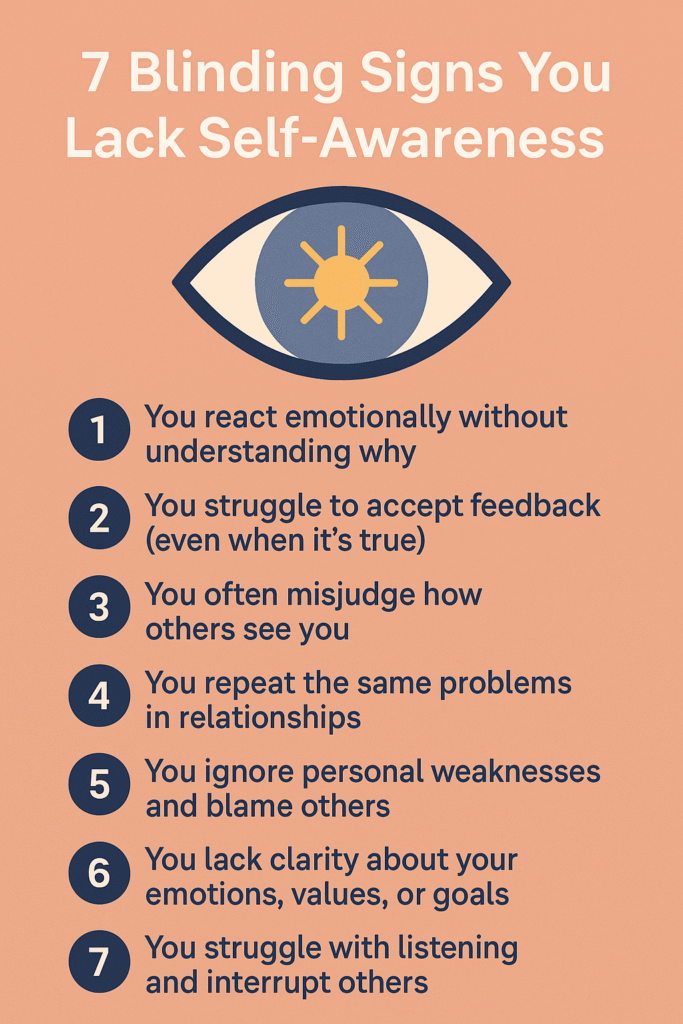
In this comprehensive, psychology-backed guide, we’ll dive deep into the 7 Blinding Signs You Lack Self-Awareness (And What to Do About It). You’ll find:

✔ Real-life coaching examples
✔ Behaviour science insights
✔ Emotional intelligence frameworks
✔ Easy, actionable steps
✔ Motivational quotes

By the end of this article, you’ll not only understand your blind spots — you’ll know exactly how to rise above them with clarity, emotional strength, and renewed personal power.

Let’s begin.


1. You React Emotionally Without Understanding Why

One of the strongest signs you lack self-awareness is reacting impulsively without recognizing the emotional trigger. This happens when your internal world controls you instead of the other way around.

Why This Happens (The Psychology Behind It)

According to the cognitive-behavioural model, emotions arise from thoughts — but when those thoughts are unconscious, the emotion feels “sudden” and uncontrollable.

You may feel:

  • Angry without knowing why
  • Anxious without a clear reason
  • Irritated even in small interactions
  • Defensive during feedback
  • Hurt by neutral comments

This happens because your brain is operating on automatic emotional scripts rooted in past experiences.

Real-Life Example (Client Story)

During a corporate training session, I worked with a manager, let’s call her Priya. She often snapped at her team but insisted she was “just stressed.”
After coaching, she realized she felt threatened whenever someone questioned her ideas — not because they were wrong, but because she grew up being criticized harshly at home.

Her emotional reactions had nothing to do with her team — but everything to do with her past.

What to Do

  • Name the emotion
  • Ask: “What triggered me?”
  • Track emotional patterns in a journal
  • Pause for 10 seconds before reacting
  • Use the CBT technique: Thought → Feeling → Behaviour

Motivational Quote:


“You cannot change what you refuse to acknowledge.”


2. You Struggle to Accept Feedback (Even When It’s True)

Do you feel attacked when someone gives you suggestions? Do you justify, argue, or shut down?
This is one of the most common signs you lack self-awareness — especially in professional settings.

Why Feedback Feels Like a Threat

According to Harvard Business Review, the brain interprets negative feedback as a threat to identity.
The less self-aware you are, the stronger the threat response.

Real-Life Example

A young entrepreneur I coached would get offended anytime investors or team members gave feedback. He believed feedback meant he wasn’t good enough.
Once he reframed feedback as data — not judgment — he started growing fast.

What to Do

  • Remind yourself: Feedback is information
  • Ask clarifying questions instead of defending
  • Thank the person
  • Implement one small action from the feedback
  • Evaluate patterns across repeated feedback

3. You Often Misjudge How Others See You

One of the most eye-opening signs you lack self-awareness is the disconnect between how you think others perceive you vs. how they actually do.

People who lack self-awareness often believe:

  • They are good communicators (but seem rude)
  • They are calm (but appear cold)
  • They are confident (but come across arrogant)
  • They are helpful (but seem controlling)

This “self-other gap” is part of social psychology’s reflected appraisal theory, which explains that we form our identity based on how we think others see us — but we often misinterpret it.

Real-Life Example

During a leadership training, one participant believed he was an “approachable leader.”
But 7/10 employees said they were afraid to speak to him because of his strict tone.

This was a powerful wake-up moment that helped him transform his leadership style.

What to Do

  • Ask 3 trusted people: “How do I show up?”
  • Use anonymous surveys (great for work)
  • Record yourself speaking and observe body language
  • Accept that perception is reality in relationships

4. You Repeat the Same Problems in Relationships

If you keep experiencing:

  • The same arguments
  • The same breakups
  • The same miscommunications
  • The same emotional patterns

…these are strong signs you lack self-awareness in relationships.

Behaviour Science Explanation

People repeat relational patterns because of subconscious attachment styles, learned behaviour, and emotional wounds.

Without self-awareness:

  • You attract similar partners
  • You make similar mistakes
  • You hold the same beliefs
  • You respond with the same emotional habits

Real-Life Example

A coaching client kept dating emotionally unavailable partners. She insisted, “All men are the same.”
Through deep introspection, she realized she herself feared intimacy — so she subconsciously chose partners who couldn’t get close.

What to Do

  • Identify recurring patterns
  • Understand your attachment style
  • Track emotional triggers
  • Seek emotional intelligence training
  • Learn reflective communication

5. You Ignore Personal Weaknesses and Blame Others

People who lack self-awareness often externalize problems:

“It wasn’t my fault.”
“They misunderstood me.”
“I didn’t do anything wrong.”

This avoidance protects the ego — but destroys growth.

Psychological Insight

This is linked to the self-serving bias, a cognitive bias where you credit yourself for successes and blame others for failures.

Real-Life Example

I once coached a team leader who blamed poor team results on “lazy team members.”
But after a performance audit, he discovered the real issue was his unclear communication and lack of follow-up.

This realization changed everything.

What to Do

  • Ask: “What part of this is in my control?”
  • Identify your role in every conflict
  • Accept that weakness ≠ failure
  • Use self-assessment tools (Johari Window, MBTI, EI scales)

6. You Lack Clarity About Your Emotions, Values, or Goals

If you don’t know:

  • What you want
  • What motivates you
  • What drains you
  • What your values are
  • What direction you’re moving in

…these are powerful signs you lack self-awareness.

Why This Happens

Many people live on autopilot — influenced by society, family expectations, and comparison culture.

Without clarity:

  • Decisions feel heavy
  • Motivation drops
  • Purpose feels missing
  • Emotional confusion increases

Real-Life Story

A young professional I worked with jumped from job to job feeling unfulfilled.
He thought something was wrong with his career — but the real issue was that he didn’t know his values.
Once we identified his core values (creativity, autonomy, impact), he finally found a career that fit him.

What to Do

  • Write your top 5 values
  • Reflect weekly on emotional highs and lows
  • Journal: “What do I want?”
  • Set 90-day goals
  • Conduct a monthly self-audit

7. You Struggle With Listening and Interrupt Others

Poor listening is one of the strongest signs you lack self-awareness because it shows a lack of presence.

Why This Happens

People interrupt because they are:

  • Preparing responses
  • Seeking validation
  • Feeling insecure
  • Distracted
  • Avoiding discomfort

Real-Life Example

During communication training, I met a participant who constantly interrupted others without realizing it.
Once she watched a recording of herself, she was shocked — and immediately started improving.

What to Do

  • Pause 2 seconds before responding
  • Listen to understand, not respond
  • Take notes during conversations
  • Validate what the other person said
  • Use the “Tell me more” technique

To Get More insights You Maye Refer This External Resources

✔ Harvard Business Review – “Self-Awareness Can Help Leaders More Than an MBA”
https://hbr.org
✔ Positive Psychology’s guide on self-awareness
https://positivepsychology.com


Conclusion

Self-awareness isn’t a skill you master once — it is a lifelong journey. The more you understand your thoughts, emotions, triggers, patterns, and relational behaviours, the more power you gain over your life.
By recognizing these 7 blinding signs you lack self-awareness, you open the door to stronger relationships, clearer goals, emotional freedom, and lasting personal growth.

Remember:
Self-awareness is not about judging yourself — it’s about discovering yourself.

Every great leader, communicator, and emotionally intelligent person began with a single brave step: the willingness to look within.

If you commit to even one strategy from this guide, you’ll notice powerful changes in the way you think, feel, and connect with others.

Thank you for exploring this insightful article.
If you’re hungry for more knowledge, don’t miss out on our other engaging articles waiting for you. Dive into our treasure trove of wisdom and discover new perspectives on related topics.
Click ‘Our Blog and How to Guide to embark on your next adventure.
Happy reading!


FAQs On Signs You Lack Self-Awareness: 7 Blinding Truths You Must Know

1. What is self-awareness in simple terms?

Self-awareness is the ability to understand your thoughts, emotions, behaviours, and how they influence your life and relationships. It’s the foundation of emotional intelligence.

2. Why do most people lack self-awareness?

Because emotions and behaviours are often unconscious. People operate on autopilot, shaped by conditioning, habits, and emotional wounds.

3. How do I know if I lack self-awareness?

Look for patterns like repeating conflicts, emotional overreactions, defensiveness, miscommunication, or not understanding your triggers.

4. Can self-awareness be learned?

Absolutely. With reflection, feedback, journaling, mindfulness, and emotional intelligence training, self-awareness improves significantly.

5. Why does feedback hurt?

Feedback threatens your identity. When self-awareness is low, the ego feels attacked, leading to defensiveness.

6. How do I become more self-aware daily?

Practice mindfulness, ask for feedback, journal emotions, pause before reacting, and track behaviour patterns.

7. Is self-awareness related to mental health?

Yes. Higher self-awareness improves emotional regulation, reduces stress, and builds resilience.

8. Can self-awareness improve relationships?

Definitely. When you understand your triggers and behaviour patterns, communication, trust, and empathy naturally strengthen.

9. What tools help develop self-awareness?

CBT worksheets, emotional journals, values assessments, feedback surveys, coaching, meditation, and personality tools.

10. How long does it take to develop self-awareness?

It varies — but consistent practice can show visible improvements within weeks.

How to Identify My Core Values (Step-by-Step Guide to Align Life & Career Decisions)

Table of Contents

Introduction

Why You Feel Stuck (Even When You’re Trying Hard)

Let’s be honest for a moment… if you have qusestion in your mind that How to Identify My Core Values, What steps can people take to identify their core values, beliefs, and principles, and use them to guide life choices and career decisions?

You’ve probably worked hard, tried different paths, maybe even achieved some goals—but something still feels off.

  • You feel confused about decisions
  • You second-guess yourself
  • You compare your path with others
  • You wonder, “Is this really what I want?”

Here’s the truth most people don’t realize:

👉 You don’t have a decision problem. You have a clarity problem.

And clarity comes from one powerful foundation:

👉 Your core values, beliefs, and principles

If you don’t define them consciously, life—and other people—will define them for you.

In this guide, I’ll walk you through simple, practical steps to identify your core values and show you exactly how to use them to guide your life and career decisions.


🌱 What Are Core Values, Beliefs, and Principles?

Before jumping into steps, let’s simplify this.

  • Core Values → What matters most to you (e.g., freedom, honesty, growth)
  • Beliefs → What you think is true about life and yourself
  • Principles → The rules you follow while making decisions

👉 Together, they act like your internal compass.

Without them, you drift.
With them, you move with purpose.


🪜 What Steps Can People Take to Identify Their Core Values, Beliefs, and Principles?

This is the heart of the process. Don’t rush it—this is where transformation begins.


🔹 Step 1: Reflect on Your Peak and Painful Moments

Your values don’t appear randomly. They reveal themselves through your experiences.

Ask yourself:

  • When did I feel truly proud of myself?
  • When did I feel deeply happy or fulfilled?
  • When did I feel angry, hurt, or frustrated?

👉 Both positive and negative experiences are powerful clues.

Example:

  • Felt proud helping someone → You value service or contribution
  • Felt hurt when ignored → You value respect or recognition
  • Felt trapped in a job → You value freedom or autonomy

Take 10–15 minutes. Write these moments down. Patterns will start appearing.


🔹 Step 2: List What Truly Matters to You

Now that you’ve reflected, start listing values.

Don’t overthink. Just write.

Here are some examples to help you:

  • Honesty
  • Freedom
  • Family
  • Growth
  • Stability
  • Creativity
  • Respect
  • Wealth
  • Learning
  • Discipline
  • Compassion

👉 Aim for 10–15 values initially

This is your raw list—don’t filter yet.


🔹 Step 3: Group and Prioritize Your Values

Now comes clarity.

Many values overlap. Combine similar ones.

Example:

Now reduce your list to:

👉 Top 5–7 Core Values

Why only 5–7?

Because if everything is important… nothing is truly important.


🔹 Step 4: Define Each Value in Your Own Words

This is where most people go wrong.

They copy definitions—but your values must be personal.

Ask:

👉 “What does this value mean to me in real life?”

Example:

  • “Success” → Not just money, but peace of mind + meaningful work
  • “Freedom” → Ability to make my own choices without pressure
  • “Family” → Being present, not just providing financially

Write 1–2 lines for each value.

Now your values are not just words—they are living principles.


🔹 Step 5: Test Your Values Against Your Current Life

Now reality check.

Ask yourself honestly:

  • Does my current job align with my values?
  • Are my daily habits reflecting what I believe in?
  • Do my relationships support my values?

If the answer is NO…

👉 That’s exactly why you feel stuck, confused, or dissatisfied.

This step creates awareness—and awareness creates change.


🔹 Step 6: Use Your Values as a Decision Filter

This is where everything becomes powerful.

From now on, before making any major decision, ask:

👉 “Does this align with my core values?”

If YES → Move forward confidently
If NO → Pause, rethink, or reconsider

This one habit can save you from:

  • Wrong career choices
  • Toxic relationships
  • Regretful decisions

💼 How to Use Core Values to Guide Life and Career Decisions

Identifying values is only half the work.

👉 Applying them is where real transformation happens.


🔹 1. Choosing the Right Career Path

Many people choose careers based on:

  • Salary
  • Society pressure
  • Trends

But long-term satisfaction comes from alignment with values.

Examples:

  • Value = Creativity → Choose design, content, innovation roles
  • Value = Stability → Choose structured jobs like government or corporate roles
  • Value = Impact → Work in education, healthcare, or social sectors

👉 When your work matches your values, motivation becomes natural.


🔹 2. Making Better Decisions (Without Overthinking)

Ever felt stuck between two options?

Your values simplify everything.

Example:

Job A → High salary, no freedom
Job B → Lower salary, more flexibility

If your value is freedom → Decision becomes easy.

👉 Clarity replaces confusion.


🔹 3. Building Meaningful Relationships

Your values influence:

  • Who you connect with
  • What behavior you accept
  • What boundaries you set

Misaligned values = constant conflict

Aligned values = peace and understanding


🔹 4. Setting Goals That Actually Matter

Most goals fail because they are based on comparison.

Instead, align goals with values.

❌ “I want to earn more money”
✅ “I want financial stability to support my family and freedom”

👉 Now your goal has meaning.


⚠️ Common Mistakes People Make While Identifying Core Values

Let’s avoid these traps.


❌ 1. Choosing “Socially Acceptable” Values

Don’t pick values that sound good.

Pick values that feel true.


❌ 2. Copying Others

Your values are personal—not borrowed.


❌ 3. Having Too Many Values

Keep it focused (5–7 max)


❌ 4. Not Applying Values

Knowing without action = no change


🔄 Can Core Values Change Over Time?

Yes… but not completely.

Your experiences, age, and environment can influence your values.

However:

👉 Your core essence remains consistent

For example:

  • Early life → Value = Achievement
  • Later life → Value = Peace

But both may come from a deeper value like fulfillment


Signs You’re Not Living Your Core Values

Before we learn how to identify my core values, here are subtle signs your values are unclear or unmet:

  • Feeling internally conflicted even when life “looks good”
  • Emotional exhaustion without clear reasons
  • Difficulty making decisions
  • Having goals that don’t excite you
  • Repeatedly choosing things that don’t feel aligned
  • Feeling guilty for prioritizing your own needs
  • Irritability, frustration, or loss of direction

In my workshops, people often realize that their stress isn’t from work or relationships—it’s from living out of alignment with values they weren’t even aware of.


🌟 Motivational Quotes to Reinforce Learning

“Your values are the blueprint of the life you are meant to live.”

“When you honor your values, you honor yourself.”


You may find deeper insights from psychology and behavioural studies here:


How Core Values Directly Impact Your Life (Advanced Breakdown)

Let’s deepen your understanding.


1. Core Values Influence Identity

When people say:

  • “I don’t know who I am anymore”
  • “I feel lost”

…it’s often because they’ve lost connection with their values.

Identity = Values + Beliefs + Behavior

A strong sense of self comes from knowing your value foundation.


2. Core Values Shape Your Goals and Priorities

If your goals don’t match your values, you will self-sabotage.

Example:

  • If your value is family, but your career goal consumes all your free time → conflict.
  • If your value is creativity, but your goal is a rigid, repetitive job → burnout.

Values create sustainable goals.


3. Core Values Build Stronger Relationships

People with conflicting values can still love each other — but shared values create emotional alignment.

What matters most is:

  • Respect
  • Communication
  • Mutual understanding
  • Priority alignment
  • Boundaries

These are all value-driven behaviors.


4. Core Values Reduce Stress & Anxiety

A lot of emotional stress comes from living in misalignment.

Psychologists call this “cognitive dissonance.”

Once you identify and honor your values, life begins to feel:

  • Lighter
  • Clearer
  • More meaningful
  • Less chaotic

This is why identifying values is essential for mental wellness.


5. Core Values Accelerate Decision-Making

When you know your values:

  • You stop overthinking
  • You stop living for approval
  • You stop choosing what looks good and start choosing what feels right

Values act like a filter.

Imagine deciding between two job offers:

  • One pays more but limits freedom
  • One pays slightly less but offers flexibility

Your values will make the right choice clear.


The Science Behind Values (Psychology + Behaviour)

Core values aren’t just “nice ideas.”
They are rooted in behavioral science.

Here’s the science:

Self-Determination Theory (SDT)

Human motivation thrives when aligned with autonomy, competence, and relatedness — all value-driven needs.

Cognitive Dissonance Theory

Living against your values produces internal stress and confusion.

Maslow’s Hierarchy of Needs

Self-actualization happens only when your actions align with your values.

Positive Psychology

Values create purpose and emotional well-being.

All of these psychological frameworks reinforce one truth:

👉 When you live your values, you live in alignment with your highest potential.


Practical Tools to Discover and Apply Your Values

Here are advanced techniques used in coaching, therapy, and leadership development.


1. Value Journaling

Daily prompts:

  • Did I honor my values today?
  • Which value guided my biggest decisions?
  • Which value did I ignore?

Journaling builds awareness.


2. Values in Action (VIA) Strengths Test

This is a research-backed assessment from the VIA Institute on Character.
It helps you identify your strengths and values.


3. Life Satisfaction Mapping

Draw a circle with 8 life areas:

  • Work
  • Health
  • Family
  • Friends
  • Spirituality
  • Growth
  • Fun
  • Contribution

Rate each 1–10.
Where you’re unhappy → a value is missing.


4. The “Perfect Day” Exercise

Imagine your perfect day from morning to night.
What values appear naturally?

Freedom? Connection? Creativity? Growth?

Your imagination reveals your heart.


How to Live According to Your Values

Identifying values is step 1.
Living them is step 2.

Here’s how.


1. Translate Values Into Habits

Example:

  • Value: Growth → Habit: Learn 30 mins daily
  • Value: Family → Habit: No phone during dinner
  • Value: Health → Habit: Exercise 4x weekly

2. Use Values as Decision Filters

Before making a decision, ask:
“Does this align with my top 5 values?”


3. Set Boundaries Based on Values

If you value:

  • Peace → limit toxic environments
  • Respect → no tolerance for rude behavior
  • Freedom → avoid restrictive commitments

4. Evaluate Your Career Against Your Values

Misalignment = burnout
Alignment = flow

This is why so many people quit high-paying jobs—they weren’t aligned.


5. Revisit Your Values Every 6–12 Months

Values can evolve.
Re-examine them regularly.


Conclusion

Your core values are not just philosophical ideas; they are the blueprint of your identity, the compass of your decisions, and the foundation of your emotional well-being. When you discover your values, you’re not learning something new—you’re remembering who you’ve always been. And once you know them, everything begins to make sense: your choices, your patterns, your triggers, your passions, and your inner conflicts.

By following The Simple 4-Step Guide on How to Identify Your Core Values, you give yourself the power to create a life that feels aligned, meaningful, and purposeful. The clarity you gain will help you make better decisions, set stronger boundaries, build deeper relationships, and design a future that matches your true self.

Values are not goals.
They are your truth.
And when you live by your truth, life transforms.

If you haven’t already, take time today to list your peak moments, identify your triggers, extract themes, and choose your top 5–7 core values. Your life will become lighter, clearer, and more intentional.

Thank you for exploring this insightful article.
If you’re hungry for more knowledge, don’t miss out on our other engaging articles waiting for you. Dive into our treasure trove of wisdom and discover new perspectives on related topics.
Click Our Blog and How to Guide to embark on your next adventure.
Happy reading!


10 FAQs How to Identify My Core Values

1. What exactly are core values?

Core values are the deeply rooted beliefs that guide your behavior, decisions, and emotional responses. They represent what matters most to you at a fundamental level.

2. Why is it important to know my core values?

Because values shape your identity, relationships, career choices, and emotional well-being. When you align your actions with your values, life becomes more meaningful and less stressful.

3. How many core values should I have?

Most people have 5–7 core values. Fewer gives clarity; more becomes confusing.

4. Can my values change over time?

Yes. Major life events—parenthood, career shifts, trauma, breakthroughs—can reshape values.

5. What if I don’t know my values at all?

You’re not alone. Most people don’t until they go through a structured exercise like the 4-step guide.

6. Are values the same as goals?

No. Goals are achievements.
Values are principles that guide how you live and behave.

7. What if my values conflict with each other?

That’s normal. Prioritizing your top values helps resolve internal conflict.

8. Can values help with anxiety or stress?

Absolutely. Clarity reduces overthinking and emotional confusion.

9. Should I make life decisions based on my values?

Yes. Decisions made through values lead to long-term satisfaction.

10. How often should I reflect on my values?

Every 6–12 months or whenever you feel lost, stuck, or misaligned.

Self-Care Checklist For Emotional Overload: The Ultimate Power Guide

Table of Contents

Introduction

A practical self-care checklist for emotional overload to reset your mind and calm your emotions fast. Learn simple steps to regain control and clarity.

Have you ever had one of those days where everything feels too loud, too heavy, or too much? When your emotions crash over you like a wave you didn’t see coming — leaving you overwhelmed, exhausted, or even numb?

If so, you’re not alone. Emotional overload is becoming increasingly common in today’s hyperconnected world. Our minds juggle notifications, deadlines, family responsibilities, social expectations, unexpected events, and the constant pressure to “keep it together.” Eventually, something inside us just… snaps.

You pause. You sigh. You mentally whisper, “I can’t do this anymore.”

This is exactly where a self-care checklist for emotional overload becomes your lifeline — not a luxury, but a survival tool. A compass that helps you navigate chaos, reclaim your calm, and reconnect with your inner steadiness.

In this guide, we’ll walk through The Self-Care Checklist to Beat Emotional Overload in 15 Minutes — a simple, realistic, and deeply effective structure that helps you pause, reset, and breathe again. Whether you’re feeling drained, scattered, overstimulated, or simply “not like yourself,” this checklist gives you a way back.

You’ll learn:

  • Why emotional overload happens
  • How to quickly reset your mind and body
  • Simple 15-minute practices you can do anywhere
  • Real-life examples from people who learned to manage emotional overwhelm
  • A practical, personalized checklist you can follow daily
  • Powerful motivational reminders to stay grounded

And here’s the best part — this guide doesn’t require fancy tools, long meditation sessions, or a perfect environment. These strategies work even in the middle of a busy day, a stressful moment, or a chaotic week.

Emotional overload isn’t a failure. It’s a signal.
A message from your mind and body saying:

“Pause. You deserve care too.”

Let’s explore how you can listen to that message with intention — and take back control of your emotional space.


Related : The Ultimate Guide to Emotional Intelligence


Understanding Emotional Overload — Why It Happens & What It Means

Emotional overload doesn’t appear out of nowhere. It’s the result of accumulated stress, unprocessed feelings, interrupted boundaries, and persistent mental overstimulation. You might notice it in the form of:

  • Sudden irritability
  • Emotional numbness
  • Difficulty concentrating
  • Feeling drained even after resting
  • Anxiety or panic sensations
  • Crying without a clear reason
  • Overthinking everything at once

In simple terms, your internal capacity gets maxed out.

The Brain’s Emergency Mode

When too many emotional signals fire at once, your brain shifts into survival mode. Logic takes a back seat. Your nervous system speeds up. Your thoughts spin.

This is not weakness — it’s biology.

A powerful reminder:

“Your body isn’t breaking down. It’s breaking through the noise.”

Understanding emotional overload is the first step to taking back your power.


The Self-Care Checklist to Beat Emotional Overload in 15 Minutes

This is the heart of our guide — your personalized, science-backed self-care checklist for emotional overload that resets your mind in minutes.

It includes:

  1. Grounding your body
  2. Decluttering your emotions
  3. Recharging your energy
  4. Restoring your mental clarity
  5. Reconnecting with yourself

Each step is designed to take 2–3 minutes, making it easy to complete even during the busiest days.


✔️ Step 1: Pause & Breathe — The Nervous System Reset

Take a deep breath. Yes, the simplest step is also the most powerful.

Breathing techniques like box breathing, 4-7-8 breathing, or slow diaphragmatic breathing instantly calm your nervous system. Research on mindful breathing (see resources at Greater Good Science Center and Verywell Mind) confirms its ability to reduce emotional intensity.

Try this:

  • Inhale 4 seconds
  • Hold 2 seconds
  • Exhale 6 seconds

Repeat 5 times.

Your shoulders loosen. Your jaw relaxes. Your mind resets.

Emotional overload often pushes your nervous system into a fight-or-flight state. Your heart races. Your thoughts scatter. Your body tightens. This is where intentional breathing becomes a superpower — a direct signal to your brain that you’re safe.

Here’s something powerful:

“When you control your breath, you control your inner weather.”

Yes — your breath is your anchor. It grounds you in the present moment, pulling you out of emotional noise and reconnecting you to your center.

Real-Life Example #1 – Neha’s “2-Minute Reset”

Neha, a full-time working mom, often felt overwhelmed between work calls, school deadlines, and home responsibilities. She started using a simple 2-minute breathing reset:

  • Close eyes
  • Inhale for 4
  • Hold for 2
  • Exhale for 6

She repeated this cycle five times wherever she was — her car, bathroom, living room, anywhere. Within a week, she said she felt “less explosive and more in control.”

This breathing step is the opening gateway of your bold — self-care checklist for emotional overload because it resets your physiology before you reset your thoughts.


✔️ Step 2: Name What You Feel — Emotional Labelling

Once your breathing softens your internal chaos, the second step is identifying your emotions. Labeling emotions helps reduce their intensity. This is not wishful thinking; multiple studies highlighted by the Greater Good Science Center show that naming your feelings decreases amygdala activation — the part of your brain responsible for emotional reactions.

Try this list:

  • “I feel overwhelmed.”
  • “I feel anxious.”
  • “I feel pressured.”
  • “I feel disappointed.”
  • “I feel unsupported.”

No judgment. No fixing. Just awareness.

Why this works:
Your brain relaxes when it has clarity. Unnamed emotional overload feels like drowning. Named emotions feel like waves you can see coming.

Real-Life Example #2 – Rohan’s Hidden Pressure

Rohan, a young entrepreneur, had frequent emotional shutdowns during work. He thought he was “just stressed,” but when he started labeling emotions, he discovered deeper layers:

  • Pressure to succeed
  • Fear of failing
  • Guilt for not resting
  • Exhaustion from multitasking

This step allowed him to sit with clarity instead of confusion.

Labeling is a powerful component of the bold — self-care checklist for emotional overload, turning emotional fog into emotional understanding.


✔️ Step 3: Physical Release — Let Your Body Let Go

Emotions live inside your body. Anxiety tightens your chest. Sadness weighs down your shoulders. Stress curls your stomach. That’s why physical release is a vital part of The Self-Care Checklist to Beat Emotional Overload in 15 Minutes.

Quick 2-minute releases:

  • Shake your hands vigorously for 30 seconds
  • Roll your shoulders in circles
  • Stretch your arms overhead
  • Squeeze your fists tight, then release
  • Do 10 slow neck rotations

These small movements send fresh oxygen through your body, releasing tension and unlocking energy stuck in your muscles.

Real-Life Example #3 – Sana’s Mid-Meeting Trick

Sana works in HR and often experiences emotional overload during long meetings. She began quietly squeezing her fists under the table and releasing them slowly. This small release reduced her stress spikes and helped her stay present.

Movement grounds you. Movement unfreezes your energy. Movement is medicine.


✔️ Step 4: Reconnect Through Sensory Grounding

When your emotions spiral, your senses can bring you back. This step helps balance your mind and body, making it a crucial part of the bold — self-care checklist for emotional overload.

Try the 5-4-3-2-1 grounding method:

  • 5 things you can see
  • 4 things you can touch
  • 3 things you can hear
  • 2 things you can smell
  • 1 thing you can taste

This technique is widely recommended by therapists and emotional wellness experts, including those cited on Verywell Mind.

Suddenly, you’re not in past regrets or future stress.
You’re right here — in the present.


✔️ Step 5: Micro-Journaling — Clear the Mental Traffic

You don’t need to write a full journal entry. Just unload your mental pressure in 30 seconds. Write:

  • What’s overwhelming me right now?
  • What do I need?
  • What is one small thing I can do?

This is not about being poetic. It’s about being honest.

This step declutters your emotional space and creates mental breathing room. When included as part of the bold — self-care checklist for emotional overload, journaling becomes a mental detox ritual.


✔️ Step 6: Do One Micro-Action of Self-Kindness

This could be:

  • Drinking a glass of water
  • Opening a window for fresh air
  • Washing your face
  • Listening to a calming song
  • Sitting in sunlight for 1 minute

These micro-actions pull your nervous system out of overwhelm and into ease.

Real-Life Example #4 – Vikram’s “Sunlight Break”

Vikram struggled with emotional overload during corporate workdays. He started walking to the balcony for 1 minute of sunlight every afternoon.

He explains, “It resets my brain faster than coffee.”


✔️ Step 7: Reframe Your Internal Dialogue

Overload often whispers:

  • “I should handle this better.”
  • “I’m failing.”
  • “Why am I so emotional?”

Transform it into:

  • “I’m doing my best.”
  • “This moment will pass.”
  • “My feelings are valid.”
  • “I’m allowed to rest.”

Self-talk is not cliché — it’s chemistry. It changes cortisol, motivation, and emotional resilience.


✔️ Step 8: Create a Boundary for the Next Hour

Emotional overload often comes from ignoring your own limits.

Ask:

  • What can I postpone?
  • What can I delegate?
  • What can I say no to?
  • What can wait until tomorrow?

Protecting your energy is not selfish. It’s strategic self-care.


✔️ Step 9: Reconnect With Your Body Rhythm (Hydrate, Breathe, Pause)

Humans are not robots. You need pauses. You need nourishment. You need oxygen.

This step reinforces physiological regulation so emotional overload doesn’t reappear later in the day.


✔️ Step 10: Affirm Your Emotional Strength

End your 15-minute checklist with:

“I am capable. I am growing. I am safe.”
“My emotions do not control me — I guide them.”

Affirmations rewire the emotional brain.


Why This 15-Minute self-care checklist for emotional overload Works (Science + Psychology)

Your bold — self-care checklist for emotional overload isn’t just a lifestyle trick. It’s built on how your brain, body, and nervous system work. Let’s break down the science so you understand why these small steps create such powerful emotional shifts.


1. It Interrupts the Emotional “Cascade Effect”

When you begin to feel overwhelmed, your nervous system releases stress hormones. If not interrupted, this becomes a cascade:

Trigger → Stress → Overthinking → Emotional flooding → Shutdown or explosion

The first 2–3 steps of your checklist interrupt this biological chain, giving you space to respond instead of react. Even a small break in the cycle can prevent emotional spirals.


2. It Activates the Parasympathetic Nervous System

Breathing, grounding, micro-journaling, and physical release all activate your rest-and-digest mode — the biological opposite of stress.

This is why:

  • Your shoulders drop
  • Your chest loosens
  • Your thoughts become clearer
  • You feel “lighter”

Your emotional intensity decreases because your brain senses safety.


3. It Creates Cognitive Distance From Your Emotions

When emotions feel close, they feel huge.

When you label them or write them down, you create distance, reducing their power. This technique is called affect labelling, widely studied at the UCLA Mindful Awareness Research Center and summarized beautifully on Greater Good Science Center.

Distance = control
Clarity = relief
Awareness = strength


4. It Reboots Your Mental Processing Power

Emotional overload reduces working memory — the mental space you use to think clearly.

Your bold — self-care checklist for emotional overload includes techniques that:

  • Clear mental clutter
  • Restore attention
  • Replace panic with clarity
  • Improve decision-making

It’s like “refreshing” your emotional browser.


5. It Rebuilds Emotional Resilience Daily

Self-care is not an emergency tool. It’s a resilience-building habit.

Every time you complete this checklist, you strengthen:

You’re not just calming your emotions — you’re reprogramming your emotional patterns for long-term strength.


Real-Life Stories — How This Self-Care Checklist For Emotional Overload Transformed Lives

Stories connect us. They make emotional overload feel less lonely and remind us that growth is possible.

Here are relatable examples you can see yourself in:


Example 1 – Priya’s Journey From Emotional Breakdown to Balance

Priya was a teacher juggling home responsibilities, online classes, and caring for her elderly parents. One morning, while preparing breakfast, she unexpectedly burst into tears. It wasn’t one big thing — it was the accumulation of hundreds of small pressures.

She found this bold — self-care checklist for emotional overload online and tried it for a week.

What changed?

  • She started pausing before reacting
  • Her emotional intensity reduced
  • She learned to say “no” without guilt
  • She stopped judging herself for feeling overwhelmed
  • She finally felt in control again

Priya said, “This checklist didn’t remove my stress, but it gave me a way to breathe inside it.”


Example 2 – The Overachiever Who Learned to Slow Down

Arvind, a high-performing engineering student, constantly pushed himself to meet academic expectations. Emotional overload became a regular part of his life — but he thought it was “normal.”

After implementing the bold — self-care checklist for emotional overload, he realized:

  • His body was constantly tense
  • His thoughts never paused
  • He was running on empty

The checklist became his daily grounding practice before studying.
Now he performs better because he takes breaks, not despite them.


Example 3 – The Introvert Who Was Drowning in Social Expectations

Maya felt overwhelmed by family gatherings, office events, and constant calls. As an introvert, emotional overload was part of her social life.

This checklist empowered her to:

  • Set boundaries
  • Take sensory breaks
  • Ground herself during conversations
  • Recover after demanding interactions

She now enjoys social events without losing herself.


Example 4 – The Corporate Leader With Silent Stress

Raj, a senior manager, looked “in control” on the outside but was internally exhausted — decision fatigue, team pressure, and constant problem-solving had overloaded him.

The checklist became his 15-minute leadership reset each morning.
He said it helped him “lead from calm instead of chaos.”


The Complete 15-Minute Self-Care Checklist — Quick Summary

Here’s the entire bold — self-care checklist for emotional overload in one simple glance:

1-minute steps (Total 15 minutes):

  1. Deep Breathing Reset (1 minute)
  2. Name Your Emotion (1 minute)
  3. Shake or Stretch (1 minute)
  4. Sensory Grounding (2 minutes)
  5. Micro-Journal (2 minutes)
  6. Drink Water or Change Position (1 minute)
  7. Reframe Your Self-Talk (2 minutes)
  8. Set a Micro-Boundary (2 minutes)
  9. Hydrate, Pause, Reset (2 minutes)
  10. Affirm Your Strength (1 minute)

Complete this checklist twice a day or whenever you feel overwhelmed.


Build Your Personalized Emotional Reset Plan

Everyone responds differently to emotional overload. So customize this checklist to your personality:

  • If you are highly sensitive: Add sensory breaks
  • If you overthink: Add grounding + journaling
  • If you get angry: Add breathing + physical release
  • If you get numb: Add movement + sunlight
  • If you shut down: Add self-talk + hydration

This makes the checklist uniquely yours.


🌿 CONCLUSION

Emotional overload doesn’t mean you’re weak—it means you’ve been strong for too long without a pause. It’s your mind and body asking for space, breath, and care. The bold — self-care checklist for emotional overload you’ve explored in this guide is more than a quick-fix routine; it’s a daily act of reclaiming your inner balance.

By following these simple yet powerful steps—breathing, grounding, labeling emotions, journaling, reframing self-talk, and setting boundaries—you create an internal environment where emotional clarity can grow. You shift from reacting to responding. From chaos to calm. From overwhelm to empowerment.

Remember: you don’t need an hour, a quiet room, or a perfect mindset to reset. Just 15 focused minutes can transform your emotional landscape.

So the next time life feels loud or heavy, trust this checklist. Return to your breath, reconnect with your senses, and remind yourself:

“I am capable, I am grounded, and I am safe.”

Your emotional well-being deserves priority—not someday, but today.


🚀 FIXED FINAL CALL TO ACTION (As Required)

Thank you for exploring this insightful article.
If you’re hungry for more knowledge, don’t miss out on our other engaging articles waiting for you. Dive into our treasure trove of wisdom and discover new perspectives on related topics.
Click ‘Our Blog’ and ‘How to Guide’ to embark on your next adventure.
Happy reading!


❓ FAQs: Self-Care Checklist for Emotional Overload

1. What is emotional overload?

Emotional overload happens when you experience more emotional input than your mind can manage. It leads to stress, fatigue, and difficulty thinking clearly. The self-care checklist for emotional overload helps interrupt this cycle.

2. How quickly does this checklist work?

Most people feel relief within 5–10 minutes, while completing the full 15-minute routine provides a deeper reset. Consistency increases long-term emotional resilience.

3. Can I use this checklist at work or in public spaces?

Absolutely. Every step—including breathing, grounding, and micro-journaling—can be done discreetly, making it perfect for high-pressure environments.

4. I can’t slow down my thoughts. What should I do first?

Start with breathing. It calms the nervous system, reducing mental speed so you can think more clearly. Then move on to sensory grounding.

5. How often should I use this self-care routine?

Use it anytime you feel overwhelmed. Many people apply the checklist morning and evening as a preventative emotional wellness practice.

6. Does journaling really help with emotional overload?

Yes. Even 30-second micro-journaling helps declutter your mind, gives clarity, and reduces emotional intensity. It’s one of the fastest ways to process feelings.

7. What if I don’t know how to identify my emotions?

Start with basics like: “I feel stressed,” “I feel tired,” or “I feel tense.” Over time, your emotional vocabulary will expand naturally.

8. Can this checklist help with anxiety too?

Yes. Many steps—like deep breathing, grounding, and sensory awareness—are also recommended for managing anxiety and panic sensations.

9. What if I don’t have 15 minutes?

Even 3 minutes of breathing + grounding can help. The full version simply provides a more complete emotional reset.

10. Is it normal to feel emotional while doing the checklist?

Yes. When your body finally relaxes, stored emotions may surface. This is healing. Let them move through you without judgment.

Daily Routine for Highly Sensitive Person: A Gentle Path to Thrive

A calming daily routine for highly sensitive person that supports emotional balance, energy, and inner peace. This gentle guide helps you thrive every day.

Have you ever walked into a room and instantly felt the tension—without anyone saying a word?
Do loud noises, chaotic schedules, or heavy emotions leave you drained while others seem perfectly fine?
If yes, you’re not alone. Millions of people experience life deeply, intensely, and beautifully. You’re what psychology calls a Highly Sensitive Person (HSP)—someone whose nervous system absorbs more information, more emotion, and more energy than the average person.

And here’s the most important thing you’ll read today:

Your sensitivity is not something to “fix.” It is a strength that can help you thrive—when you build a life that supports it.

That’s why creating a daily routine for highly sensitive person is not just helpful…
It’s essential for your mental, emotional, and physical well-being.

Being an HSP isn’t about fragility. It’s about depth. You notice details others miss. You connect emotionally at a level that many only dream of. You feel the world intensely—sometimes painfully, often beautifully. But without the right boundaries and lifestyle habits, the world can become overwhelming. Fast.

If you’ve ever asked yourself:

  • “How do I stop absorbing everyone else’s energy?”
  • “How do I protect my peace without isolating myself?”
  • “How can I feel less overwhelmed and more grounded?”

…then this guide was created for you.

In this article, we’ll design The Gentle Daily Routine for Highly Sensitive Person to Thrive—a nurturing, flexible, restorative lifestyle framework built specifically for the way your mind and heart work.

You’ll learn:

  • how to structure your day to minimize overwhelm
  • how to protect your emotional energy
  • how to prevent burnout
  • how to recharge without guilt
  • how to honor your sensitivity instead of fighting it

This isn’t just a routine.
It’s a roadmap back to yourself.

Let’s begin building the life your sensitive nervous system has always needed.


🌼 The Gentle Daily Routine for Highly Sensitive Person to Thrive

Being an HSP means you feel everything—sounds, emotions, tension, expectations—more intensely. That’s why your routine must be peaceful, structured, flexible, and deeply supportive. Each section below is designed to help you protect your energy and operate from inner calm instead of overwhelm.


🌞 Morning Rituals for Emotional Stability & Calm

Mornings are the most sensitive time for HSPs. Your brain is coming out of rest mode, and any shock—loud sounds, screens, chaos—can set the tone for the entire day.

Here’s how to build a gentle morning ritual tailored specifically for highly sensitive nervous systems.


1. Wake Up Slowly & Softly

A shocking alarm can jolt your nervous system. Instead, use:

  • soft chimes
  • nature sounds
  • sunrise lamp
  • vibration-only alarm

Why it works:
HSPs have more reactive nervous systems. A calm wake-up preserves morning energy rather than draining it.

Real-life example:
Maya, a graphic designer, switched from a loud alarm to a sunrise lamp. She said, “I stopped waking up already anxious. My mornings feel kinder now.”


2. Avoid Screens for First 20–30 Minutes

Your brain is in a “receiving mode” early in the day. Flooding it with:

  • messages
  • notifications
  • news
  • social media

…can instantly overwhelm you.

Instead, start your day with presence, not pressure.


3. Drink Water Before Coffee

Hydration stabilizes your nervous system better than caffeine.

If you love coffee, keep it—but enjoy it after grounding yourself.


4. Practise a 5-Minute Grounding Ritual

This is non-negotiable for HSPs. Just 5 minutes can shift your entire day.

Choose one:

  • deep breathing
  • light stretching
  • morning journaling
  • a gratitude pause
  • mindfulness meditation

Motivational Quote:
“You don’t need a lighter schedule. You need a calmer nervous system.”


5. Set a Gentle Intention for the Day (H3)

Instead of a long to-do list, choose one guiding intention like:

  • “Today I protect my peace.”
  • “Today I respond, not react.”
  • “Today I give myself compassion.”

This strengthens emotional resilience.


🧘 Mid-Morning Rhythm: Protecting Your Emotional & Mental Energy

Sensitivity is often mistaken for weakness. But in reality, HSPs simply have lower thresholds for overstimulation. When the environment becomes too loud, too fast, or too chaotic, your brain enters survival mode.

This part of your daily routine for highly sensitive person helps your mind avoid overload.


1. Time-Block Your Deep Work

HSPs work best in focused blocks—not multitasking chaos.

Try:

  • 90 minutes deep work
  • 15 minutes recharge
  • repeat

Example:
Arjun, an HSP entrepreneur, began deep-work sessions with noise-cancelling headphones and reported a 40% boost in productivity.


2. Create Micro-Grounding Breaks

Every 60–90 minutes, pause to reset.

Do one of these:

  • stretch
  • take 10 slow breaths
  • step outside
  • drink water
  • eye relaxation

This prevents overstimulation before it begins.


3. Protect Yourself from Emotional Absorption

HSPs often absorb emotions like sponges.

Use emotional boundaries like:

  • “Let me get back to you on that.”
  • “I can listen, but can we keep it solution-focused?”
  • “I’m here for you, but I need 5 minutes first.”

These protect your energy without guilt.


4. Keep Your Environment Calm

Your surroundings affect you more deeply than others.

Try:

  • decluttered desk
  • soft lighting
  • instrumental music
  • noise-free workspace

A calm space = a calm mind.


🌐 Reference Suggestion

To understand HSP traits better, you may explore Dr. Elaine Aron’s research on sensitivity:
Highly Sensitive Person Research


🌤️ Afternoon Routine: Sustaining Energy & Preventing Emotional Overload

Afternoons can be particularly draining for Highly Sensitive Persons (HSPs). By this point in the day, your brain has already processed thousands of stimuli—sounds, expressions, conversations, notifications, decisions, and emotional signals. Without a supportive structure, this can lead to emotional fatigue, irritability, or sensory overwhelm.

That’s why this section of the daily routine for highly sensitive person focuses on creating energetic protection, thoughtful pacing, and emotional recovery.


1. Eat a Light, Nourishing Lunch

HSPs naturally process internal sensations more intensely—including digestion. Heavy meals can trigger sleepiness, fogginess, or irritability.

Choose meals that are:

  • easy to digest
  • rich in nutrients
  • low in processed ingredients
  • balanced in carbs, protein & healthy fats

Examples:

  • quinoa bowl with veggies
  • lentil soup
  • stir-fry with tofu or chicken
  • smoothie bowls
  • light salads with seeds & nuts

Real-life example:
Sonia noticed she was “crashing every day at 2 PM.” Switching to smaller lunches and adding a mid-afternoon snack helped her maintain stable energy.


2. Schedule “Quiet Hour” After Lunch

This is a powerful secret weapon for HSPs.

During this hour:

  • avoid meetings
  • avoid emotionally-heavy conversations
  • avoid decision-making
  • avoid crowded environments

Instead, choose:

  • planning
  • organizing
  • admin tasks
  • solo work
  • reflection
  • gentle creativity

This reduces overstimulation and boosts mental clarity.


3. Use the 3-Breath Reset Technique

Whenever you feel overwhelmed, pause and take:

1️⃣ A deep breath in
2️⃣ A deeper breath out
3️⃣ A grounding breath while saying mentally: “I release what isn’t mine.”

This simple pattern calms the vagus nerve and reduces emotional absorption.


4. Step Into Nature

Even five minutes outside can completely rebalance an HSP’s nervous system.

Try:

  • walking barefoot on grass
  • looking at trees
  • feeling sunshine on your face
  • watching the sky
  • breathing with nature’s rhythm

Nature grounds the emotional body and stabilizes sensory overload.


5. Limit Emotional Energy Leaks

This is a critical part of creating a healthier daily routine for highly sensitive person.

Energy leaks often include:

  • unnecessary group messages
  • draining coworkers
  • emotionally heavy content
  • social media distress
  • multitasking
  • solving everyone’s problems

Protecting your emotional resources is not selfish—it’s essential.


6. Prioritize Heart-Centered Productivity

Instead of pushing yourself endlessly, adopt the HSP-friendly productivity rule:

👉 “Do the right tasks, not more tasks.”

Choose work that aligns with:

  • your emotional bandwidth
  • your creative strengths
  • your natural rhythms
  • your values
  • your energy level

This reduces stress and boosts meaningful output.


7. Recharge With Sensory Relief

Your senses work harder than most people’s. Give them breaks.

Try:

  • white noise
  • aromatherapy
  • stretching
  • dimming lights
  • short meditation
  • closing your eyes for 2 minutes
  • minimizing screen brightness

Small sensory resets prevent huge emotional crashes later.


🌙 Evening Routine: Releasing the Day & Recharging Your Emotional Energy

Evenings are when your system finally gets permission to “exhale.”
But if evenings are chaotic, overstimulating, or emotionally heavy, your sleep quality will suffer—and tomorrow becomes harder too.

An HSP-friendly evening routine is all about:

  • unwinding slowly
  • processing emotions gently
  • nourishing the nervous system
  • creating psychological distance from the day
  • preparing the mind for rest and renewal

Let’s build it step by step.


1. Transition Ritual: Leave “Day Energy” Behind

The moment your workday ends, create a ritual that tells your brain:

“The day is done. You can soften now.”

Examples:

  • light music
  • warm shower
  • changing clothes
  • making tea
  • lighting a candle
  • short meditation

This helps your body shift from doing mode to being mode.


2. Perform a 5-Minute Emotional Release

HSPs collect emotions throughout the day—your own + others’.

Release them daily using:

  • journaling
  • talking to a supportive friend
  • breathwork
  • prayer
  • grounding visualization

Write one sentence:

💬 “What emotion am I letting go of today?”

This prevents emotional overflow.


3. Do a Calm Hobby That Nourishes Your Soul

Instead of screens, try hobbies that activate creativity and grounding:

  • drawing
  • music
  • reading
  • cooking
  • knitting
  • painting
  • nature photography
  • mindful movement

Hobbies help you process the day more gently.


4. Eat a Soothing Dinner

Choose foods that support digestion and hormonal balance.

Avoid:

  • heavy fried foods
  • stimulants
  • too much sugar
  • late-night snacking

Your nervous system loves balanced, warm meals at night.


5. Digital Detox After 8 PM

Screens overstimulate the sensitive mind through:

  • blue light
  • emotional content
  • information overload
  • comparison
  • fast-paced visuals

Replace digital noise with quiet presence.


6. Prepare Your Space for Peace

Your environment deeply affects your emotions.

Soften your space by:

  • dimming lights
  • using warm lamps
  • adding essential oils (lavender, chamomile, bergamot)
  • reducing clutter
  • playing soft music

A peaceful space supports a peaceful mind.


7. Practice a Nighttime Gratitude Ritual

Gratitude grounds the emotional body.

Write down:

  • one thing that went right
  • one thing you learned
  • one thing you’re proud of

This shifts your nervous system into a relaxed parasympathetic state.


8. Connect Meaningfully With Someone You Trust

HSPs thrive on deep, authentic connections—not surface-level chats.

Talk with someone who:

  • listens
  • understands you
  • does not drain you
  • respects your boundaries

Quality connection > quantity.


9. Create a Predictable Bedtime

A stable sleep routine is essential for HSP recovery.

Aim for:

  • consistent sleep time
  • calming pre-sleep ritual
  • minimal noise
  • cozy bedding
  • cooler room temperature

Quality sleep boosts emotional resilience.


🌙 HSP Night Ritual: Healing the Nervous System

This part of the daily routine for highly sensitive person focuses on restoring your mind, emotions, and sensory system.


1. Gentle Reflection

Ask yourself:

  • “What drained me today?”
  • “What energized me today?”
  • “What boundary needs strengthening?”

This awareness builds emotional intelligence.


2. Breathwork for Deep-Calm

Try the 4-7-8 method:

  • inhale 4 seconds
  • hold 7 seconds
  • exhale 8 seconds

This signals your nervous system to sleep.


3. Let Your Body Relax

Try:

  • stretching
  • warm bath
  • slow yoga
  • self-massage with warm oil

These nurture your sensory system.


4. Say Your Nighttime Affirmation

“I release the day. I am safe. I am at peace.”

A powerful HSP sleep ritual.


💬 Motivational Quote

“Sensitivity is not a burden. It’s a deeper way of experiencing the world—one that requires gentleness, not resistance.”


🌼 Example 1: The Overwhelmed Employee Who Regained Her Peace

Ritika, a 29-year-old HR executive, used to cry after work because the emotional overwhelm of constant conversations, conflicts, and pressure drained her. She thought something was “wrong” with her.

Then she discovered she was an HSP.

By adopting a daily routine for highly sensitive person, she made small but powerful changes:

  • turned off notifications
  • added 3 grounding breaks
  • avoided heavy conversations in the morning
  • made evenings sacred quiet time

Within 3 weeks, her emotional breakdowns stopped. She said:

“Once I honored my sensitivity instead of fighting it, my entire life changed.”


🌱 Example 2: The Creative Freelancer Who Doubled Productivity

Kabir, a freelance designer, always struggled with multitasking and overstimulation. He felt “slow” compared to peers.

But after learning about HSP traits, he restructured his day with:

  • deep work blocks
  • noise-cancelling headphones
  • nature breaks
  • low-stimulation mornings

His productivity improved so much that he started charging higher rates.

He shared:

“I’m not slow. I’m deep. And deep work needs a gentler rhythm.”


🌿 Example 3: The Mother Who Stopped Feeling Guilty for Needing Space

Rhea, a mother of two, constantly felt overstimulated by noise, clutter, and emotional demands. She believed she was a “bad mom” for needing alone time.

Then she learned she was an HSP.

She built a family-friendly routine:

  • solo tea ritual before kids woke up
  • quiet hour after lunch
  • sensory downtime in evenings
  • “no-noise” boundaries after 9 PM

This not only improved her emotional health, but her kids also became calmer because she was calmer.

She says:

“Self-care made me a better mother, not a selfish one.”


🌸 Example 4: The Sensitive Student Who Turned Anxiety into Clarity

Aarav, a 20-year-old psychology student, felt overwhelmed by college noise, crowding, and group expectations.

He incorporated:

  • morning journaling
  • digital detox periods
  • studying in quiet corners
  • emotional boundaries with friends

His anxiety reduced drastically, and his grades improved.

He concludes:

“HSP-friendly habits didn’t just help me survive college—they helped me understand myself.”


🌼 Example 5: The Corporate Professional Who Reduced Burnout

Anika, a senior manager, constantly dealt with meetings, deadlines, and people’s emotions. She was burning out.

With a structured daily routine for highly sensitive person, she added:

  • lunchtime solitude
  • post-work transition rituals
  • light morning tempo
  • environmental calm at her desk

This improved not only her productivity but also her leadership style.

These real-life stories show that sensitivity becomes strength when the environment supports it.


🌿 The Science Behind Sensitivity

Understanding the biology of your sensitivity empowers you to work with your nervous system instead of against it.


1. HSPs Have More Active Mirror Neurons

This makes you more:

  • empathetic
  • intuitive
  • emotionally aware

But also more prone to emotional absorption.


2. Deeper Processing

HSPs process information more deeply—your brain uses more neural pathways.

This explains why you:

  • think before reacting
  • notice details others miss
  • recall emotional experiences more vividly

3. Stronger Startle Response

Your amygdala is more reactive, making you sensitive to:

  • sudden noise
  • abrupt changes
  • unexpected stimuli

A gentle routine reduces these reactions.


4. Higher Emotional Responsiveness

You feel emotions more intensely.
But you also excel in:

  • compassion
  • creativity
  • emotional intelligence

5. Sensory Processing Sensitivity

This is the scientific term for being an HSP. It’s a temperament, not a disorder.

To learn more, you can check research supported by organizations like the American Psychological Association:
👉 https://www.apa.org


🌼 Deep-Dive: Why HSPs Need a Special Daily Routine

This section expands on the inner mechanics of emotional overwhelm—and how the right routine can reshape your life.


1. The Energy Bucket Model

HSPs have a limited “stimulus capacity” per day.

Meaning:

  • too many conversations
  • too much noise
  • too many decisions
  • too many emotional cues

…can drain your bucket by afternoon.

The right routine keeps your bucket full longer.


2. Emotional Contamination

HSPs unintentionally “pick up” emotions around them.

A structured routine helps you discharge emotional weight before it becomes anxiety.


3. Sensory Overload Cycles

Overstimulation leads to:

  • irritability
  • confusion
  • fatigue
  • emotional flooding

Your routine breaks the overload cycle before it escalates.


4. Nervous System Recovery

HSPs need regular restoration periods throughout the day.
This is not laziness—it’s biology.


5. Predictability Reduces Stress

A routine gives your brain:

  • safety
  • structure
  • comfort
  • stability

HSPs thrive when life feels rhythmic instead of chaotic.


✨ Motivational Quote

“You are allowed to protect your peace. You are allowed to choose calm. You are allowed to be sensitive.”


🌿 Lifestyle Practices That Support a Highly Sensitive Person’s Daily Routine

Creating a daily routine for highly sensitive person doesn’t end with morning, afternoon, and evening habits. True transformation happens when you build a lifestyle that supports your emotional rhythms, sensory needs, and energetic boundaries.

Below are essential long-term habits that elevate your routine into a sustainable, nourishing way of living.


1. Create an HSP-Friendly Home Sanctuary

Your home should be the safest, softest, most peaceful place in your world.

To transform your living space:

  • use warm, gentle lighting
  • minimize visual clutter
  • remove loud or harsh décor
  • add plants for natural grounding
  • choose soft fabrics and textures
  • create a quiet reading or meditation corner

A peaceful space resets your sensory system daily.

Why it works:
HSPs absorb sensory signals more deeply. A calm space protects your energy even when life feels chaotic.


2. Build Emotional Boundaries That Don’t Feel Harsh

Many HSPs fear disappointing others, so they over-give, over-explain, and over-accommodate.

Gentle boundaries to practice:

  • “I need some quiet time before we continue talking.”
  • “I care, but I’m not able to take this on right now.”
  • “Let me get back to you; I need a moment to think.”
  • “I want to help, but I have limited energy today.”

Boundaries don’t push people away — they protect your heart.


3. Practice Selective Socializing

Not all relationships nourish you.
HSPs thrive when they choose deeper connections over wider circles.

Healthy social habits:

  • limit high-drama relationships
  • prioritize people who make you feel calm
  • avoid constantly chaotic environments
  • choose meaningful conversations over draining ones

You’re not antisocial — you’re energy conscious.


4. Learn to Pause Before Reacting

HSPs often react quickly because you feel emotions intensely and immediately.

Build the reflex of pausing:

  1. Stop
  2. Breathe
  3. Observe your emotions
  4. Respond calmly

This protects your peace and keeps relationships healthier.


5. Reduce Exposure to Digital Overstimulation

Your nervous system is not built to digest:

  • endless scrolling
  • breaking news
  • emotional videos
  • arguments on social media
  • constant notifications

Digital minimalism is essential for HSP mental health.

Try:

  • device-free mornings
  • social media “quiet hours”
  • disabling non-essential notifications
  • using your phone intentionally
  • deleting apps that drain your mood

6. Create Rhythms Instead of Strict Schedules

Rigid schedules often feel suffocating to HSPs.
Rhythms feel softer, more intuitive, more humane.

Replace:

❌ strict time blocks
with
✔ gently paced activity cycles

For example:

  • After I wake up → I hydrate
  • After lunch → I recharge
  • After work → I decompress
  • Before bed → I reflect

A rhythm is flexible and supports your natural highs and lows.


7. Use Energy-Based Planning

Plan your day based on energy—NOT time.

Ask yourself:

  • When is my mind sharpest?
  • When am I most emotionally sensitive?
  • When do I feel more open to communication?
  • When do I need solitude?

Then schedule tasks accordingly.

This single shift can transform an HSP’s work-life harmony.


8. Avoid Rushing — It Damages Your Nervous System

Rushing triggers:

  • panic
  • overwhelm
  • frustration
  • emotional spiraling

Move at a steady, calm pace whenever possible.

Give yourself:

  • 10 extra minutes
  • less multitasking
  • fewer commitments
  • more breathing room

Slow is smooth — smooth becomes strength.


9. Practice Gentle Self-Compassion Daily

HSPs tend to:

  • judge themselves harshly
  • feel guilty easily
  • internalize negative feedback
  • believe they “should be stronger”

But sensitivity is strength.

Use soft affirmations:

  • “I am allowed to rest.”
  • “My feelings matter.”
  • “I honor my pace.”
  • “Sensitivity is my gift.”

Compassion is emotional fuel for HSPs.


10. Listen to Your Nervous System — It Always Gives Signals

Before overwhelm hits, your body whispers warnings like:

  • tight chest
  • irritability
  • quick frustration
  • headaches
  • heavy fatigue
  • zoning out
  • emotional flooding

Learn to respond early with:

  • short rests
  • grounding breaths
  • hydration
  • silence
  • gentle movement
  • stepping outside

Prevention is far easier than emotional recovery.


🌿 HSP Communication Styles & How to Honor Them

Communication drains HSPs more quickly because you process tone, emotion, and unspoken meaning all at once.

Here’s how to communicate in a way that preserves your energy.


1. Prefer Deep Conversations Over Small Talk

Surface-level conversation can feel meaningless or draining.

Instead, thrive in:

  • authentic sharing
  • empathetic listening
  • purpose-driven discussions

Don’t force yourself into shallow socializing if it exhausts you.


2. Use Gentle Honesty

HSPs often silence their needs to avoid hurting others.

Practise honest but kind communication:

“I really want to continue this conversation, but I need a few minutes to recharge.”

People who care will understand.


3. Communicate Boundaries Early

If you wait until you’re overwhelmed, your message may sound irritated.

Set limits proactively:

  • “Today is a low-energy day for me.”
  • “I may not respond right away.”
  • “Let’s talk about this after I rest.”

Simple statements prevent emotional exhaustion.


4. Express Needs Without Apology

HSPs often feel like a burden.
You are not.

Instead of:

“Sorry, I know it’s silly but can we speak more softly?”

Say:

“My sensitivity makes loud environments difficult. Can we talk somewhere quieter?”

Needs deserve respect — not apology.


5. Schedule Social Recovery Time

After socializing, give yourself:

  • stillness
  • silence
  • journaling
  • warm tea
  • soft music
  • no commitments

Social recovery is as valid as sleep.


🌸 HSP Work-Life Balance: Building a Career With Compassion

Many HSPs struggle professionally not because they lack skill, but because the environment lacks sensitivity awareness.

Here’s how to thrive at work.


1. Choose Work That Aligns With Your Natural Gifts

HSP strengths include:

  • empathy
  • creativity
  • deep thinking
  • detail awareness
  • emotional intelligence
  • intuition
  • conscientiousness

Careers that honor these traits naturally reduce stress.


2. Avoid Environments With High Chaos

If possible, avoid:

  • loud offices
  • emotionally intense workplaces
  • micromanaged environments
  • toxic teams
  • unpredictable schedules

These environments drain HSPs quickly.


3. Set Communication Windows

Responding to messages all day disrupts an HSP’s flow.

Create set times for:

  • emails
  • calls
  • meetings

This protects your deep focus.


4. Ask for Tools That Support Focus

Like:

  • noise-cancelling headphones
  • flexible or remote work
  • quiet workspaces
  • written instructions instead of verbal
  • reduced multitasking

Small accommodations make big differences.


5. Take a Transition Break After Work

Before going home or interacting with family, decompress for 10–15 minutes in silence.

It resets your emotional field.


🌟 Motivational Slogan

“Your sensitivity is the doorway to your superpower. Protect it. Honor it. Let it guide you.”


🌿 Conclusion: Embrace Your Sensitivity and Thrive

Living as an HSP in a fast-paced, overstimulated world can feel overwhelming — but only when you try to live against your sensitivity instead of with it. Once you understand how your nervous system works, everything changes. You stop seeing sensitivity as a burden and begin to recognize it as the profound gift it truly is.

A well-designed daily routine for highly sensitive person becomes your anchor in a chaotic world. It helps you manage emotional energy, protect your peace, stay grounded, and honor your natural rhythms without guilt. By embracing gentle mornings, intentional afternoons, and restorative evenings, you create a life that supports—not suppresses—your natural depth.

And remember…

You don’t need to be “less sensitive” to survive.
You need to be more aligned with who you truly are.

Sensitivity is not the opposite of strength.
Sensitivity is strength—expressed differently.

Live gently.
Live consciously.
Live with compassion for yourself.

Your sensitivity isn’t something to overcome.

It’s something to grow into.


Thank you for exploring this insightful article.
If you’re hungry for more knowledge, don’t miss out on our other engaging articles waiting for you. Dive into our treasure trove of wisdom and discover new perspectives on related topics.
Click ‘Our Blog’ and ‘How to Guide’ to embark on your next adventure.
Happy reading!


10 FAQs About Highly Sensitive People & Daily Routines

1. What is the best daily routine for a Highly Sensitive Person?

The best routine includes slow mornings, low-stimulation environments, grounding breaks, predictable rhythms, and built-in emotional recovery periods. The goal is to support—not overwhelm—the sensitive nervous system.

2. Why do I feel exhausted even after doing very little?

HSPs process sensory and emotional information more deeply, which burns energy faster. Overwhelm doesn’t come from doing “too much,” but from absorbing too much stimulation.

3. How can HSPs stop absorbing other people’s stress?

Use boundaries like taking pauses, limiting emotional labor, grounding breaths, and separating your feelings from others. Emotional release rituals also help unload accumulated stress.

4. What foods are best for HSPs?

Light, balanced meals with whole foods, healthy fats, and low stimulants are ideal. HSPs do well with warm meals, herbal teas, and easy-to-digest foods.

5. How much alone time does an HSP need?

It varies, but most HSPs need 1–3 hours of solitude daily to regulate emotions, process the day, and restore sensory balance.

6. Can HSPs be successful in high-pressure careers?

Absolutely. Many HSPs thrive in leadership, creativity, counseling, entrepreneurship, academia, and healing professions — especially when they create routines that support their sensitivity.

7. Is being an HSP a mental health disorder?

No. It is a personality trait rooted in Sensory Processing Sensitivity (SPS). It is not anxiety, depression, or overthinking — although unmanaged sensitivity can mimic these.

8. How can HSPs manage social overwhelm?

Use selective socializing, emotional boundaries, post-social recovery time, and smaller group interactions. Avoid chaotic environments when possible.

9. Why do HSPs struggle with noise and clutter?

Your brain takes in sensory signals more intensely. Clutter, noise, and chaos overstimulate your system, causing irritability and fatigue. A calm environment soothes your mind.

10. Can you become “less sensitive” over time?

You can’t change your biological sensitivity, but you can strengthen emotional resilience, improve boundaries, and live in ways that support your nervous system so life becomes easier and more peaceful.

Exit mobile version