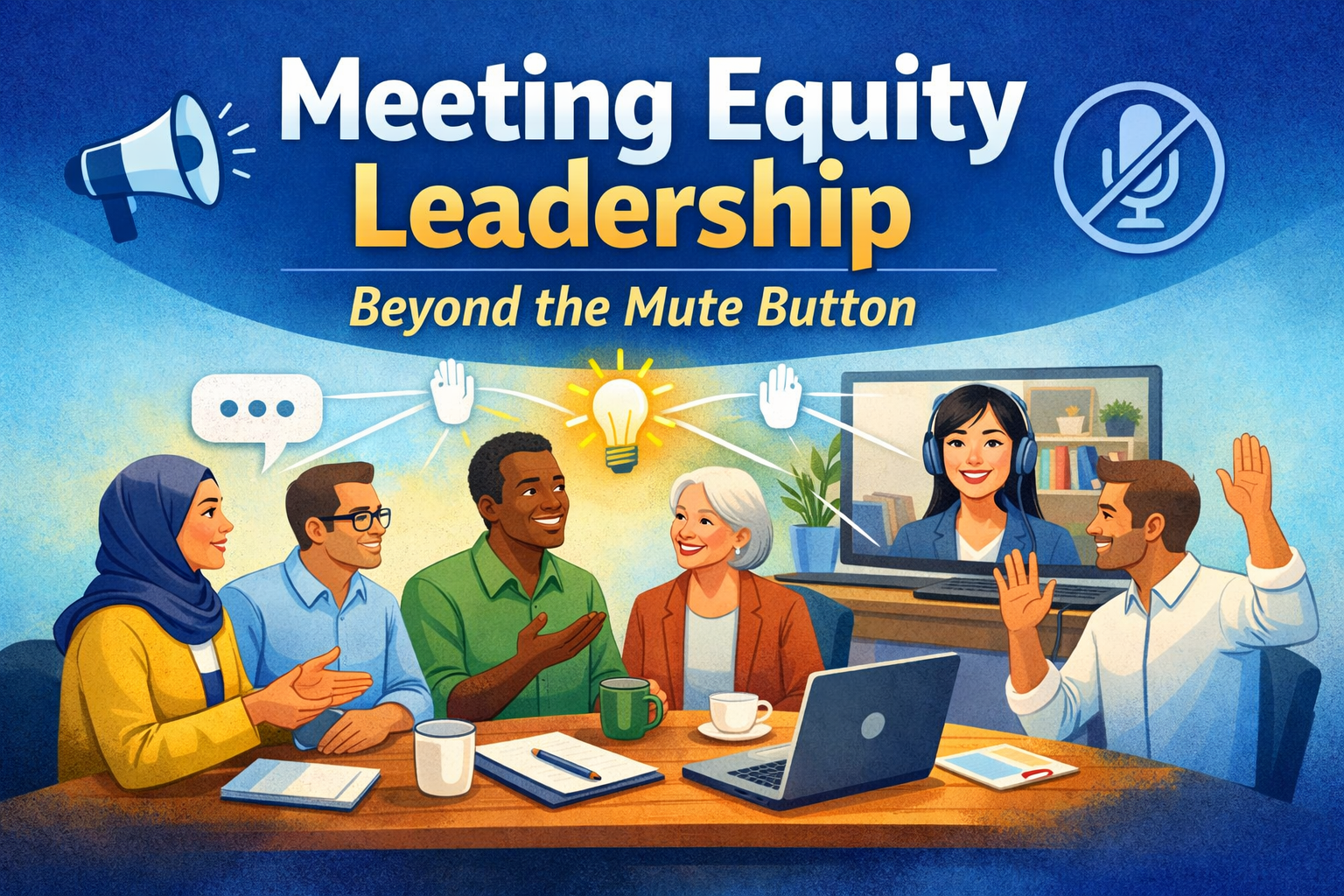
Have you ever sat in a meeting where a few people dominate while others quietly disappear into the background?
Maybe you’ve seen it in online calls—cameras off, mics muted, ideas unspoken. Or in physical rooms where hierarchy silently decides who gets heard. You nod along, but deep inside, you wonder—Is this really collaboration?
This is exactly where Meeting Equity Leadership comes in.
In today’s rapid fire age, hybrid work culture, meetings are everywhere. Yet, most of them fail to create equal participation, psychological safety, and shared ownership. According to research from Harvard Business School, up to 70% of meeting time is dominated by a few individuals. That means the majority of voices remain unheard.
As a trainer working with teams across corporate and community sectors, I’ve personally seen how small changes in meeting culture can completely transform team energy. One rural women’s group I worked with went from silent participation to active decision-making—simply by restructuring how meetings were facilitated.
That’s the power of Meeting Equity Leadership.
This guide is not just theory. It’s a deep, practical roadmap backed by behavioral science, real-life experiences, and actionable tools you can start using today.
Let’s move beyond the mute button—and create meetings where every voice counts.
What Is Meeting Equity Leadership?
Meeting Equity Leadership is the practice of designing and facilitating meetings where every participant has a fair opportunity to contribute, influence, and be heard.
How Does Meeting Equity Leadership Work in Virtual Meetings?
Virtual meetings need extra care.
Challenges:
Camera fatigue
Silent participants
Multitasking
Solutions:
Use chat actively
Polls and reactions
Smaller breakout rooms
👉 Always ask: “Who hasn’t had a chance to speak?”
Common Mistakes in Meeting Equity Leadership
Avoid these:
Assuming silence means agreement
Ignoring introverts
Over-structuring meetings
Not following up
Meeting Equity Leadership vs Traditional Leadership
Traditional
Meeting Equity Leadership
Leader speaks most
Everyone participates
Hierarchy-driven
Inclusion-driven
Passive attendees
Active contributors
Fixed roles
Shared ownership
Powerful Quotes to Remember
“Inclusion is not bringing people into what already exists—it’s creating something new.”
“A meeting is successful when everyone feels heard—not just when decisions are made.”
Practical Exercises to Build Meeting Equity Leadership
Exercise 1: 1-Minute Voice Round
Everyone speaks for 1 minute.
Exercise 2: Silent Brainstorming
Write ideas before speaking.
Exercise 3: Rotate Leader
New facilitator every meeting.
How Leaders Can Build Meeting Equity Culture
Model inclusive behavior
Reward participation
Train teams regularly
Use feedback loops
Conclusion: The Future of Meetings Is Equitable
Meetings are not just about agendas—they are about people.
When you practice Meeting Equity Leadership, you unlock:
Hidden ideas
Untapped potential
Stronger teams
You move from control → collaboration From silence → expression From hierarchy → humanity
👉 And that’s where real transformation begins.
Thank you for exploring this insightful article. If you’re hungry for more knowledge, don’t miss out on our other engaging articles waiting for you. Dive into our treasure trove of wisdom and discover new perspectives on related topics. Click ‘Our Blog’ and ‘How to Guide’ to embark on your next adventure. Happy reading!
FAQs: Meeting Equity Leadership
1. What is Meeting Equity Leadership in simple terms?
It means creating meetings where everyone gets a fair chance to speak, share ideas, and influence decisions. It focuses on inclusion, fairness, and participation rather than hierarchy or dominance.
2. Why is Meeting Equity Leadership important?
Because many meetings silence valuable voices. When everyone participates, decisions improve, engagement increases, and teams become more innovative and collaborative.
3. How can I implement Meeting Equity Leadership quickly?
Start with simple steps—use round-robin speaking, encourage quieter members, and set clear rules for participation. Small changes create big impact.
4. What are the biggest barriers to Meeting Equity Leadership?
Hierarchy, dominant personalities, lack of facilitation skills, and poor meeting design are the main barriers that prevent equitable participation.
5. Is Meeting Equity Leadership only for corporate teams?
No. It works in community groups, NGOs, classrooms, and even family discussions—anywhere people come together to make decisions.
6. How does Meeting Equity Leadership improve productivity?
By reducing wasted time, increasing engagement, and ensuring better decisions, meetings become more efficient and outcome-focused.
7. Can introverts benefit from Meeting Equity Leadership?
Absolutely. It creates structured opportunities for introverts to share ideas without pressure or interruption.
8. What tools support Meeting Equity Leadership?
Tools like Mentimeter, Miro, Zoom polls, and shared documents help ensure equal participation and engagement.
9. How can leaders measure Meeting Equity Leadership success?
By tracking participation levels, feedback scores, and quality of decisions made during meetings.
10. What is the future of Meeting Equity Leadership?
With hybrid work rising, equitable meetings will become essential for effective collaboration and team success.
Every relationship, no matter how strong, faces conflict. It’s inevitable. Two individuals, shaped by different experiences, beliefs, and emotional patterns, will not always see eye to eye. But here’s the truth most couples miss:
Conflict is not the problem. The way we communicate during conflict is.
Have you ever found yourself saying things you didn’t mean? Or shutting down instead of expressing what you truly feel? Maybe you’ve experienced arguments that spiral out of control, leaving both partners hurt, misunderstood, and emotionally distant.
This is where A Non-Violent Communication Guide for Couples becomes a life-changing approach.
Developed by psychologist Marshall Rosenberg, Non-Violent Communication (NVC) is a powerful framework rooted in empathy, emotional awareness, and conscious expression. It shifts conversations from blame and criticism to understanding and connection.
In my years as a trainer working with couples and individuals, I’ve seen one simple truth repeatedly:
Couples don’t break because of problems—they break because of poor communication patterns.
This article is not just theory. It combines behavioral science, real-life coaching insights, and practical tools that you can apply immediately.
By the end, you’ll learn how to:
Turn arguments into meaningful conversations
Express needs without hurting your partner
Listen deeply and build emotional safety
Strengthen your bond—even during disagreements
Let’s dive into A Non-Violent Communication Guide for Couples and transform the way you connect.
Understanding Non-Violent Communication (NVC)
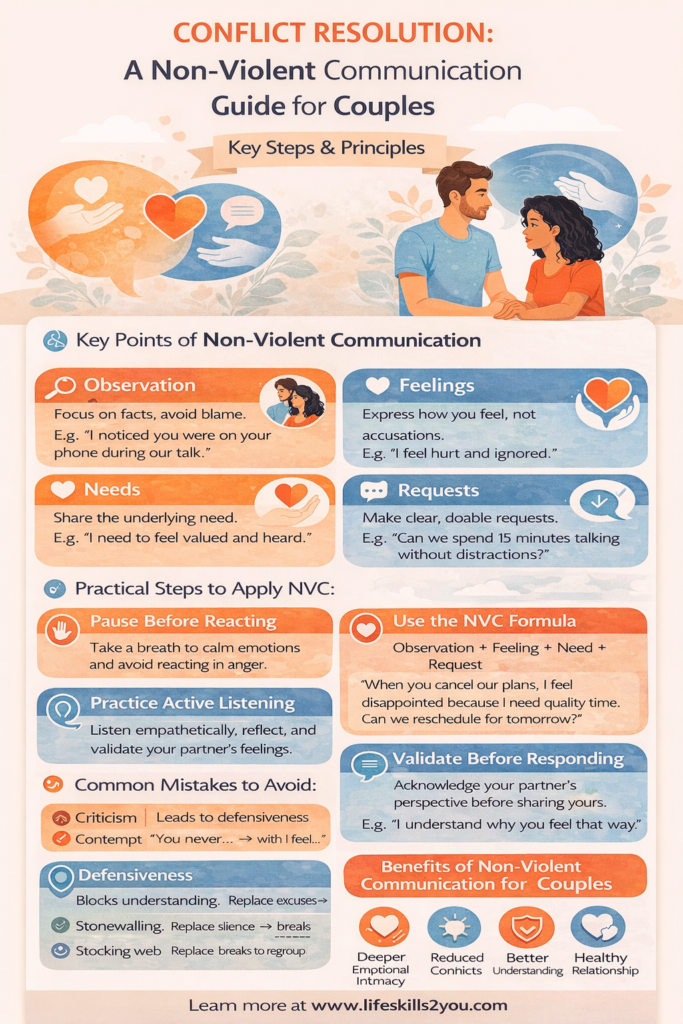
At its core, A Non-Violent Communication Guide for Couples is based on four key components:
1. Observation (Without Judgment)
Instead of blaming:
❌ “You never listen to me!”
✅ “When I was talking, I noticed you were on your phone.”
👉 This removes defensiveness and creates clarity.
2. Feelings (Not Accusations)
❌ “You make me angry.”
✅ “I feel hurt and ignored.”
👉 You own your emotions instead of projecting them.
3. Needs (The Root Cause)
Every feeling is connected to a need.
Need for respect
Need for attention
Need for appreciation
👉 Most conflicts are unmet needs in disguise.
4. Requests (Not Demands)
❌ “You should care more!”
✅ “Can we spend 15 minutes daily talking without distractions?”
👉 Clear, actionable, and respectful.
Why Couples Struggle with Communication
Even intelligent, loving couples struggle. Why?
1. Emotional Triggers
Your reactions are often rooted in past experiences.
2. Ego Defense Mechanisms
Blame, criticism, and withdrawal protect the ego—but damage the relationship.
3. Lack of Emotional Vocabulary
Many people simply don’t know how to express feelings clearly.
👉 A Non-Violent Communication Guide for Couples aligns with Emotional Intelligence (EQ) and Attachment Theory.
Key Insight:
“Behind every angry reaction is an unmet need.”
Step-by-Step: Applying A Non-Violent Communication Guide for Couples
Step 1: Pause Before Reacting
In training sessions, I always teach:
“Respond. Don’t react.”
Take 10 seconds. Breathe. Reset.
Step 2: Use the NVC Formula
Observation + Feeling + Need + Request
Example:
“When you cancel our plans (observation), I feel disappointed (feeling) because I value quality time (need). Can we reschedule for tomorrow? (request)”
“In every argument, there are two sides—and one opportunity for growth.”
Advanced Techniques for Deeper Connection
1. Emotional Check-Ins
Ask daily:
“How are you feeling today?”
2. Weekly Relationship Meetings
Discuss:
What worked
What didn’t
What can improve
3. Empathy Practice
Try to feel what your partner feels.
Scientific Backing & References
Marshall Rosenberg – Nonviolent Communication Model
Gottman Institute – Relationship Research
Harvard Health Publishing – Emotional Intelligence
WHO – Mental health and relationships
UNICEF – Communication frameworks
Conclusion: Transform Conflict into Connection
Conflict is not the enemy. Silence, misunderstanding, and ego are.
A Non-Violent Communication Guide for Couples teaches us something powerful:
“When we change the way we communicate, we change the quality of our relationships.”
Start small:
Listen more
Blame less
Express clearly
Connect deeply
Your relationship doesn’t need perfection—it needs understanding.
Thank you for exploring this insightful article. If you’re hungry for more knowledge, don’t miss out on our other engaging articles waiting for you. Dive into our treasure trove of wisdom and discover new perspectives on related topics. Click ‘Our Blog’ and ‘How to Guide’ to embark on your next adventure. Happy reading!
FAQs: A Non-Violent Communication Guide for Couples
1. What is Non-Violent Communication in relationships?
It’s a communication approach that focuses on empathy, understanding, and expressing needs without blame or criticism. It helps couples resolve conflicts peacefully.
2. Can NVC really reduce conflicts?
Yes. Studies show that empathetic communication reduces defensiveness and increases connection, leading to fewer and healthier conflicts.
3. How long does it take to see results?
With consistent practice, couples often notice improvements within a few weeks.
4. Is NVC difficult to learn?
Initially, it requires awareness and practice, but it becomes natural over time.
5. What if my partner doesn’t cooperate?
Start with yourself. Communication patterns often shift when one partner changes.
6. Can NVC help in long-distance relationships?
Absolutely. Clear and empathetic communication is even more important in distance-based relationships.
7. Does NVC mean avoiding conflict?
No. It means handling conflict constructively.
8. Is NVC backed by science?
Yes. It aligns with emotional intelligence, psychology, and behavioral research.
9. Can NVC improve emotional intimacy?
Yes. It builds trust, openness, and deeper connection.
10. How can I practice daily?
Use the 4-step formula: Observation, Feeling, Need, Request.
Have you ever sent a simple message like “Okay.” and instantly worried… Did I sound rude? Was I too cold?
Welcome to the world of Digital Non-Verbal Cues—the invisible signals that shape how your words are felt, not just read.
In face-to-face communication, we rely heavily on body language, tone of voice, eye contact, and gestures. But what happens when communication shifts to screens? Emails, WhatsApp messages, Zoom calls, Slack chats—suddenly, the physical cues disappear. Yet, communication doesn’t become neutral. Instead, it evolves.
That’s where Digital Non-Verbal Cues come into play.
These cues include typing speed, punctuation, emoji use, message timing, capitalization, formatting, and even silence. They silently convey emotions, intent, authority, and relationship dynamics. In fact, according to research in communication psychology, over 60% of perceived meaning in communication comes from non-verbal elements—even in digital spaces, our brains try to fill in the gaps.
As a trainer and communication coach, I’ve seen countless professionals struggle not because of what they said—but how it was interpreted digitally. One corporate leader I worked with nearly damaged a key client relationship simply because his short, abrupt emails were perceived as dismissive.
This guide will help you understand, decode, and master Digital Non-Verbal Cues so you can:
“In the digital world, how you say it matters more than what you say.”
Let’s dive into this powerful, often overlooked skill.
Step1: Understanding Digital Non-Verbal Communication
What Are Digital Non-Verbal Cues?
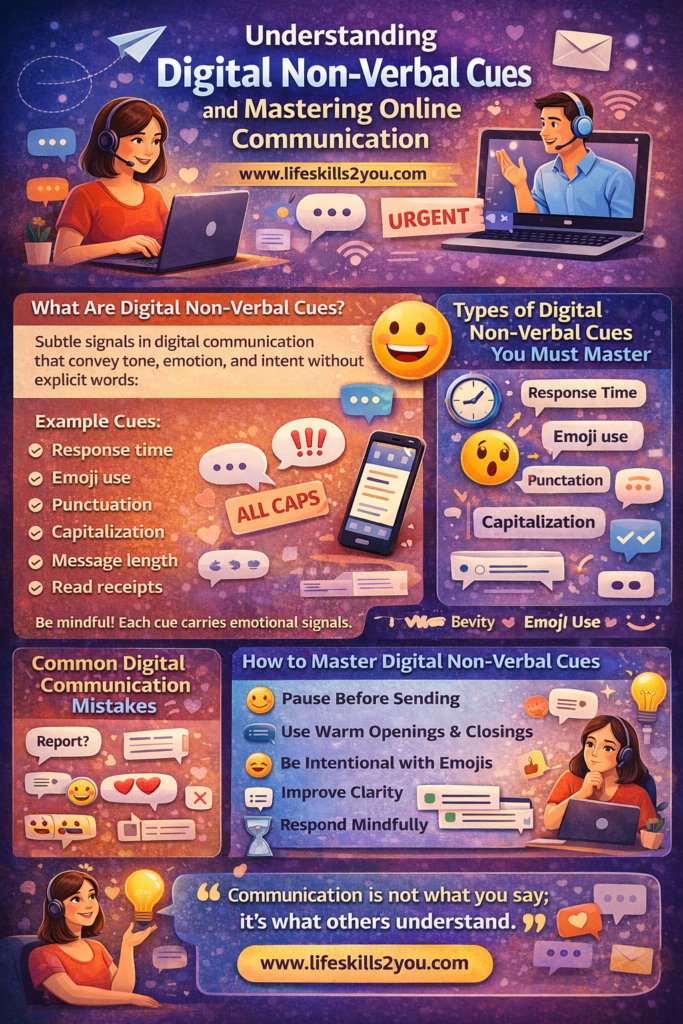
Digital Non-Verbal Cues are the subtle signals embedded in digital communication that convey tone, emotion, and intent without explicit words.
Examples of Digital Non-Verbal Cues
Message length (short vs detailed)
Response time
Use of emojis 😊
Punctuation (!!! vs .)
Capitalization (ALL CAPS = shouting)
Formatting (bold, spacing, bullet points)
Read receipts and seen indicators
These are part of digital body language, a concept widely discussed in modern communication psychology and highlighted in research from platforms like Harvard Business Review on virtual communication effectiveness.
Why Digital Non-Verbal Cues Matter More Than Ever
In today’s remote and hybrid work culture, Digital Non-Verbal Cues are often the only signals people rely on.
Psychological Impact
Our brains are wired to interpret tone and emotion. When cues are missing, we:
Assume negative intent
Misinterpret neutrality as rudeness
Fill gaps based on past experiences
Key Insight
Silence in digital communication is not neutral—it is interpreted.
Step2: Types of Digital Non-Verbal Cues You Must Master
1. Timing as a Communication Signal
Response Time Matters
Immediate reply → Interest, urgency
Delayed reply → Disinterest or disrespect
Real-Life Example 1
A manager I coached delayed responses to team messages. Employees assumed he was ignoring them, leading to disengagement. Once he improved response timing, team morale improved significantly.
2. Punctuation and Tone
The Power of a Period
“Thanks.” → Cold
“Thanks!” → Warm
“Thanks 😊” → Friendly
Micro-differences, massive impact
These subtle Digital Non-Verbal Cues can completely change emotional interpretation.
3. Emojis and Emotional Context
Emotional Amplifiers
Emojis act as tone indicators:
😊 → Friendly
👍 → Agreement (or sometimes passive acknowledgment)
😐 → Neutral or awkward
Real-Life Example 2
A client used “👍” frequently. His team perceived it as dismissive. Switching to short responses improved clarity and connection.
People tend to interpret neutral messages negatively.
Example
“Noted.” → Often perceived as passive-aggressive
Step 6: How to Master Digital Non-Verbal Cues (Action Plan)
1. Pause Before Sending
Ask:
How will this be interpreted?
Is my tone clear?
2. Use Warm Openings and Closings
Examples:
“Hope you’re doing well”
“Appreciate your help”
3. Match Tone with Context
Formal → Emails
Casual → Chats
4. Be Intentional with Emojis
Use sparingly in professional settings.
5. Improve Clarity
Use:
Bullet points
Clear instructions
6. Respond Mindfully
Even a quick acknowledgment helps.
Step 7: Motivational Insight
“Communication is not what you say; it’s what others understand.”
Mastering Digital Non-Verbal Cues is not just a skill—it’s a competitive advantage in the modern world.
Conclusion
In a world dominated by screens, Digital Non-Verbal Cues are your hidden language of influence. They shape perception, build trust, and define relationships.
By becoming aware of these subtle signals, you can:
Communicate with clarity
Avoid misunderstandings
Build stronger professional and personal connections
Remember, every message you send carries more than words—it carries you.
Thank you for exploring this insightful article. If you’re hungry for more knowledge, don’t miss out on our other engaging articles waiting for you. Dive into our treasure trove of wisdom and discover new perspectives on related topics. Click ‘Our Blog’ and ‘How to Guide’ to embark on your next adventure. Happy reading!
FAQs: Digital Non-Verbal Cues
1. What are Digital Non-Verbal Cues?
They are subtle signals like emojis, timing, punctuation, and formatting that convey tone and emotion in digital communication.
2. Why are Digital Non-Verbal Cues important?
They help prevent misunderstandings and improve clarity, especially in remote communication.
3. Can emojis be used professionally?
Yes, but in moderation. They should match the context and audience.
4. How does response time affect communication?
Quick responses show engagement, while delays may signal disinterest.
5. What is digital body language?
It refers to how tone and intent are expressed through digital behavior.
6. Why do people misinterpret messages online?
Because of lack of physical cues and the brain’s tendency toward negative assumptions.
7. How can I improve my digital communication?
Focus on clarity, tone, structure, and timely responses.
8. Are short messages always bad?
No, but they can seem abrupt if not balanced with politeness.
9. What role does emotional intelligence play?
It helps you understand how your message will be perceived.
10. Can Digital Non-Verbal Cues impact career growth?
Absolutely. Strong communication skills improve leadership, teamwork, and influence.
This article is your comprehensive guide to doing just that. We’re going to dive deep into how to stop absorbing other people’s stresswith 7 simple steps and build the inner fortress you deserve. This is not about becoming cold or uncaring; it’s about becoming a strong, clear channel of support without becoming a sponge. It’s about mastering the crucial life skills that allow your empathy to be your superpower, not your secret weakness.
Have you ever walked into a room feeling perfectly fine, only to leave feeling heavy, anxious, or inexplicably overwhelmed?
Perhaps you spent an hour with a friend who was venting about their challenging week, and later, you found yourself tossing and turning at 3 AM, your mind replaying their worries as if they were your own. Or maybe you simply scrolled through social media and suddenly felt the weight of the world—the general anxiety, the collective tension—settle directly into your chest.
If this sounds familiar, you are not alone. And more importantly, there’s a powerful reason for it: you are likely a Highly Sensitive Person (HSP), or simply someone with a profound capacity for empathy. Our emotional radar is so finely tuned that we don’t just observe emotions; we often feel them, absorb them, and accidentally carry them around.
It feels like a curse sometimes, doesn’t it? As a professional trainer and content creator, I’ve worked with countless individuals and organizational leaders who describe this same crippling empathy. They are deeply kind, intuitive, and gifted, but they struggle because they haven’t learned the fundamental life skills of emotional boundary setting. They confuse compassion (caring about someone) with absorption (taking on their burden). The result is chronic fatigue, burnout, and a constant, low-level buzz of borrowed anxiety.
This isn’t just an inconvenience; it’s a sustainable crisis. When you constantly run on borrowed stress, you quickly deplete your own emotional and physical resources. You lose the ability to help others effectively because you’re running on empty, and you lose the ability to live your own life with joy and clarity. The most compassionate thing you can do—for yourself and for others—is to create an energetic firewall.
Are you ready to stop carrying burdens that aren’t yours? Let’s start building those boundaries together.
🛡️ Step 1: Master the Art of Self-Identification and Acceptance
The very first and most powerful step in stopping the absorption of other people’s energy is a simple one: Acknowledge and accept your sensitivity. You cannot build a shield around a problem you haven’t fully named. This is a foundational life skill that grounds all others.
The HSP Trait: Your Superpower, Not Your Flaw
You may have heard of Dr. Elaine Aron’s research on the Highly Sensitive Person (HSP). Approximately 15–20% of the population possess a nervous system that processes information—both external and emotional—more deeply and thoroughly than others. This depth of processing is what makes you an excellent listener, a perceptive friend, and often, a highly effective leader or creative. It is also why you may feel like a raw nerve when surrounded by strong emotions.
The key to this step is reframing. Many sensitive people spend years trying to “toughen up” or “be less emotional.” I want you to reject that notion entirely. Your sensitivity is a strength, but like any strength, it requires strategic management. When you stop fighting your nature, you can start working with it.
Actionable Insight: Start a “Sensitivity Journal.” For one week, instead of criticizing yourself when you feel overwhelmed, simply observe and write down: “I am feeling [X emotion], and I believe it originated from [Y situation/person].” This practice separates your feelings from absorbed feelings.
Emotional Overload and Why It Happens
Emotional overload isn’t just stress; it’s a state where your system, having processed too many external stimuli (be it noise, lights, or intense emotions), enters a state of high alert. When you absorb a friend’s anxiety about a deadline, your brain treats it as if you have that deadline. Your sympathetic nervous system responds with the fight-or-flight response, generating real physical symptoms like a tight chest, shallow breathing, or a headache—all for a problem that isn’t actually yours. Recognizing this physiological mechanism is a fundamental life skill for self-regulation.
🧱 Step 2: Implement the ‘Energy Firewall’ Visualization Technique
One of the most effective, immediate life skills you can use when entering a challenging environment (a difficult meeting, a crowded store, a family gathering) is a simple, five-second visualization.
How to Build Your Invisible Shield
Before you engage with the source of stress, visualize a protective boundary around you. This is not a metaphysical exercise; it’s a powerful tool for mentally separating your energy field from others.
The Sphere of Calm: Close your eyes briefly (or look down) and visualize a beautiful, calming sphere of light that completely surrounds you—like a bubble, a force field, or a cocoon. Choose a color that represents calm to you (e.g., deep blue, gentle gold, soft green).
The Permission Statement: Mentally affirm: “This is my space. I am compassionate, but I do not absorb. I am here to listen and support, but I will not carry this burden.”
The Porous Barrier: Crucially, visualize this sphere as a barrier that is porous in one direction: your compassion and support can flow out to the other person, but their intense, chaotic energy cannot penetrate in. It bounces gently off the surface.
This simple ritual programs your subconscious mind to be in an observational, supportive state rather than an absorbent, sponge-like one. It’s an immediate activation of a core life skill: conscious disengagement.
Real-Life Example 1: The Distressed Colleague
Situation: Your colleague, Brenda, rushes to your desk in tears over a project failure. Her distress is immediate and intense.
Action: As she approaches, you briefly engage your Energy Firewall. You listen actively, offering a supportive phrase like, “That sounds incredibly hard, Brenda,” but you mentally remain inside your calm sphere. You support her search for a solution without letting her desperation hijack your internal state. You offer a clear boundary: “I can help you review the report, but I need 10 minutes to finish this email first.” Your calm becomes her anchor, rather than her distress becoming your chaos.
🚫 Step 3: Define and Enforce Verbal and Physical Boundaries
While Step 2 is about internal, energetic boundaries, this step focuses on the necessary life skills of external, actionable boundaries. Absorbing stress often happens when we allow others to monopolize our time, space, or emotional energy without limit.
The Power of the ‘Exit Strategy’ and ‘Time Cap’
When dealing with a known source of stress or an emotionally draining person, you need a proactive plan—not a reactive one.
The Time Cap: Before a meeting or a phone call with a “venter,” set a mental or physical time cap. Announce it gently: “I have 20 minutes before my next commitment, but I’d love to focus on this until then.” This gives you a clear, guilt-free exit.
The Shift: When a conversation has descended into repetitive negative venting, shift the energy. Use the life skill of redirecting. You can say: “I hear how frustrated you are. Let’s switch gears: what is one small thing you can do right now to move forward?” This moves the focus from problem absorption to solution orientation.
Physical Distance: Do not underestimate the power of physical space. In an office setting, you may need to close your door or put on noise-canceling headphones. In a social setting, literally take one step back during intense conversation. Respecting your need for space is a fundamental life skill that prevents absorption.
Motivational Quote: “When we fail to set boundaries and hold people accountable, we feel used and mistreated.” – Brené Brown.
🧘 Step 4: Use ‘Grounding’ Techniques to Release Borrowed Energy
Even with the best boundaries, some external energy will seep in. This is where the life skill of grounding becomes vital. Grounding is any intentional practice that quickly brings your consciousness back into your body and the present moment, releasing the borrowed energy back to the earth.
The 5-4-3-2-1 Sensory Technique
This simple technique is a fast-acting antidote to feeling unmoored or highly agitated by external stressors:
5: Name five things you can see (the color of the wall, a picture, your keyboard).
4: Name four things you can touch (the fabric of your shirt, the texture of the chair, the smooth desk).
3: Name three things you can hear (the distant traffic, the clock ticking, your own breathing).
2: Name two things you can smell (coffee, hand lotion).
1: Name one thing you can taste (the lingering taste of your morning tea).
By forcing your mind to focus on objective, external reality, you interrupt the emotional feedback loop of the absorbed stress. You are asserting: “I am here, in my body, now. I am safe.” This is a powerful, practical life skill that anyone can deploy in seconds.
Real-Life Example 2: The Stressful News Cycle
Situation: You find yourself mindlessly scrolling through the news, and the cumulative anxiety from various global or local events starts to leave you feeling anxious and hopeless—a form of collective stress absorption.
Action: Close the tab. Stand up and do a quick grounding exercise. Focus on your feet on the floor. Wiggle your toes. Drink a glass of water slowly, noting the coolness. You are physically asserting control and releasing the borrowed chaos of the screen.
Self-Regulation and Nervous System Reset
The goal of grounding is self-regulation. The absorbed stress triggers an alarm in your nervous system. Grounding acts like a reset button. Other powerful techniques include deep, controlled breathing (Box Breathing: inhale for 4, hold for 4, exhale for 4, hold for 4) or physically shaking your limbs for 30 seconds to release tension. The more you practice these life skills, the faster your nervous system learns to downshift from alert to calm.
💬 Step 5: Practice the “Empathy, Not Sympathy” Approach
Understanding the subtle yet profound difference between empathy and sympathy is perhaps the most crucial life skill for highly sensitive people.
Sympathy: Means you feel for them. You enter the pit of despair with them. This is the act of stress absorption.
Empathy: Means you understand their feeling. You stand at the edge of the pit, acknowledge their pain, and offer a rope. This is the act of compassionate boundary.
When you offer empathy, you validate the other person’s experience without claiming it as your own. Your mantra shifts from “Oh, I feel that way too” to “I recognize that feeling, and I’m here to support you through it.”
The “It’s Their Emotion, Not My Experience” Frame
This requires a conscious shift in your internal dialogue. When a friend is complaining about a difficult boss, a sympathetic response (“That’s awful, I’d be devastated too”) drags you down. An empathetic, boundary-setting response (“That sounds incredibly frustrating. What would you like to see happen next?”) keeps you separate and action-oriented.
External Reference 1: For more on the difference, I recommend exploring the widely cited work by Dr. Brené Brown on the power of vulnerability and empathy. Her research clearly distinguishes between the two concepts, proving that empathy is far more helpful than sympathy, which often leaves the other person feeling pitied, not understood.
This shift ensures that your powerful emotional intelligence remains a resource for the person in need, rather than becoming a drain on your own resources.
Real-Life Example 3: The Child’s Overreaction
Situation: Your child (or niece/nephew) is having a huge meltdown over a broken toy. Their distress is intense and loud, and you can feel your own tension rising in response.
Action: Instead of absorbing their panic, you validate: “I see you are really upset about your toy. That is a very sad feeling.” You then use a core life skill by shifting to the practical: “Let’s take three deep breaths together, and then we will figure out how to fix it.” You acknowledged the emotion but refused to join the emotional chaos, offering a calm, regulated presence instead.
The biggest mistake highly sensitive people make is trying to fit into a non-sensitive world without building in mandatory recovery time. If you know you are prone to absorbing stress, decompression is not a luxury; it is a vital, non-negotiable life skill for sustainable functioning.
The 20/20 Rule of Recovery
Think of your emotional state like a phone battery. If you spend an hour with a draining person, you need to budget at least a 20-minute de-stressing or decompression period afterward. If you’ve been in a high-intensity environment (like an all-day conference or a busy family weekend), you might need a full 20 hours of quiet, solitary time afterward.
Your Decompression Non-Negotiables:
Silence: This is your best tool. At least 15 minutes of pure silence (no music, no podcast, no TV) in a quiet room.
Nature: Stepping outside, even for five minutes, reconnects you with the grounding energy of the earth and shifts your focus outward.
Sensory Reset: A hot shower or bath is excellent for physical release. Water is powerfully cleansing; visualize the stress washing off your skin and down the drain.
This is a proactive life skill that requires planning. Block out time in your calendar for “Quiet Recovery,” just as you would for an important meeting. Treat this time with the respect it deserves. This proactive approach prevents the cumulative build-up of absorbed stress.
🔄 Step 7: Build a Roster of ‘Personal Energy Anchors’
To stop absorbing stress, you need reliable practices that immediately restore your internal equilibrium. These are your personal life skills that remind you of your core strength and happiness.
Identifying Your Joy Triggers
What activities, scents, sounds, or people instantly make you feel like you again?
The Go-To Playlist: Have a playlist of music that instantly elevates your mood or calms your system. This is an immediate buffer against absorbed negativity.
A Comfort Object/Spot: A favorite mug, a cozy blanket, or a specific chair in your home that is reserved for pure comfort. This designated spot acts as a safe harbor from the external world.
The Accountability Partner: Have a friend or partner (not the person you’re trying to help, but an outside party) you can text a simple code word to (e.g., “Sponge Mode”) when you feel yourself absorbing too much. They can remind you of your boundaries.
Real-Life Example 4: The Client Meeting Recovery
Situation: You just finished a high-stakes, stressful meeting with a demanding client who was highly critical and anxious. You feel tense and agitated, and the absorbed negativity is starting to affect your outlook for the rest of the day.
Action: You immediately deploy your Energy Anchor: You head straight to your car, put on your ‘Calm Down’ playlist, and do 5 minutes of Box Breathing before driving away. You stop at a park, walk for 10 minutes, and consciously perform the 5-4-3-2-1 Grounding Technique. This routine prevents the absorbed stress from transferring to your family when you get home.
Emotional Resilience Through Active Practice
Ultimately, the mastery of these life skills leads to emotional resilience. Resilience isn’t the ability to avoid bad things; it’s the ability to bounce back quickly from emotional challenges, whether they are your own or absorbed from others. By actively practicing grounding, boundary setting, and self-care, you are strengthening your emotional core, making you less susceptible to the chaos around you.
External Reference 2: For more evidence-based practices on building resilience, The American Psychological Association (APA) has extensive resources on building emotional resilience that emphasize the importance of making connections and taking care of your body.
The Final Piece of the Puzzle: Setting a Daily Intentional Focus
The most advanced life skill in stress absorption prevention is proactive self-management. This involves starting your day with a clear intention that acts as a rudder for your emotional ship, guiding you through the day’s turbulence.
The Morning ‘Non-Absorption’ Affirmation
Before you check your phone, before you engage with the outside world, take one minute to set your energetic tone. This prevents you from starting the day in a reactive state.
Affirmation:“I am centered. I am calm. I will engage with the world with love and compassion, but I will not take on any stress or burden that is not mine to carry. My empathy is a gift, and my boundaries are my strength.”
This is a powerful life skill because it anchors your focus. It reminds your subconscious mind of your commitment to self-preservation before external demands begin to chip away at your resolve. It’s an act of sovereignty over your own emotional landscape.
Cultivating Compassionate Detachment
The goal is not to be detached from people, but to be detached from outcome and chaos. Compassionate detachment is the ability to care deeply while maintaining internal separation. It means loving and supporting your friend without needing their problem to be solved right now in order for you to feel okay. It is a mature life skill that understands everyone is on their own journey. You can cheer them on and offer water, but you cannot run the race for them.
Real-Life Example 5: Maintaining Professional Distance
Situation: As a manager or team leader, you have an employee constantly underperforming due to severe personal issues. You feel their stress about potentially losing their job and are absorbing the fear, leading to loss of sleep.
Action: You use the life skill of compassionate detachment. You address the performance gap clearly and professionally (your job) while offering appropriate resources (EAP, time off). You maintain that their professional path is theirs to walk, and your role is to define the boundary of the job requirement. You care deeply about them as a person, but you detach from the outcome of their current crisis. This allows you to sleep soundly, knowing you did your job with integrity and compassion, without sacrificing your well-being.
Integrating Your New Life Skills for Lasting Change
Learning these strategies—from the energetic shield to verbal boundary setting—is not a one-time fix. They are life skills that require daily practice, much like physical fitness. You will have days where you slip up, where an intense interaction leaves you feeling drained, and that is okay. The resilience is in the recovery.
The Self-Correction Loop
When you realize you’ve absorbed stress, don’t beat yourself up. Activate the Self-Correction Loop:
Acknowledge:“I realize I just absorbed that tension from the conversation.”
Ground: Immediately perform the 5-4-3-2-1 technique or deep breathing.
Release: Use the physical release method—a strong stretch, a quick walk, or the water visualization.
Re-Affirm: State your boundary again: “That was their stress. I am releasing it now. I am centered.”
By making this loop a habit, you reduce the duration of the absorbed stress, which is often more important than preventing the initial seep. The ultimate goal of mastering these life skills is to move from being a stress sponge to being a stress filter. A sponge soaks it all up and becomes heavy; a filter processes it and lets the clean water (your own energy and calm) pass through.
Conclusion
We have explored seven simple, yet profoundly powerful life skills designed specifically to help you stop absorbing other people’s stress. You now know that your sensitivity is not a curse, but a gift that requires boundaries—your personal Energy Firewall. From the power of visualization and the strategic use of grounding, to the essential difference between empathy and sympathy, you have a toolkit for reclaiming your emotional space. Remember, setting a boundary is not an act of selfishness; it is an act of self-preservation, which allows you to show up for others from a place of genuine strength, not depletion. Embrace the concept of emotional resilience as your new normal. Begin today by practicing just one of these techniques. Your energy is precious. Guard it fiercely.
Notice
The information provided in this article is for informational and educational purposes only. It is not intended as a substitute for professional medical advice, diagnosis, or treatment. Always seek the advice of your physician, mental health professional, or other qualified health provider with any questions you may have regarding a medical or psychological condition.
Thank you for exploring this insightful article.
If you’re hungry for more knowledge, don’t miss out on our other engaging articles waiting for you. Dive into our treasure trove of wisdom and discover new perspectives on related topics.
FAQ’s on 7 Simple Steps to Stop Absorbing Other People’s Stress
Q1: Is absorbing stress a permanent problem for HSPs?
A: No, it is a learned pattern of boundary failure. By consistently practicing the life skills of grounding and energetic shielding, you can train your nervous system to regulate itself, making the absorption of stress less frequent and less intense over time.
Q2: Will setting boundaries make me seem rude or cold to others?
A: Healthy boundaries are communicated with kindness and respect. True empathy is ruined by absorption. When you set a calm boundary, you are preserving your ability to be genuinely supportive without becoming a victim of the situation, which is ultimately more helpful.
Q3: What’s the fastest way to get rid of absorbed stress immediately?
A: The fastest method is a physical/sensory reset. Step away, do 10 deep box breaths, or use the 5-4-3-2-1 Grounding Technique. Physical activity, like shaking your limbs or a quick stretch, also immediately releases trapped nervous energy.
Q4: Can I use these techniques even if I’m not an HSP?
A: Absolutely. While this guide is tailored for high sensitivity, the life skills of visualization, boundary setting, and grounding are foundational tools for emotional resilience for anyone who deals with stressful people or environments.
Q5: How do I handle a family member who is constantly negative?
A: The key is physical and time boundaries. Limit the duration of the interaction, choose public places for meetings, and when they begin to vent, gently redirect to solutions or neutral topics. For example: “I hear you, but let’s talk about the good news from your job instead.”
Q6: Does diet affect my ability to absorb stress?
A: Yes. Your nervous system is less resilient when you are running on caffeine, sugar, or are dehydrated. A well-nourished body and stable blood sugar levels provide a stronger, more resilient buffer against external stress and boost your overall life skills capacity.
Q7: How can I tell the difference between my stress and absorbed stress?
A: Ask yourself: “Was I feeling this way five minutes before I interacted with this person or situation?” If the feeling came on suddenly or feels disproportionate to your personal circumstances, it is likely absorbed. Use this realization to activate your energy firewall.
Q8: What if I feel guilty after setting a boundary?
A: Guilt is a learned response, often tied to a fear of disappointing others. Recognize the guilt, validate the feeling, and then stand firm in the knowledge that you are prioritizing your long-term health, which is a key life skill. Guilt fades with consistent practice.
Q9: Can meditation help me stop absorbing stress?
A: Yes, daily meditation is one of the best life skills for this. It builds the skill of mindfulness, which is the ability to observe a feeling (like stress) without reacting to it or identifying with it. This creates the necessary separation to prevent absorption.
Q10: Should I tell people I am highly sensitive and need boundaries?
A: You don’t need to label yourself. You only need to communicate your needs clearly and kindly. Instead of “I can’t talk because I’m too sensitive,” say “I can listen for ten minutes, and then I need to get back to my work.” Focus on the action, not the trait.
Q9: Can meditation help me stop absorbing stress?
A: Yes, daily meditation is one of the best life skills for this. It builds the skill of mindfulness, which is the ability to observe a feeling (like stress) without reacting to it or identifying with it. This creates the necessary separation to prevent absorption.
Q10: Should I tell people I am highly sensitive and need boundaries?
A: You don’t need to label yourself. You only need to communicate your needs clearly and kindly. Instead of “I can’t talk because I’m too sensitive,” say “I can listen for ten minutes, and then I need to get back to my work.” Focus on the action, not the trait.
Have you ever looked at your bank balance and felt a rush of fear… even when nothing was actually “wrong”? Or found yourself hesitating to invest in something important — not because you lacked money, but because you didn’t feel you deserved to spend it?
If yes, you’re not alone. Across cultures, professions, and income levels, millions silently struggle with invisible mental barriers that hold them back from financial growth. Psychologists call these money scripts, subconscious stories that shape how you think, feel, and behave around money. They usually come from childhood, society, cultural conditioning, or past failures — and unless challenged, they become self-fulfilling limitations.
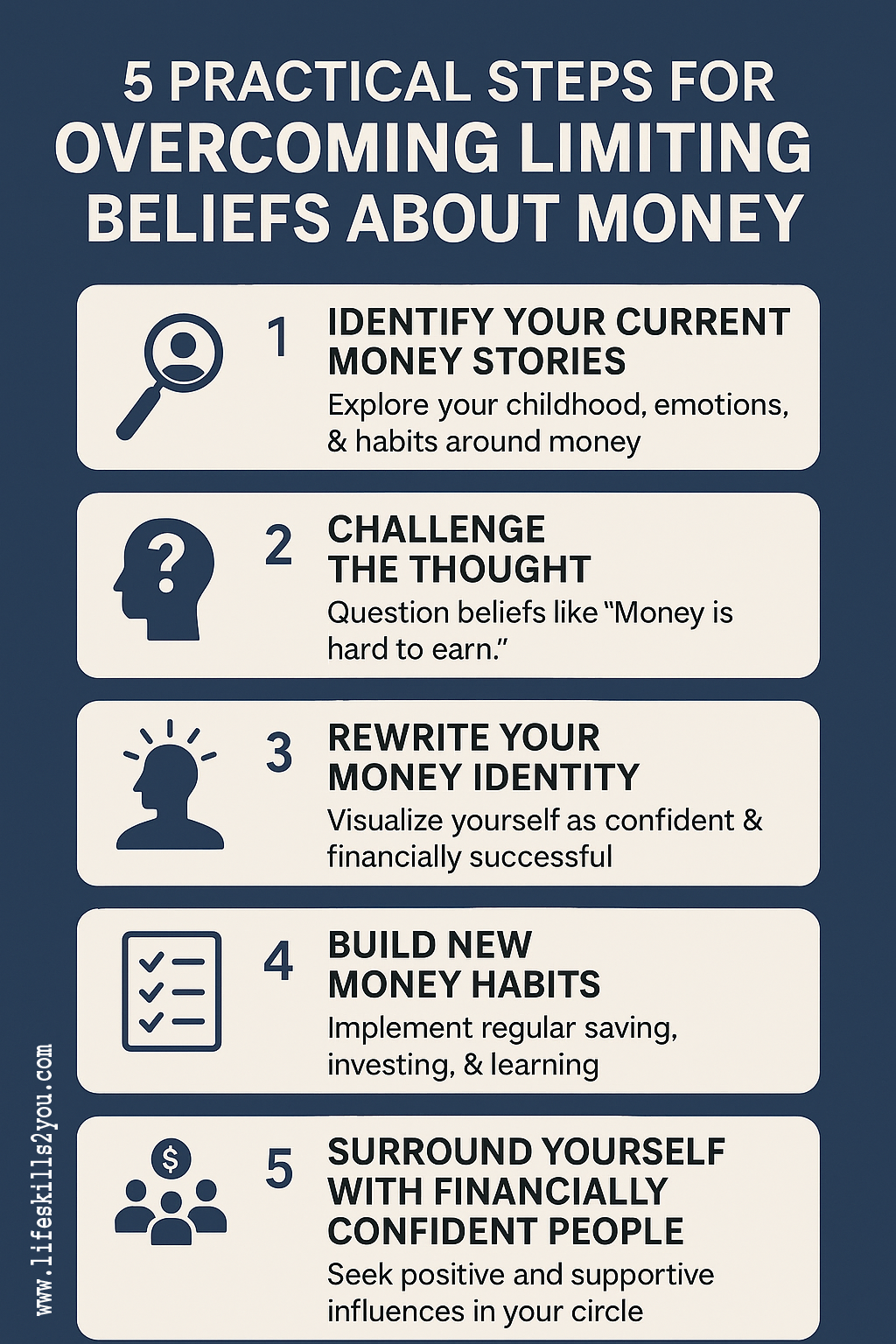
This article is a step-by-step transformation guide on overcoming limiting beliefs about money. Whether you’re a working professional, entrepreneur, student, or homemaker, your relationship with money influences your confidence, decisions, career growth, relationships, and overall wellbeing.
But here’s the empowering truth: 💡 Your beliefs about money are learned — which means they can be unlearned.
In my years of training individuals and teams across India, the Middle East, and Asia, I’ve coached thousands who carried self-defeating beliefs such as:
“Money is hard to earn.”
“I’ll never be wealthy like others.”
“If I make too much money, people will judge me.”
“I’m bad with money.”
“Wanting money means I’m greedy.”
What amazed me is that once these internal stories were rewritten, financial breakthroughs followed — promotions, cleared debts, new businesses, better negotiation skills, and improved decision-making. Behavioural science supports this: According to research from the American Psychological Association, beliefs directly influence financial behaviour more than external economic factors.
In this blog, we will walk through 5 Practical Steps for Overcoming Limiting Beliefs About Money, backed by:
This is not just another motivational blog — it is a mindset reset blueprint designed to help you understand your financial fears, break free from inherited patterns, and start building a healthier, empowered, and abundant relationship with money.
Let’s begin.
🟣 Understanding Money Beliefs: Why Your Mind Resists Wealth
Money beliefs are not logical. They are emotional, subconscious, and deeply rooted in your early experiences. To begin overcoming limiting beliefs about money, you must first understand where these beliefs come from — and how they silently control your financial choices.
🔵 How Money Beliefs Are Formed (Psychology Perspective)
According to behavioural finance research from Harvard Business School, financial decisions are influenced more by emotion and narrative than by income or knowledge. This means your money mindset is shaped by:
Childhood environment
Parental behaviour around money
Cultural conditioning
Religious messaging about wealth
Economic trauma or past failures
Social comparison and fear of judgment
Here are examples of how early experiences shape adult financial behaviour:
💡 Real-Life Example 1 — The “Money Causes Fights” Belief
A corporate leader I coached avoided high-paying roles for years. Why? He grew up seeing his parents fight every time money was discussed. Subconsciously, he believed: “More money means more conflict.” After we addressed the belief, he finally applied for — and secured — a senior position with a 48% salary increase.
💡 Real-Life Example 2 — The “I Don’t Deserve Wealth” Belief
A young woman from a modest family felt guilty charging fair prices in her freelance business. Her belief was: “Good people shouldn’t want too much.” Once we reframed the belief, her monthly income jumped from ₹20,000 to ₹75,000 in six months.
These stories prove one simple truth: 👉 You cannot change your financial life until you change the beliefs guiding it.
🟣 Step 1 — Identify Your Current Money Stories (Awareness Phase)
Awareness is the starting point for [5 Practical Steps for Overcoming Limiting Beliefs About Money]. Before rewriting your beliefs, you must surface them clearly.
🔵 The “Money Story Excavation” Exercise
Take out a notebook and answer these questions honestly:
What did I hear about money as a child?
How did my parents behave with money?
What financial situations scared me growing up?
What emotions do I feel when I think about earning, saving, investing, or spending?
What money habits do I repeat even though they harm me?
💡 Real-Life Example 3 — The Overspender
One of my workshop participants realised she overspent not because she lacked control, but because spending made her temporarily feel “worthy.” That insight alone changed her entire relationship with money.
💬 Motivational Quote:
“Money doesn’t change you. It reveals who you believe you are.”
🟣 Step 2 — Challenge the Thought: “Is This Belief Actually True?” (Cognitive Restructuring)
Once you identify your money stories, the next step in [5 Practical Steps for Overcoming Limiting Beliefs About Money] is to challenge them with logic, psychology, and evidence.
This step is rooted in Cognitive Behavioral Therapy (CBT) — a proven psychological framework used worldwide, including at institutions like Harvard Health and the American Psychological Association. CBT teaches that thoughts are not facts. They are interpretations.
When a limiting belief shows up, ask yourself: “What evidence supports this belief — and what evidence disproves it?”
Your identity — how you see yourself — determines your financial ceiling. Neuroscience research from institutions like Stanford proves that identity-driven behaviour lasts longer than motivation-driven behaviour.
To continue the journey of overcoming limiting beliefs about money, you must consciously create a new version of yourself who handles money with confidence.
🔵What Is a Money Identity?
It is the internal image you hold about:
How much you believe you can earn
What level of financial comfort you feel “safe” with
What kind of life you think you deserve
How capable you believe you are with money
For example:
If you see yourself as “average,” you will avoid high-paying opportunities.
If you see yourself as “bad with money,” you will avoid investing.
If you see wealth as “dangerous,” you will sabotage success.
🔵The Identity Upgrade Process
Use the “Future Self Mapping” method:
Close your eyes
Imagine the financially empowered version of yourself
Notice:
How they speak
How they manage money
How they make decisions
How they negotiate
Their confidence, posture, tone
Now write:
What they believe
What habits they follow
What boundaries they keep
This future-self identity becomes your internal GPS.
💬 Motivational Slogan:
“You don’t earn from your potential — you earn from your identity.”
💡 Real-Life Example — The Woman Who Didn’t See Herself as “Wealthy”
A participant in my financial psychology workshop proudly told me: “I’m just a simple person… wealth isn’t for people like us.”
This belief kept her stuck at the same salary for 7 years.
We worked on rewriting her money identity. Within months:
She negotiated a raise
Began her first SIP
Built her emergency fund
Started taking financial decisions confidently
Her external life changed only after her internal identity shifted.
Once beliefs and identity shift, the next phase is execution.
Habits are the bridge between intention and transformation. Behavioural scientists at Duke University estimate that 45% of daily behaviour is habitual, not conscious.
That means your financial future depends on the systems you build — not on willpower.
🔵The 6 Essential Money Habits for Growth
Include these to continue overcoming limiting beliefs about money:
Weekly Money Review
Track expenses
Check investments
Review goals
Automated Saving System
SIPs
Recurring deposits
Emergency fund autosave
The 24-Hour Delay Rule Helps reduce emotional, impulsive spending.
The Learning Habit (10 minutes/day) Learn something new about:
The Earning Growth Habit Each month ask: “What skill can I learn to increase my value?”
The Gratitude + Abundance Habit Write 3 things you’re grateful for financially — rewires scarcity mindset.
🟣Step 5 — Surround Yourself With Financially Confident People (Environmental Psychology)
Your environment shapes your behaviour. A study from the National Bureau of Economic Research found that people’s income levels correlate strongly with the economic behaviour of their peer groups.
If you want to succeed at overcoming limiting beliefs about money, upgrade your environment.
🔵Create a “Money Growth Circle”
Surround yourself with:
Financially responsible peers
Skilled mentors
People who speak positively about money
Investors and entrepreneurs
Coaches or trainers
Online communities that focus on growth
The conversations you hear shape the beliefs you adopt.
External Reference Example
Consider reading guides from Investopedia’s Beginner Financial Education section“financial education resources” to strengthen foundational knowledge in simple language.
Another useful resource is the Mindset articles on Psychology Today, which help understand mental blocks and behaviour patterns.
🟩 Conclusion
Money isn’t just a financial tool — it is an emotional story, a psychological pattern, and a behavioural habit. Most people try to improve their financial life by focusing only on income, but true transformation begins within.
By identifying, challenging, and rewriting your money stories, you start overcoming limiting beliefs about money from the root. When you pair this internal work with powerful habits, a new identity, and a supportive environment, your financial potential expands automatically.
You now have a complete roadmap: ✔ Awareness ✔ Cognitive reframing ✔ Identity shift ✔ Systems and habits ✔ Supportive circle
If you follow these steps consistently, you will not only change your financial mindset — you will change your entire life.
Final Call to Action
Thank you for exploring this insightful article. If you’re hungry for more knowledge, don’t miss out on our other engaging articles waiting for you. Dive into our treasure trove of wisdom and discover new perspectives on related topics. Click ‘Our Blog’ and ‘How to Guide’ to embark on your next adventure. Happy reading!
🟦 10 FAQs 5 Practical Steps for Overcoming Limiting Beliefs About Money
1. What are limiting beliefs about money?
They are subconscious stories that shape how you feel and behave around money. These beliefs often come from childhood, past failures, or social conditioning.
2. How do limiting beliefs affect financial success?
They limit decisions, opportunities, risk-taking, and confidence. Your financial ceiling is determined by your psychological ceiling.
3. Can money beliefs really be changed?
Yes. With awareness, reframing, identity shifts, and new habits, beliefs can be replaced with empowering alternatives.
4. How long does it take to change your money mindset?
It varies. Some people see changes in weeks; others take months. Consistency is key.
5. What is the fastest way to improve financial confidence?