Meeting Equity Leadership: The Ultimate Guide

Introduction: Why Some Voices Still Stay Muted

Have you ever sat in a meeting where a few people dominate while others quietly disappear into the background?

Maybe you’ve seen it in online calls—cameras off, mics muted, ideas unspoken. Or in physical rooms where hierarchy silently decides who gets heard. You nod along, but deep inside, you wonder—Is this really collaboration?

This is exactly where Meeting Equity Leadership comes in.

In today’s rapid fire age, hybrid work culture, meetings are everywhere. Yet, most of them fail to create equal participation, psychological safety, and shared ownership. According to research from Harvard Business School, up to 70% of meeting time is dominated by a few individuals. That means the majority of voices remain unheard.

As a trainer working with teams across corporate and community sectors, I’ve personally seen how small changes in meeting culture can completely transform team energy. One rural women’s group I worked with went from silent participation to active decision-making—simply by restructuring how meetings were facilitated.

That’s the power of Meeting Equity Leadership.

This guide is not just theory. It’s a deep, practical roadmap backed by behavioral science, real-life experiences, and actionable tools you can start using today.

Let’s move beyond the mute button—and create meetings where every voice counts.


What Is Meeting Equity Leadership?

Meeting Equity Leadership is the practice of designing and facilitating meetings where every participant has a fair opportunity to contribute, influence, and be heard.

It combines principles from:

Key Elements of Meeting Equity Leadership

  • Equal speaking opportunities
  • Respect for diverse perspectives
  • Psychological safety
  • Structured participation
  • Conscious facilitation

👉 In simple words:
“It’s not about who speaks the loudest, but who gets the space to speak.”


Why Do Most Meetings Fail to Be Inclusive?

Let’s be honest—most meetings are not designed for equity.

Common Problems

  • Dominant personalities take over
  • Introverts remain silent
  • Hierarchy blocks honest input
  • Virtual fatigue reduces engagement
  • No clear facilitation structure

Real Example from Training

During a leadership workshop, I asked a team:

“Who speaks the most in your meetings?”

Everyone laughed—and pointed at the same two people.

When I asked, “Who has ideas but doesn’t speak?”
Almost half the room raised their hands.

That’s the hidden cost of poor Meeting Equity Leadership—lost innovation.


What Are the Benefits of Meeting Equity Leadership?

When you implement Meeting Equity Leadership, everything changes.

1. Better Decision-Making

Diverse perspectives lead to smarter decisions.

2. Increased Engagement

People feel valued—and they show up fully.

3. Stronger Team Trust

Psychological safety builds deeper connections.

4. Innovation Boost

New ideas come from unheard voices.

5. Reduced Conflict

Everyone feels included, reducing resentment.

👉 According to research from Google’s Project Aristotle, psychological safety is the #1 factor for high-performing teams.


How to Practice Meeting Equity Leadership (Step-by-Step)

Let’s get practical.

Step 1: Set Clear Meeting Intentions

Before the meeting, ask:

  • What is the goal?
  • Who needs to speak?
  • What decisions are expected?

👉 Without clarity, meetings become chaotic.


Step 2: Design Participation, Don’t Leave It to Chance

Use structured methods:

  • Round-robin sharing
  • Breakout discussions
  • Anonymous input tools

Pro Tip:
Use digital tools like
👉 Mentimeter
👉 Mural

These encourage equal participation.


Step 3: Create Psychological Safety

People speak when they feel safe.

How to build it:

  • Acknowledge all ideas
  • Avoid interrupting
  • Encourage dissent
  • Appreciate contributions

👉 “No idea is a bad idea” is not just a phrase—it’s a culture.


Step 4: Manage Dominant Voices

As a leader, you must gently balance participation.

Techniques:

  • “Let’s hear from someone who hasn’t spoken yet.”
  • Time limits for responses
  • Redirecting conversation

Step 5: Use Inclusive Language

Replace:

  • “Does anyone have anything?” ❌
    With
  • “Let’s hear from each person briefly.” ✅

Language shapes behavior.


Step 6: Rotate Facilitation Roles

Don’t always lead yourself.

Let others:

  • Facilitate
  • Take notes
  • Summarize

👉 This builds ownership and confidence.


Step 7: Close with Reflection

End meetings with:

  • What worked?
  • What can improve?

This creates continuous improvement in Meeting Equity Leadership.


What Are the Best Tools for Meeting Equity Leadership?

Here are some powerful tools:

ToolPurpose
MentimeterAnonymous input
Zoom PollsQuick engagement
MiroVisual collaboration
Google DocsShared note-taking

👉 Explore more tools at Atlassian Team Playbook


Real-Life Case Study: Transformation Through Meeting Equity Leadership

Case: Rural Women SHG Group

I worked with a Self-Help Group where:

  • Only leaders spoke
  • Others stayed silent
  • Decisions were one-sided

Intervention:

  • Introduced round-robin sharing
  • Used visual voting
  • Encouraged storytelling

Result:

  • 80% participation increase
  • Better financial decisions
  • Stronger group trust

This is the real impact of Meeting Equity Leadership.


What Psychological Theories Support Meeting Equity Leadership?

1. Social Loafing Theory

People disengage when they feel invisible.

2. Psychological Safety (Amy Edmondson)

Teams perform better when people feel safe to speak.

3. Equity Theory

Fairness drives motivation and satisfaction.

👉 Read more at Harvard Business Review


How Does Meeting Equity Leadership Work in Virtual Meetings?

Virtual meetings need extra care.

Challenges:

  • Camera fatigue
  • Silent participants
  • Multitasking

Solutions:

  • Use chat actively
  • Polls and reactions
  • Smaller breakout rooms

👉 Always ask:
“Who hasn’t had a chance to speak?”


Common Mistakes in Meeting Equity Leadership

Avoid these:

  • Assuming silence means agreement
  • Ignoring introverts
  • Over-structuring meetings
  • Not following up

Meeting Equity Leadership vs Traditional Leadership

TraditionalMeeting Equity Leadership
Leader speaks mostEveryone participates
Hierarchy-drivenInclusion-driven
Passive attendeesActive contributors
Fixed rolesShared ownership

Powerful Quotes to Remember

“Inclusion is not bringing people into what already exists—it’s creating something new.”

“A meeting is successful when everyone feels heard—not just when decisions are made.”


Practical Exercises to Build Meeting Equity Leadership

Exercise 1: 1-Minute Voice Round

Everyone speaks for 1 minute.

Exercise 2: Silent Brainstorming

Write ideas before speaking.

Exercise 3: Rotate Leader

New facilitator every meeting.


How Leaders Can Build Meeting Equity Culture

  • Model inclusive behavior
  • Reward participation
  • Train teams regularly
  • Use feedback loops

Conclusion: The Future of Meetings Is Equitable

Meetings are not just about agendas—they are about people.

When you practice Meeting Equity Leadership, you unlock:

  • Hidden ideas
  • Untapped potential
  • Stronger teams

You move from control → collaboration
From silence → expression
From hierarchy → humanity

👉 And that’s where real transformation begins.


Thank you for exploring this insightful article.
If you’re hungry for more knowledge, don’t miss out on our other engaging articles waiting for you. Dive into our treasure trove of wisdom and discover new perspectives on related topics.
Click Our Blog and How to Guide to embark on your next adventure.
Happy reading!


FAQs: Meeting Equity Leadership

1. What is Meeting Equity Leadership in simple terms?

It means creating meetings where everyone gets a fair chance to speak, share ideas, and influence decisions. It focuses on inclusion, fairness, and participation rather than hierarchy or dominance.

2. Why is Meeting Equity Leadership important?

Because many meetings silence valuable voices. When everyone participates, decisions improve, engagement increases, and teams become more innovative and collaborative.

3. How can I implement Meeting Equity Leadership quickly?

Start with simple steps—use round-robin speaking, encourage quieter members, and set clear rules for participation. Small changes create big impact.

4. What are the biggest barriers to Meeting Equity Leadership?

Hierarchy, dominant personalities, lack of facilitation skills, and poor meeting design are the main barriers that prevent equitable participation.

5. Is Meeting Equity Leadership only for corporate teams?

No. It works in community groups, NGOs, classrooms, and even family discussions—anywhere people come together to make decisions.

6. How does Meeting Equity Leadership improve productivity?

By reducing wasted time, increasing engagement, and ensuring better decisions, meetings become more efficient and outcome-focused.

7. Can introverts benefit from Meeting Equity Leadership?

Absolutely. It creates structured opportunities for introverts to share ideas without pressure or interruption.

8. What tools support Meeting Equity Leadership?

Tools like Mentimeter, Miro, Zoom polls, and shared documents help ensure equal participation and engagement.

9. How can leaders measure Meeting Equity Leadership success?

By tracking participation levels, feedback scores, and quality of decisions made during meetings.

10. What is the future of Meeting Equity Leadership?

With hybrid work rising, equitable meetings will become essential for effective collaboration and team success.

The concept of clarity in communication: Comprehensive Guide.

Clarity in Communication: The Key to Effective Interactions

Clarity in communication is essential for fostering strong relationships, enhancing productivity, and achieving success in both personal and professional settings. Clarity in Communication ensures that messages are understood as intended, minimizing confusion and improving interactions. 😊📢✅

The most important thing in communication is to hear what isn’t being said.”

 Peter Drucker

The Importance of Clarity in Communication 🎯💡🗣️

Strengthening Relationships ❤️🤝💬

Clear communication nurtures healthy relationships by reducing misunderstandings and conflicts. Whether in personal or professional interactions, articulating thoughts and emotions effectively builds trust and mutual understanding.

Boosting Productivity 📈🚀🛠️

In workplaces, Communication Clarity accelerates productivity by ensuring that employees understand their tasks, objectives, and expectations. When instructions are precise, teams work efficiently, reducing errors and delays.

Enhancing Leadership 👑🎤🌟

Great leaders excel in Clarity in Communication. Their ability to convey vision, strategies, and expectations in a concise manner motivates teams, fosters collaboration, and drives success.

Aiding Decision-Making 🧠📊✅

Clarity in Communication plays a vital role in decision-making by presenting information succinctly. When facts and options are well-structured, individuals can make informed choices without unnecessary complexity.

The 7 C’s of Communication 🏆📝🔍

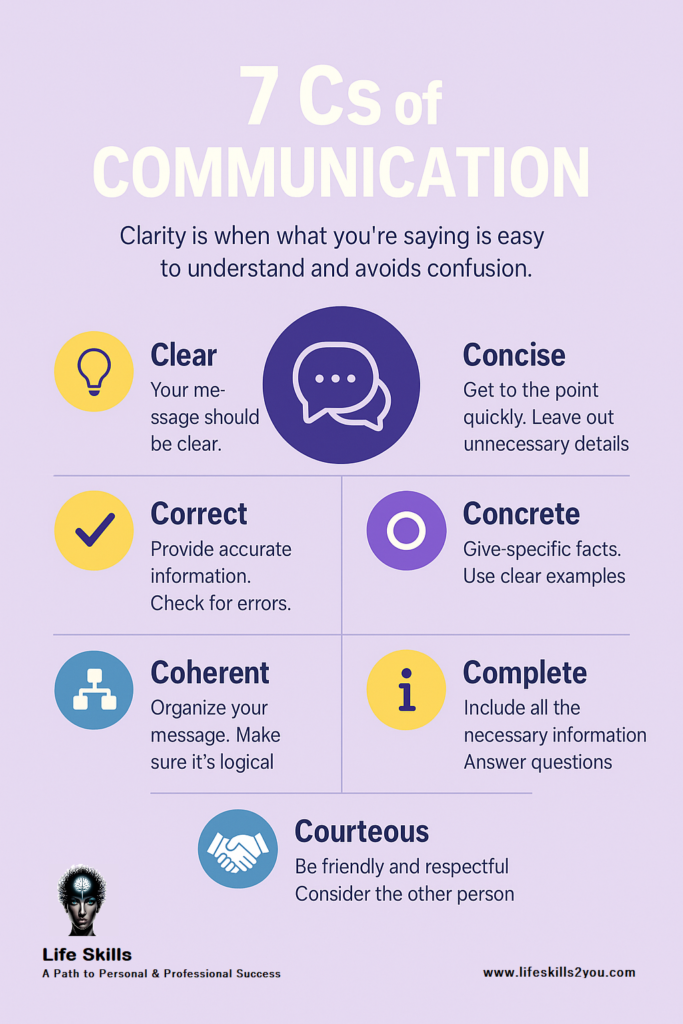
Effective communication is guided by seven fundamental principles known as the 7 C’s. These principles help ensure that messages are clear, concise, and impactful.

1. Clarity 🌟💡✔️

Messages should be clear and easy to understand, leaving no room for misinterpretation.

2. Conciseness ✂️📌📢

Keep communication brief and to the point, avoiding unnecessary words or details.

3. Correctness ✅📖✍️

Ensure that the information shared is accurate, error-free, and grammatically correct.

4. Completeness 📋✔️📊

Provide all necessary information so that the recipient has everything required to understand and respond.

5. Coherence 🔄🔗📚

Structure messages logically, maintaining a smooth flow of ideas.

6. Courtesy 😊🙏💬

Use polite language and consider the recipient’s perspective to maintain a respectful tone.

7. Consideration ❤️🤔👂

Understand the needs, emotions, and background of the audience while communicating.

3. Achieving Clarity in Communication: Techniques and Strategies 🎯🛠️📢

Mastering Clarity in Communication requires consistent practice and the application of effective techniques. Here are some key strategies to enhance clarity in communication:

Simplify Complex Concepts 🧩📖🔍

Break down intricate ideas into easily digestible components. Use relatable examples and analogies to bridge the gap between complexity and comprehension.

Organize Your Thoughts 🗂️🧠📌

Before communicating, structure your thoughts logically. A well-organized message ensures that each point seamlessly leads to the next, improving overall coherence.

Choose Your Words Wisely 🗣️✏️📢

Word choice significantly impacts Clarity in Communication. Use precise and concise language while avoiding jargon and technical terms when speaking to non-experts.

Practice Active Listening 👂🎯🤝

Effective communication is a two-way process. Active listening—focusing on the speaker, asking clarifying questions, and paraphrasing—ensures mutual understanding.

Use Visual Aids 📊📌🎨

In presentations, visuals such as slides, charts, and diagrams reinforce messages and enhance audience comprehension.

How I Learned to Speak With More CLARITY

Clarity in Professional Communication 💼📢✅

In professional environments, Clarity in Communication fosters collaboration, efficiency, and workplace success.

Providing Clear Instructions 📜✅📌

When giving instructions, be specific and detailed to eliminate ambiguity. Clearly outline steps and expectations to ensure smooth execution.

Effective Email Communication ✉️📖📌

Written workplace communication demands Clarity in Communication. Structure emails logically, use bullet points for easy readability, and highlight key takeaways.

Offering Transparent Feedback 🎯🗣️📊

Constructive feedback should be clear and actionable. Avoid vague comments and focus on specific areas for improvement.

Conflict Resolution ⚖️🤝💬

Clarity in Communication is essential when resolving conflicts. Clearly articulate concerns, listen actively, and propose solutions that all parties can understand and accept.

Clarity in Personal Relationships ❤️🗣️💡

Applying Clarity in Communication in personal interactions strengthens connections and minimizes misinterpretations.

Expressing Emotions Clearly 💖🗣️😊

Openly communicating emotions fosters deeper relationships. Clearly articulating feelings and concerns ensures messages are received as intended.

During disagreements, prioritize Clarity in Communication. Express your viewpoint clearly, listen attentively, and collaborate to find common ground.

Bridging Cultural Differences 🌍👂💬

Cross-cultural communication requires heightened clarity. Be mindful of language barriers and adapt communication styles to enhance mutual understanding.

The Role of Clarity in Public Speaking 🎤📢✨

Public speaking demands Clarity in Communication to captivate audiences and convey messages effectively.

Structuring Speeches Properly 📝🎯📢

Organize speeches with a clear introduction, well-defined key points, and smooth transitions to ensure audience engagement.

Delivering Messages Effectively 🎙️🔊😊

Beyond words, delivery plays a crucial role. Maintain steady pacing, use expressive gestures, and modulate your voice for emphasis.

Connecting with the Audience 🤝👂📢

Tailor speeches to align with the audience’s understanding. Use relatable language and examples to make messages more impactful.

References:
For further insights on communication skills, I recommend exploring articles on reputable website like Udemy. Additionally, you can enrich your understanding by watching empowering YouTube videos from channels like TED Talks.

In a world flooded with information, achieving clarity in communication is paramount. It transcends verbal exchanges, touching every aspect of our lives – from personal relationships to professional success. By understanding the essence of clarity and implementing effective strategies, you empower yourself to be a better communicator. Embrace clarity and watch as your interactions flourish, connections deepen, and your influence grows.

Frequently Asked Questions (FAQs) about the concept of clarity in communication

Q1: How does clarity in communication impact interpersonal relationships?

Ans: Clarity minimizes misunderstandings, fostering trust and deeper connections between individuals.

Q2: Can clarity in communication be achieved in non-verbal communication?

Ans: Yes, clarity extends to non-verbal cues such as body language and facial expressions.

Q3: What’s the connection between clarity in communication and effective leadership?

Ans: Effective leaders communicate clearly, inspiring and motivating their teams toward success.

Q4: How can I improve clarity in my writing?

Ans: Simplify complex ideas, organize your content logically, and choose precise vocabulary to enhance clarity.

Q5: Is clarity more important than brevity in communication?

Ans: While brevity is valuable, clarity should never be compromised. Clear communication trumps all

Q6: How does clarity contribute to conflict resolution?

Ans: Clear communication during conflicts helps parties understand each other’s perspectives and find common ground.

Setting and Achieving Goals: Your Path to Personal Growth and Success

In a world driven by constant change and evolving aspirations, setting and achieving goals has become a fundamental aspect of realizing personal growth and achieving success. Whether you’re striving for professional advancement, improving your health and well-being, or pursuing a passion, the journey begins with defining clear and SMART goals, fostering personal growth, and nurturing unwavering motivation.

The Power of SMART Goals

Setting goals is an art that requires careful planning, dedication, and an understanding of the SMART framework – Specific, Measurable, Achievable, Relevant, and Time-bound. By incorporating these elements, you create a roadmap that outlines your objectives, making them more manageable and attainable.

Specific: Clearly defining what you want to achieve is the cornerstone of effective goal setting. Rather than vaguely aiming to “get fit,” you might set the specific goal of “losing 15 pounds within six months through a combination of regular exercise and a balanced diet.”

Measurable: Quantifying your progress allows you to track your achievements and stay motivated. In our fitness example, measuring your weight loss progress each month provides tangible evidence of your success.

Achievable: Goals should be challenging yet realistic. Losing 50 pounds in a month might be unattainable, but aiming for 15 pounds is more achievable, promoting sustained effort.

Relevant: Your goals should align with your values, aspirations, and overall life plan. If career growth is your focus, setting a goal to complete a relevant certification is more aligned than pursuing unrelated endeavors.

Time-bound: Setting a timeframe creates a sense of urgency and prevents procrastination. In our weight loss scenario, having a six-month timeframe pushes you to take consistent action.

Nurturing Personal Growth Through Goal Pursuit

Personal growth is the essence of continuous development and self-improvement. The pursuit of meaningful goals fuels this growth, propelling you forward on your path to success.

By embarking on the journey of setting and achieving goals, you expose yourself to new experiences, challenges, and learning opportunities. Each milestone achieved brings a sense of accomplishment, boosting your confidence and encouraging you to tackle even more ambitious objectives.

Moreover, goal pursuit often requires stepping out of your comfort zone, which is where growth truly happens. Overcoming obstacles, adapting to changes, and acquiring new skills contribute to your personal development, expanding your capabilities and enhancing your self-awareness.

Cultivating Unwavering Motivation

Motivation is the driving force behind sustained goal pursuit. It’s what keeps you going when the initial excitement fades and challenges arise. To maintain unwavering motivation, it’s essential to understand the sources of motivation and employ effective strategies.

Intrinsic Motivation: This type of motivation comes from within and is fueled by personal values, passions, and a sense of purpose. When your goals align with your core beliefs, you’re more likely to stay committed and enthusiastic.

Extrinsic Motivation: External factors like rewards, recognition, or praise from others can also fuel motivation. While effective, it’s important to strike a balance between intrinsic and extrinsic motivation to avoid dependency on external validation.

Visualization and Affirmations: Visualizing your success and using positive affirmations can reinforce your commitment and keep your goals at the forefront of your mind. Envisioning yourself achieving your objectives creates a powerful mental image that boosts motivation.

Accountability Partnerships: Sharing your goals with a trusted friend or mentor holds you accountable and provides valuable support. Regular check-ins and discussions about progress can reignite motivation during challenging times.

The Synergy of Personal Growth and Success

As you embark on your journey of setting and achieving goals, you’ll notice a beautiful synergy between personal growth and success. The pursuit of meaningful goals fosters qualities such as resilience, adaptability, determination, and discipline – attributes that are not only crucial for achieving success but also for sustaining it.

Personal growth equips you with the mindset and skills needed to navigate the ever-changing landscape of life. The challenges you overcome and the lessons you learn along the way become invaluable tools that enhance your overall success, both personally and professionally.

In essence, the process of setting and achieving goals is a transformative experience that not only leads to tangible outcomes but also cultivates a stronger, wiser, and more accomplished version of yourself.

Conclusion

In the pursuit of personal growth and success, setting and achieving goals serve as guiding stars, lighting up the path ahead. The journey is transformative, propelling you toward a more empowered and accomplished version of yourself. By harnessing the power of SMART goals, nurturing personal growth, and cultivating unwavering motivation, you pave the way for a future brimming with triumph and fulfillment.

How to enhance your adaptability: A Comprehensive Guide

In today’s fast-paced and ever-changing world, adaptability has become a crucial skill that can significantly impact both personal and professional success. As the digital landscape evolves, individuals and businesses must develop the ability to adapt to new challenges, technologies, and trends. In this comprehensive guide, we delve deep into the concept of adaptability, its importance, and practical strategies to enhance your adaptability quotient.

Understanding Adaptability: A Foundation for Success

Adaptability can be defined as the capacity to adjust and thrive in changing environments, circumstances, and situations. It’s about being open to learning, embracing uncertainty, and swiftly acclimating to the demands of the modern world. In a rapidly evolving landscape, adaptability has shifted from being a desirable trait to an essential skill.

The Importance of Enhancing Adaptability

In an era of constant innovation and disruption, individuals who possess high levels of adaptability are better equipped to navigate challenges and seize opportunities. Whether you’re an entrepreneur, professional, or student, cultivating adaptability can lead to:

1. Improved Problem-Solving

Adaptable individuals are more adept at analyzing problems from various angles and devising innovative solutions. They can swiftly assess changing situations and make informed decisions.

2. Increased Resilience

Enhancing adaptability fosters resilience, allowing individuals to bounce back from setbacks and failures. Resilient people view challenges as opportunities for growth and development.

3. Seamless Skill Acquisition

Adaptable individuals embrace continuous learning. They are eager to acquire new skills and knowledge, which is crucial in a world where technologies and industries evolve rapidly.

4. Enhanced Interpersonal Relationships

Adaptability nurtures effective communication and collaboration. People who can adapt to different communication styles and work approaches are more likely to succeed in diverse social and professional settings.

Strategies to Boost Your Adaptability Quotient

Now that we’ve established the significance of adaptability, let’s explore actionable strategies to enhance your adaptability quotient:

1. Embrace Lifelong Learning

Commit to ongoing education and skill development. Attend workshops, webinars, and courses to stay updated with the latest trends in your field. This proactive approach ensures you’re well-prepared for changes.

2. Step Out of Your Comfort Zone

Push yourself to try new experiences and take on challenges that stretch your abilities. Stepping out of your comfort zone fosters adaptability by exposing you to unfamiliar situations.

3. Develop Cognitive Flexibility

Cognitive flexibility involves being open to different perspectives and approaches. Engage in activities that require you to think creatively and consider alternative solutions.

4. Practice Stress Management

Effective stress management is essential for adaptability. Techniques such as mindfulness, meditation, and deep breathing can help you remain calm and composed in the face of change.

5. Foster a Growth Mindset

Cultivate a growth mindset by believing in your ability to develop and improve. Embrace failures as learning opportunities and maintain a positive outlook on challenges.

6. Cultivate Interpersonal Skills

Strong interpersonal skills are crucial for adapting to various social and professional scenarios. Focus on active listening, empathy, and effective communication to build meaningful relationships.

7. Stay Tech-Savvy

In today’s digital age, technological advancements play a pivotal role in shaping industries. Stay updated with technological trends relevant to your field to remain adaptable in a tech-driven environment.

Final Thoughts

In a world characterized by rapid change and innovation, adaptability has become a non-negotiable skill for success. Those who can navigate uncertainty with resilience and open-mindedness are poised to thrive in any situation. By embracing lifelong learning, stepping out of your comfort zone, and fostering a growth mindset, you can enhance your adaptability quotient and position yourself for a future of endless possibilities.

Remember, adaptability is not a trait reserved for the elite few; it’s a skill that can be developed and honed over time. So, embark on this journey of self-improvement and discover the transformative power of adaptability in your personal and professional life.

Mastering Effective Communication: Tips for Better Conversations

In a world where communication reigns supreme, mastering effective communication skills is an indispensable asset that can significantly enhance your personal and professional life. Whether you’re navigating complex business negotiations, nurturing relationships, or simply engaging in everyday conversations, the power of effective communication cannot be underestimated. Communication plays a vital role in personal and professional sphere, and here is with comprehensive insights and invaluable tips to help you become a master communicator.

The Art of Active Listening

Active listening is the cornerstone of effective communication. It involves not just hearing the words spoken but truly understanding the emotions, concerns, and intentions behind them. When engaged in a conversation, devote your full attention to the speaker. Maintain eye contact, nod in agreement, and show genuine interest in what they’re saying. By doing so, you not only foster a deeper connection but also gain insights that can guide your responses.

Clarity and Conciseness

Clarity and conciseness go hand in hand when it comes to effective communication. Crafting your messages with precision eliminates misunderstandings and ensures your point is conveyed accurately. Avoid using jargon or convoluted language that may confuse your audience. Instead, opt for clear and straightforward words that resonate with your listeners.

Non-Verbal Communication

It’s often said that actions speak louder than words, and this couldn’t be truer in the realm of communication. Non-verbal cues, such as facial expressions, gestures, and body language, can convey emotions and attitudes that words might not capture. Maintaining an open posture, offering a firm handshake, and smiling warmly can instantly create a positive impression and establish rapport.

Empathy and Understanding

Empathy forms the bedrock of effective communication. Putting yourself in someone else’s shoes allows you to understand their perspective, feelings, and needs. When engaged in a conversation, show empathy by acknowledging the other person’s emotions and validating their experiences. This not only builds trust but also encourages open and honest dialogue.

Constructive Feedback

Providing and receiving feedback is an essential aspect of communication, especially in professional settings. When offering feedback, focus on the specific behavior or outcome rather than making it personal. Constructive feedback should be actionable, highlighting areas for improvement while recognizing strengths. On the receiving end, approach feedback with an open mind, viewing it as an opportunity for growth.

Adaptability in Communication Styles

Effective communicators are versatile and adapt their communication style to suit different situations and audiences. Whether you’re addressing colleagues, clients, or friends, tailor your language, tone, and content to resonate with your listeners. This adaptability enhances understanding and engagement, ensuring your message is received positively.

Conflict Resolution

Conflict is inevitable in any human interaction, but how it’s managed can make or break relationships. Master communicators approach conflicts with patience, active listening, and a focus on finding common ground. By addressing concerns calmly and seeking solutions collaboratively, you can transform conflicts into opportunities for growth and strengthened relationships.

Storytelling as a Communication Tool

Storytelling transcends cultures and generations, making it a powerful tool for effective communication. Weaving relevant anecdotes and narratives into your conversations can capture your audience’s attention and make complex concepts more relatable. A well-told story has the ability to evoke emotions, drive home key messages, and create a lasting impact.

Digital Communication Etiquette

In today’s digital age, mastering effective communication extends to the virtual realm. When communicating through emails, texts, or social media, practice proper etiquette. Use clear subject lines, maintain a professional tone, and avoid misinterpretation by choosing your words carefully. Emojis and exclamation points can add warmth, but use them judiciously to maintain professionalism.

Continuous Learning and Improvement

Effective communication is a skill that can always be refined and improved. Keep learning by seeking feedback, attending communication workshops, and studying successful communicators. Stay updated on communication trends and technologies to remain relevant in an ever-evolving landscape.

In conclusion, mastering effective communication is a journey that requires dedication, self-awareness, and a genuine desire to connect with others. By honing your active listening skills, fostering empathy, adapting to different communication styles, and embracing continuous learning, you can become a master communicator who navigates conversations with finesse and creates meaningful connections.

Exit mobile version