A Non-Violent Communication Guide for Couples: Conflict Resolution

Introduction: When Love Meets Conflict

Every relationship, no matter how strong, faces conflict. It’s inevitable. Two individuals, shaped by different experiences, beliefs, and emotional patterns, will not always see eye to eye. But here’s the truth most couples miss:

Conflict is not the problem. The way we communicate during conflict is.

Have you ever found yourself saying things you didn’t mean? Or shutting down instead of expressing what you truly feel? Maybe you’ve experienced arguments that spiral out of control, leaving both partners hurt, misunderstood, and emotionally distant.

This is where A Non-Violent Communication Guide for Couples becomes a life-changing approach.

Developed by psychologist Marshall Rosenberg, Non-Violent Communication (NVC) is a powerful framework rooted in empathy, emotional awareness, and conscious expression. It shifts conversations from blame and criticism to understanding and connection.

In my years as a trainer working with couples and individuals, I’ve seen one simple truth repeatedly:

Couples don’t break because of problems—they break because of poor communication patterns.

This article is not just theory. It combines behavioral science, real-life coaching insights, and practical tools that you can apply immediately.

By the end, you’ll learn how to:

  • Turn arguments into meaningful conversations
  • Express needs without hurting your partner
  • Listen deeply and build emotional safety
  • Strengthen your bond—even during disagreements

Let’s dive into A Non-Violent Communication Guide for Couples and transform the way you connect.


Understanding Non-Violent Communication (NVC)

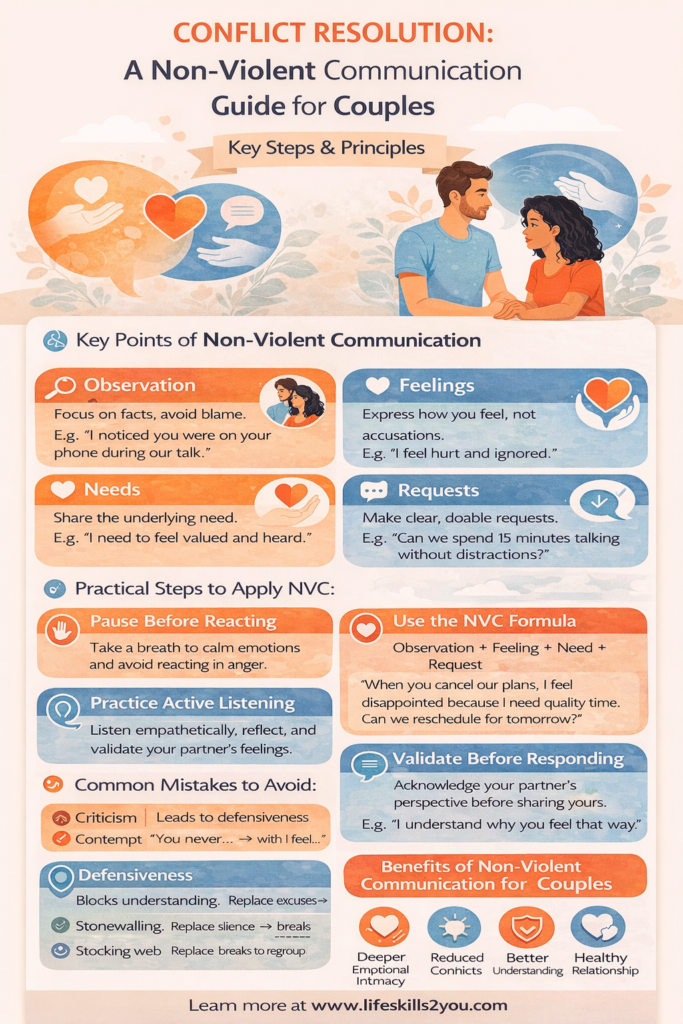
At its core, A Non-Violent Communication Guide for Couples is based on four key components:

1. Observation (Without Judgment)

Instead of blaming:

  • ❌ “You never listen to me!”
  • ✅ “When I was talking, I noticed you were on your phone.”

👉 This removes defensiveness and creates clarity.

2. Feelings (Not Accusations)

  • ❌ “You make me angry.”
  • ✅ “I feel hurt and ignored.”

👉 You own your emotions instead of projecting them.

3. Needs (The Root Cause)

Every feeling is connected to a need.

  • Need for respect
  • Need for attention
  • Need for appreciation

👉 Most conflicts are unmet needs in disguise.

4. Requests (Not Demands)

  • ❌ “You should care more!”
  • ✅ “Can we spend 15 minutes daily talking without distractions?”

👉 Clear, actionable, and respectful.


Why Couples Struggle with Communication

Even intelligent, loving couples struggle. Why?

1. Emotional Triggers

Your reactions are often rooted in past experiences.

2. Ego Defense Mechanisms

Blame, criticism, and withdrawal protect the ego—but damage the relationship.

3. Lack of Emotional Vocabulary

Many people simply don’t know how to express feelings clearly.

4. Assumptions & Mind Reading

“If they loved me, they would understand.”

This belief destroys clarity.


The Psychology Behind Non-Violent Communication

Research from Harvard Medical School and Gottman Institute shows:

  • Criticism triggers defensiveness
  • Defensiveness blocks connection
  • Emotional safety increases relationship satisfaction

👉 A Non-Violent Communication Guide for Couples aligns with Emotional Intelligence (EQ) and Attachment Theory.

Key Insight:

“Behind every angry reaction is an unmet need.”


Step-by-Step: Applying A Non-Violent Communication Guide for Couples

Step 1: Pause Before Reacting

In training sessions, I always teach:

“Respond. Don’t react.”

Take 10 seconds. Breathe. Reset.


Step 2: Use the NVC Formula

Observation + Feeling + Need + Request

Example:

“When you cancel our plans (observation), I feel disappointed (feeling) because I value quality time (need). Can we reschedule for tomorrow? (request)”


Step 3: Practice Active Listening

Listening is not waiting to speak.

It means:

  • Maintaining eye contact
  • Not interrupting
  • Reflecting back

👉 “What I hear you saying is…”


Step 4: Validate Before Responding

You don’t have to agree—but you must acknowledge.

“I understand why you feel that way.”

This builds emotional safety.


Step 5: Avoid Toxic Communication Patterns

❌ Criticism
❌ Contempt
❌ Defensiveness
❌ Stonewalling

(These are called Gottman’s Four Horsemen)


Real-Life Case Study (From Training Experience)

A couple I coached had constant arguments over “time.”

  • Wife felt neglected
  • Husband felt pressured

Using A Non-Violent Communication Guide for Couples, we reframed:

Before:
“You never spend time with me!”

After:
“I feel lonely because I need connection. Can we plan one evening together weekly?”

👉 Result:

  • Reduced arguments by 70%
  • Increased emotional intimacy
  • Improved mutual understanding

Powerful Communication Scripts for Couples

When You Feel Ignored

“I feel unseen when I’m talking and don’t get a response. Can we talk without distractions?”

When You Feel Angry

“I’m feeling frustrated because I need clarity. Can we discuss this calmly?”

When You Need Support

“I feel overwhelmed. I need support right now—can you help me?”


Common Mistakes Couples Make (And Fixes)

MistakeWhy It FailsBetter Approach
BlamingTriggers defenseUse “I feel…”
GeneralizingCreates conflictBe specific
SilenceBuilds resentmentExpress needs
DemandingCauses resistanceMake requests

Benefits of A Non-Violent Communication Guide for Couples

  • 💛 Deeper emotional intimacy
  • 💛 Reduced conflicts
  • 💛 Better understanding
  • 💛 Stronger trust
  • 💛 Long-term relationship satisfaction

Motivational Insight

“In every argument, there are two sides—and one opportunity for growth.”


Advanced Techniques for Deeper Connection

1. Emotional Check-Ins

Ask daily:

  • “How are you feeling today?”

2. Weekly Relationship Meetings

Discuss:

  • What worked
  • What didn’t
  • What can improve

3. Empathy Practice

Try to feel what your partner feels.


Scientific Backing & References

  • Marshall Rosenberg – Nonviolent Communication Model
  • Gottman Institute – Relationship Research
  • Harvard Health Publishing – Emotional Intelligence
  • WHO – Mental health and relationships
  • UNICEF – Communication frameworks

Conclusion: Transform Conflict into Connection

Conflict is not the enemy. Silence, misunderstanding, and ego are.

A Non-Violent Communication Guide for Couples teaches us something powerful:

“When we change the way we communicate, we change the quality of our relationships.”

Start small:

  • Listen more
  • Blame less
  • Express clearly
  • Connect deeply

Your relationship doesn’t need perfection—it needs understanding.

Thank you for exploring this insightful article.
If you’re hungry for more knowledge, don’t miss out on our other engaging articles waiting for you. Dive into our treasure trove of wisdom and discover new perspectives on related topics.
Click Our Blog and How to Guide to embark on your next adventure.
Happy reading!


FAQs: A Non-Violent Communication Guide for Couples

1. What is Non-Violent Communication in relationships?

It’s a communication approach that focuses on empathy, understanding, and expressing needs without blame or criticism. It helps couples resolve conflicts peacefully.

2. Can NVC really reduce conflicts?

Yes. Studies show that empathetic communication reduces defensiveness and increases connection, leading to fewer and healthier conflicts.

3. How long does it take to see results?

With consistent practice, couples often notice improvements within a few weeks.

4. Is NVC difficult to learn?

Initially, it requires awareness and practice, but it becomes natural over time.

5. What if my partner doesn’t cooperate?

Start with yourself. Communication patterns often shift when one partner changes.

6. Can NVC help in long-distance relationships?

Absolutely. Clear and empathetic communication is even more important in distance-based relationships.

7. Does NVC mean avoiding conflict?

No. It means handling conflict constructively.

8. Is NVC backed by science?

Yes. It aligns with emotional intelligence, psychology, and behavioral research.

9. Can NVC improve emotional intimacy?

Yes. It builds trust, openness, and deeper connection.

10. How can I practice daily?

Use the 4-step formula: Observation, Feeling, Need, Request.

Your Guide to Digital Non-Verbal Cues

The Silent Language of the Digital World

Have you ever sent a simple message like “Okay.” and instantly worried… Did I sound rude? Was I too cold?

Welcome to the world of Digital Non-Verbal Cues—the invisible signals that shape how your words are felt, not just read.

In face-to-face communication, we rely heavily on body language, tone of voice, eye contact, and gestures. But what happens when communication shifts to screens? Emails, WhatsApp messages, Zoom calls, Slack chats—suddenly, the physical cues disappear. Yet, communication doesn’t become neutral. Instead, it evolves.

That’s where Digital Non-Verbal Cues come into play.

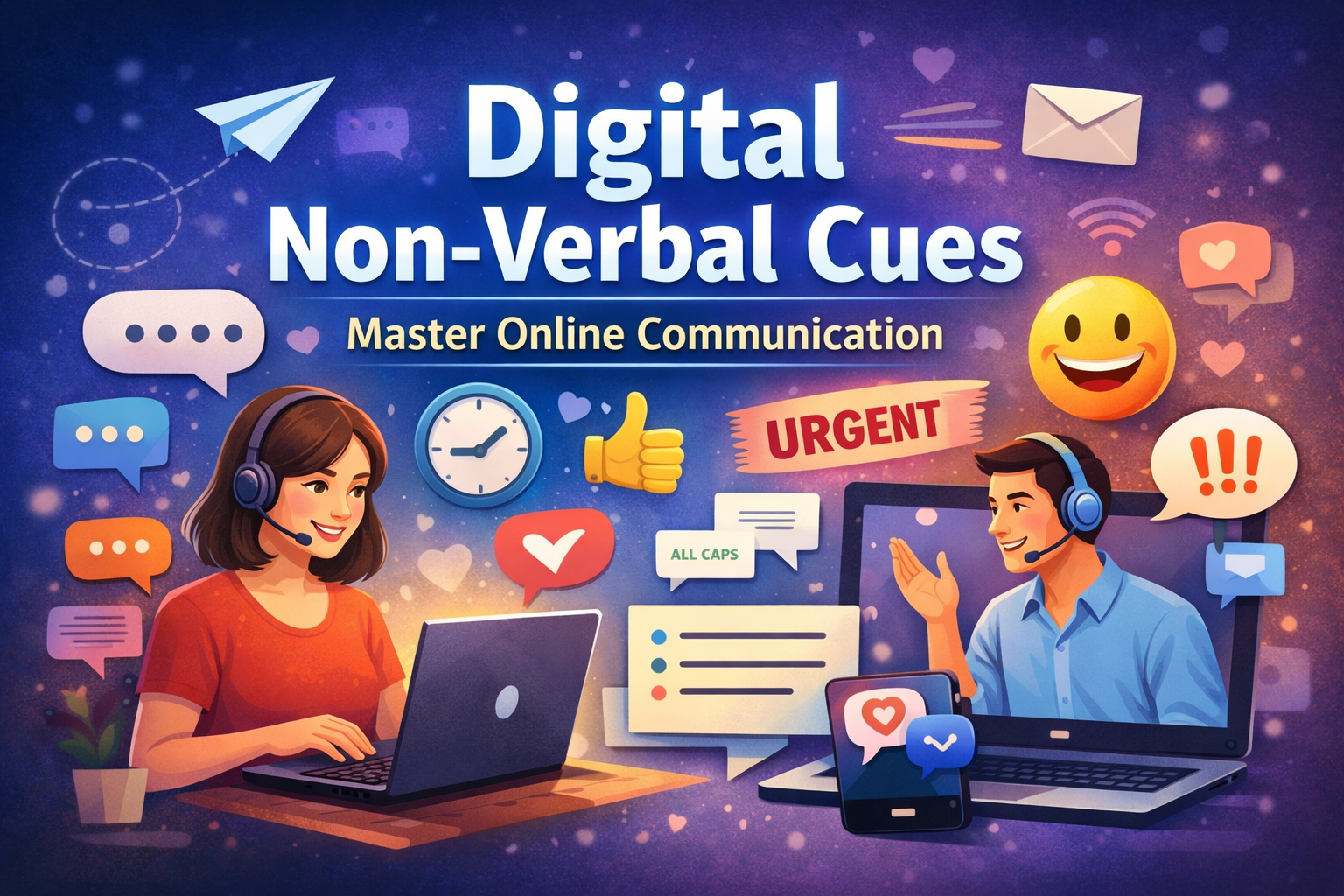
These cues include typing speed, punctuation, emoji use, message timing, capitalization, formatting, and even silence. They silently convey emotions, intent, authority, and relationship dynamics. In fact, according to research in communication psychology, over 60% of perceived meaning in communication comes from non-verbal elements—even in digital spaces, our brains try to fill in the gaps.

As a trainer and communication coach, I’ve seen countless professionals struggle not because of what they said—but how it was interpreted digitally. One corporate leader I worked with nearly damaged a key client relationship simply because his short, abrupt emails were perceived as dismissive.

This guide will help you understand, decode, and master Digital Non-Verbal Cues so you can:

  • Build stronger relationships online
  • Avoid misunderstandings
  • Communicate with clarity and emotional intelligence
  • Increase your professional influence

“In the digital world, how you say it matters more than what you say.”

Let’s dive into this powerful, often overlooked skill.


Step1: Understanding Digital Non-Verbal Communication

What Are Digital Non-Verbal Cues?

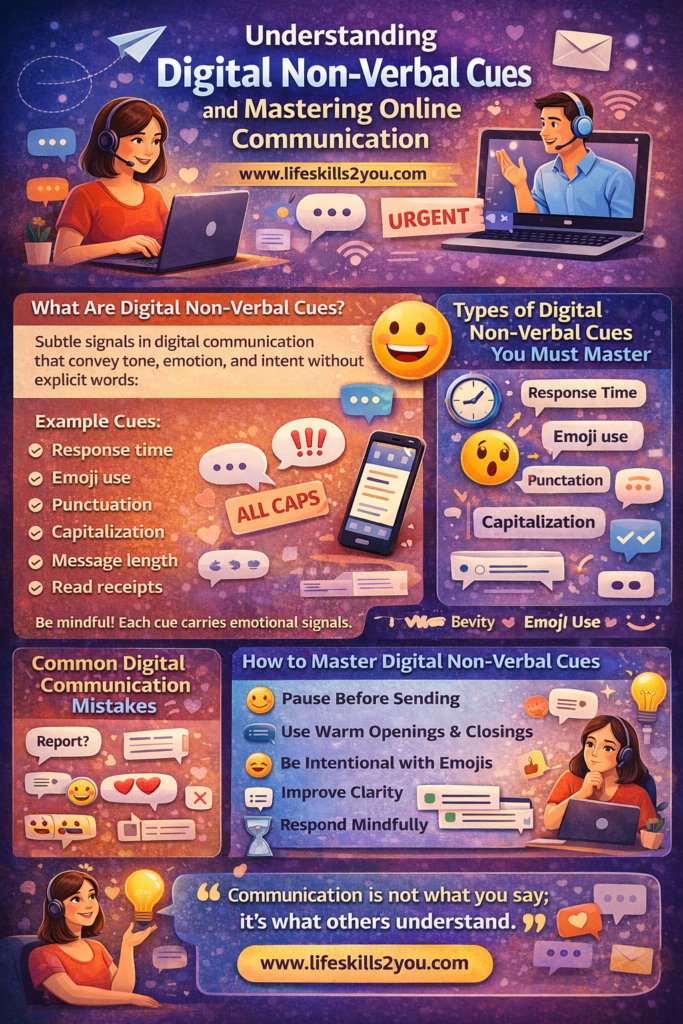
Digital Non-Verbal Cues are the subtle signals embedded in digital communication that convey tone, emotion, and intent without explicit words.

Examples of Digital Non-Verbal Cues

  • Message length (short vs detailed)
  • Response time
  • Use of emojis 😊
  • Punctuation (!!! vs .)
  • Capitalization (ALL CAPS = shouting)
  • Formatting (bold, spacing, bullet points)
  • Read receipts and seen indicators

These are part of digital body language, a concept widely discussed in modern communication psychology and highlighted in research from platforms like Harvard Business Review on virtual communication effectiveness.


Why Digital Non-Verbal Cues Matter More Than Ever

In today’s remote and hybrid work culture, Digital Non-Verbal Cues are often the only signals people rely on.

Psychological Impact

Our brains are wired to interpret tone and emotion. When cues are missing, we:

  • Assume negative intent
  • Misinterpret neutrality as rudeness
  • Fill gaps based on past experiences
Key Insight

Silence in digital communication is not neutral—it is interpreted.


Step2: Types of Digital Non-Verbal Cues You Must Master

1. Timing as a Communication Signal

Response Time Matters

  • Immediate reply → Interest, urgency
  • Delayed reply → Disinterest or disrespect

Real-Life Example 1

A manager I coached delayed responses to team messages. Employees assumed he was ignoring them, leading to disengagement. Once he improved response timing, team morale improved significantly.


2. Punctuation and Tone

The Power of a Period

  • “Thanks.” → Cold
  • “Thanks!” → Warm
  • “Thanks 😊” → Friendly
Micro-differences, massive impact

These subtle Digital Non-Verbal Cues can completely change emotional interpretation.


3. Emojis and Emotional Context

Emotional Amplifiers

Emojis act as tone indicators:

  • 😊 → Friendly
  • 👍 → Agreement (or sometimes passive acknowledgment)
  • 😐 → Neutral or awkward

Real-Life Example 2

A client used “👍” frequently. His team perceived it as dismissive. Switching to short responses improved clarity and connection.


4. Message Length and Structure

Short vs Long Messages

  • Short → Efficient or rude
  • Long → Detailed or overwhelming

Best Practice

Use:

  • Bullet points
  • Clear spacing
  • Logical flow

These improve clarity in communication and reduce misinterpretation.


5. Capitalization and Formatting

Hidden Emotional Signals

  • ALL CAPS → Aggressive
  • lowercase → casual
  • Bold text → emphasis

Use formatting intentionally

Formatting is a strong Digital Non-Verbal Cue that signals importance.


Step 3: Common Mistakes in Digital Communication

Mistake 1: Overusing Brevity

Short messages often lack warmth.

Example

“Send report.”
vs
“Hi, could you please send the report when you get a chance?”


Mistake 2: Ignoring Emotional Tone

Many professionals focus only on content, ignoring emotional intelligence in communication.


Mistake 3: Misusing Emojis

Too many emojis can reduce professionalism.


Mistake 4: Delayed Responses

Silence can damage trust faster than criticism.


Step 4: Applying Digital Non-Verbal Cues in Real Life

Case Study 1: Corporate Leader Transformation

A senior executive struggled with team engagement. His emails were:

  • Short
  • Direct
  • Emotionally flat

Intervention

We improved his Digital Non-Verbal Cues:

  • Added greetings
  • Used positive tone
  • Included appreciation

Result

  • 40% increase in team satisfaction
  • Better collaboration

Case Study 2: Freelancer Client Communication

A freelancer lost clients due to poor messaging tone.

Fix

  • Used structured messages
  • Added polite language
  • Improved response time

Outcome

  • Increased repeat clients

Case Study 3: Remote Team Miscommunication

A global team faced conflicts due to tone misunderstandings.

Solution

Training on Digital Non-Verbal Cues.

Result

  • Reduced conflicts
  • Improved clarity

Step 5: Science Behind Digital Non-Verbal Cues

Behavioural Psychology Perspective

According to communication studies and WHO-backed emotional intelligence frameworks:

  • Humans rely on contextual cues
  • Absence of cues increases cognitive load

You can explore more about emotional communication at WHO Emotional Wellbeing Resources.


The “Negativity Bias” Effect

People tend to interpret neutral messages negatively.

Example

“Noted.” → Often perceived as passive-aggressive


Step 6: How to Master Digital Non-Verbal Cues (Action Plan)

1. Pause Before Sending

Ask:

  • How will this be interpreted?
  • Is my tone clear?

2. Use Warm Openings and Closings

Examples:

  • “Hope you’re doing well”
  • “Appreciate your help”

3. Match Tone with Context

  • Formal → Emails
  • Casual → Chats

4. Be Intentional with Emojis

Use sparingly in professional settings.


5. Improve Clarity

Use:

  • Bullet points
  • Clear instructions

6. Respond Mindfully

Even a quick acknowledgment helps.


Step 7: Motivational Insight

“Communication is not what you say; it’s what others understand.”

Mastering Digital Non-Verbal Cues is not just a skill—it’s a competitive advantage in the modern world.


Conclusion

In a world dominated by screens, Digital Non-Verbal Cues are your hidden language of influence. They shape perception, build trust, and define relationships.

By becoming aware of these subtle signals, you can:

  • Communicate with clarity
  • Avoid misunderstandings
  • Build stronger professional and personal connections

Remember, every message you send carries more than words—it carries you.

Thank you for exploring this insightful article.
If you’re hungry for more knowledge, don’t miss out on our other engaging articles waiting for you. Dive into our treasure trove of wisdom and discover new perspectives on related topics.
Click Our Blog and How to Guide to embark on your next adventure.
Happy reading!


FAQs: Digital Non-Verbal Cues

1. What are Digital Non-Verbal Cues?

They are subtle signals like emojis, timing, punctuation, and formatting that convey tone and emotion in digital communication.

2. Why are Digital Non-Verbal Cues important?

They help prevent misunderstandings and improve clarity, especially in remote communication.

3. Can emojis be used professionally?

Yes, but in moderation. They should match the context and audience.

4. How does response time affect communication?

Quick responses show engagement, while delays may signal disinterest.

5. What is digital body language?

It refers to how tone and intent are expressed through digital behavior.

6. Why do people misinterpret messages online?

Because of lack of physical cues and the brain’s tendency toward negative assumptions.

7. How can I improve my digital communication?

Focus on clarity, tone, structure, and timely responses.

8. Are short messages always bad?

No, but they can seem abrupt if not balanced with politeness.

9. What role does emotional intelligence play?

It helps you understand how your message will be perceived.

10. Can Digital Non-Verbal Cues impact career growth?

Absolutely. Strong communication skills improve leadership, teamwork, and influence.

How to Build a Growth Mindset for Adults: The Ultimate Guide

Introduction

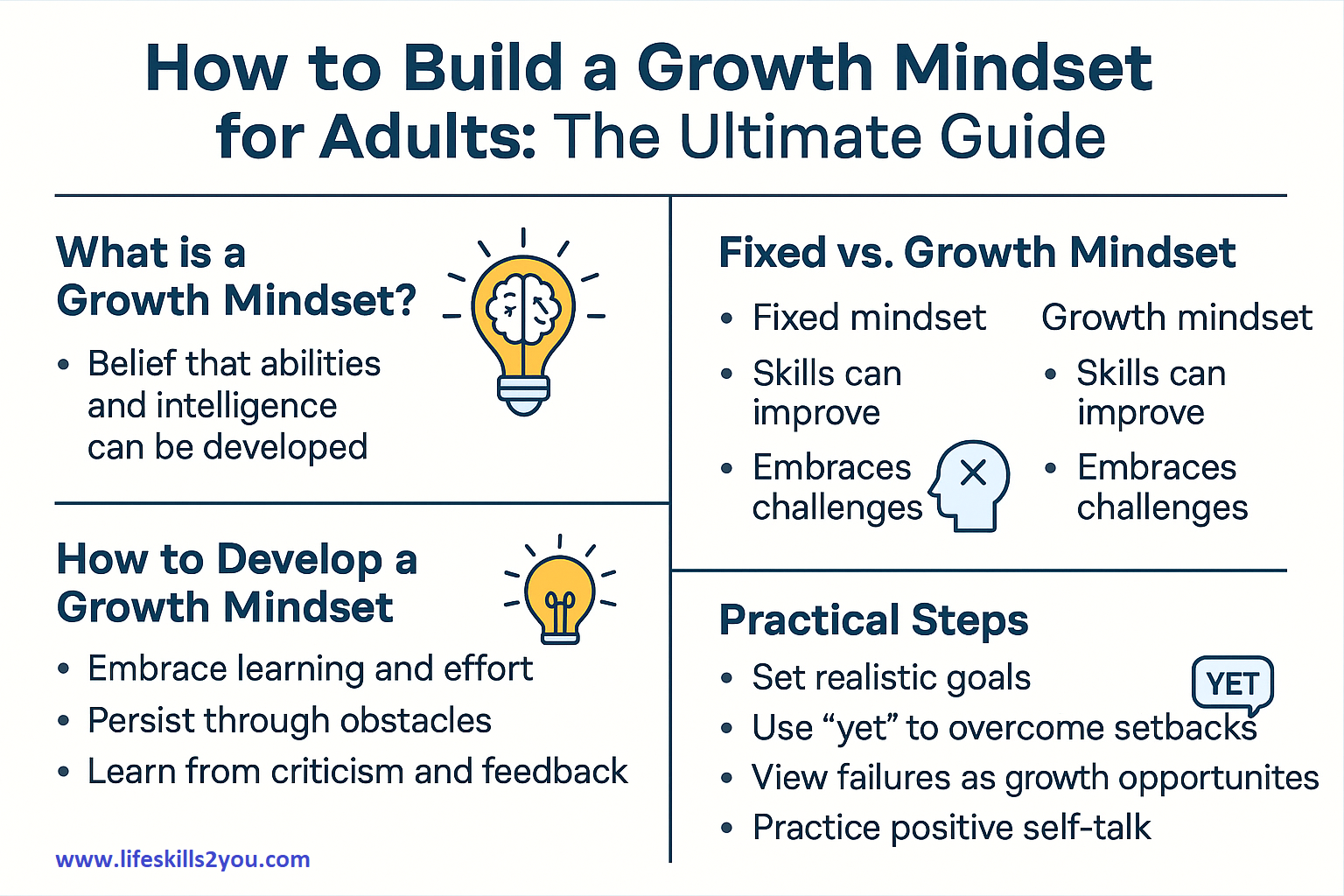
Learn how to build a growth mindset for adults with practical strategies, science-backed tools, and real-life examples to elevate your personal growth.

Have you ever reached a point in life where growth felt harder than it used to be?
Maybe you’ve caught yourself saying things like:

  • “I’m just not good at this.”
  • “I’m too old to learn new skills.”
  • “People like me don’t change.”

If so, you’re not alone. Many adults carry invisible mental blocks shaped by childhood, early experiences, or repeated failures. But here’s the liberating truth: your abilities, intelligence, habits, and outcomes are not fixed. Modern psychology, neuroscience, and behavioural studies consistently reveal that adults can rewire their thinking and unlock higher potential at any age.

That’s where today’s topic becomes a life-changer: how to build a growth mindset for adults.

Whether you’re trying to advance your career, lead your team better, improve your emotional resilience, or simply become a stronger version of yourself — developing a growth mindset is the foundation for lasting transformation.

In my 12+ years as a life skills trainer, I’ve worked with professionals, entrepreneurs, rural self-help groups, government staff, and youth leaders. Across all these groups, one pattern is constant:
🌱 People who adopt a growth mindset achieve better results, stay motivated longer, and handle challenges more effectively than those who don’t.

What makes the difference isn’t talent, luck, or intelligence — it’s mindset.

In this in-depth blueprint, you’ll learn:

  • The psychology behind mindset
  • Real-life stories of adults who transformed their lives
  • Science-backed tools from Stanford, Harvard & behavioural research
  • Step-by-step strategies to cultivate a growth mindset starting today
  • A complete transformation system you can apply at home or work

This guide is written to be practical, human, and deeply relatable. You’ll not only understand the concept — you’ll feel confident implementing it.

Let’s begin your journey into The Best Blueprint for How to Build a Growth Mindset for Adults.


🔶 Understanding the Psychology Behind a Growth Mindset

Before diving into The Best Blueprint for How to Build a Growth Mindset for Adults, it’s essential to understand why your mindset shapes your reality. The term “growth mindset” originates from the pioneering research of Dr. Carol Dweck, a Stanford University psychologist known for her work on motivation and behaviour change. Her studies demonstrate that individuals who believe abilities can be developed achieve more than those who believe abilities are fixed.

But here’s something most people don’t talk about:

👉 Adults struggle more with shifting mindset than children
Why?
Because adults have decades of experiences, fears, conditioning, and emotional patterns built into their identity.

Your brain becomes comfortable with predictable routines.
Your nervous system associates change with risk.
And your habits quietly train you to stay where you are.

Yet neuroscience also reveals an empowering truth:
🧠 Adult neuroplasticity is real. Your brain can grow new pathways at any age.

Whether you’re 25, 45, or 75, the human brain can rewire, relearn, and rebuild confidence — if you follow the right process.

That’s exactly what the full blueprint below will help you do.


🔶 Signs You May Be Operating from a Fixed Mindset

Before learning how to build a growth mindset for adults, check if any of these resonate with you. Awareness is the first step toward personal transformation.

1. You Avoid Challenges or Feel Drained by Them

Challenges feel like threats instead of opportunities. You might avoid tasks outside your comfort zone because you fear failure or judgement.

2. You Believe Talent Matters More Than Effort

If you’ve ever said,

  • “I’m not naturally good at this,”
  • “He’s talented; I’m not,”
    these are fixed-thinking patterns.

3. You Feel Defeated by Setbacks

A growth mindset sees mistakes as feedback.
A fixed mindset interprets them as personal inadequacy.

4. You Seek Approval Instead of Learning

If you prioritise looking smart over improving, you may be stuck in performance mode rather than learning mode.

5. You Take Criticism Personally

Feedback feels like an attack, not a tool for development.

If you relate to any of these, don’t worry — this article will teach you exactly how to break free from fixed mindset thinking and cultivate a resilient growth mindset instead.


🔶 The Best Blueprint for How to Build a Growth Mindset for Adults

Below is a complete, science-backed transformation system designed specifically for adults who want to reshape how they think, lead, grow, and live.

Each step includes behavioural science, coaching insights, real examples, and now-proven techniques.

Let’s dive in.


🔷 Step 1: Shift Your Mindset from Outcome to Learning

One of the core principles in how to build a growth mindset for adults is switching your focus from being the best to becoming better.

Why This Matters

Adults are conditioned to chase outcomes:

  • Promotions
  • Validation
  • Salaries
  • Achievements
  • Social approval

But studies conducted at Harvard Business School show that when individuals focus on daily learning instead of performance, they grow faster, achieve more confidence, and sustain long-term motivation.

Try the Learning Focus Reframe

Instead of asking:
“Did I succeed?”
Ask:
“What did I learn today?”

Real-Life Example 1: Corporate Manager, Age 42

A client of mine, a mid-level manager in Bengaluru, constantly felt insecure about not getting promoted. When he shifted attention from proving himself to improving himself, everything changed. Within eight months, he improved communication skills, handled pressure better, and was eventually promoted — not because he chased outcomes, but because he focused on daily learning.


🔷 Step 2: Rewire Your Beliefs Through Neuroplasticity Habits

This is one of the most powerful tools in how to build a growth mindset for adults.

Neuroscience research from University College London shows that neural pathways can be reshaped through repetition and emotional engagement.

Use Growth Affirmations the Right Way

Not generic positivity.
But identity-shifting affirmations like:

  • “I am capable of improving any skill I commit to.”
  • “Every challenge strengthens my abilities.”
  • “My brain learns, adapts, and expands daily.”

Combine Affirmations + Evidence

Instead of simply saying “I can improve,”
write down moments today where you DID improve.

This reinforces belief with proof.


🔷 Step 3: Redefine Failure as Data, Not Identity

This is where most adults get stuck.

They see failure as:

  • Embarrassment
  • Proof of incompetence
  • A sign to quit

But successful people interpret failure differently.

Failure = Information

Every setback offers:

  • Skill gaps
  • Emotional triggers
  • Strategy flaws
  • Areas needing refinement

Quote to Empower You

“Failure is not the opposite of success; it is a crucial part of success.”

Real-Life Example 2: The Entrepreneur Who Rebuilt Everything

A 38-year-old female entrepreneur I once coached failed twice in her startup journey. She felt ashamed, doubted her intelligence, and nearly gave up. After learning to see failure as feedback, she rebuilt her business model and now runs a profitable learning platform.

She didn’t change her life by “winning.”
She changed because she redefined failing.


🔷 Step 4: Build Emotional Resilience Through Growth Mindset Thinking

Adults often confuse emotions with personal limitations.

But research published on PositivePsychology.com shows that emotional intelligence and resilience are highly trainable traits.

The 3-Step Emotional Reset Formula

  1. Pause – Notice what you’re feeling
  2. Name – Label the emotion (fear, frustration, doubt)
  3. Navigate – Choose a wiser response instead of reacting

Real-Life Example 3: From Impulsive to Empowered

A government field trainer struggled with anger during team conflicts. Once she adopted the emotional reset formula, her team rated her as more composed, supportive, and solution-focused within just six weeks.

This is what growth mindset looks like in action:
Better emotional responses → better outcomes.


🔷 Step 5: Surround Yourself with Growth-Minded People

Adults absorb the energy and mindset of people around them.
If your environment is full of:

  • complainers
  • gossipers
  • excuse-makers
  • negative thinkers
  • people stuck in comfort zones

…it will be extremely hard to grow.

Build a Growth-Mindset Circle

Your group should include:

  • A mentor
  • A peer who challenges you
  • Someone you teach
  • Someone who inspires you

This combination reinforces growth, accountability, and motivation.

Real-Life Example 4: Skill Development in Rural Communities

When working with rural women’s SHGs, I observed that members who spent time with goal-driven peers completed training faster and started microenterprises sooner. Growth mindset spreads through community influence.


🔷 Step 6: Develop the Habit of Daily Micro-Progress

Adults often fail because they aim for big leaps.
But research from the University of Chicago shows that small daily wins create more motivation than large, inconsistent efforts.

The “1% Growth Habit”

Improve one small thing every day:

Daily micro-progress rewires the brain for consistency and self-belief — the foundation of a true growth mindset.


🔷 Step 7: Use Reflection to Strengthen Learning

Reflection is one of the most undervalued tools in how to build a growth mindset for adults.

Try the 5-Question Growth Journal

Every night, ask:

  1. What challenged me today?
  2. What did I learn from it?
  3. How did I show resilience?
  4. What can I improve tomorrow?
  5. What am I proud of today?

This shifts your brain from survival mode to growth mode.


🔷 Step 8: Adopt the “Yet” Mindset

A simple word with massive impact.

Instead of:
“I can’t do this.”
say:
“I can’t do this yet.”

This word activates hope and future potential.

Quote

“Yet is the most powerful word in a growth mindset vocabulary.”


🔷 Step 9: Move from Fear-Based Thinking to Curiosity-Based Thinking

Fear shuts down learning.
Curiosity opens it.

Ask more questions like:

  • “What if I tried a new approach?”
  • “What skill could help me handle this better?”
  • “What am I assuming here?”

Curiosity is the engine of adult learning.


🔷 Step 10: Build Accountability Systems That Keep You Growing

Growth doesn’t happen automatically.
It requires systems.

Your Accountability Toolkit

  • Habit tracker
  • Weekly goals
  • Monthly challenges
  • Feedback partner
  • Growth rewards (celebrating progress!)

When systems support you, mindset change becomes sustainable.


🔶 Trusted External References

Here are two supportive resources you can explore:

Both explain psychology-based insights that strengthen the concepts discussed above.


🔶 CONCLUSION

Building a growth mindset as an adult is not just a learning strategy — it is a lifelong transformation. It reshapes how you think, behave, respond to challenges, and design your future. Throughout this blueprint, you explored step-by-step methods rooted in psychology, neuroscience, coaching, emotional intelligence, and real-life success stories.

The truth is simple: Your potential is never fixed. You can improve any skill, break any limitation, and rise beyond past conditioning if you commit consistently. Growth is not an accident — it is a daily choice. And today, by reading this guide, you’ve taken one powerful step toward unlocking your fullest capabilities.

Whether you’re upgrading your career, mindset, relationships, communication, or self-confidence — now you have the tools to strengthen your transformation journey.

So go ahead. Apply one skill today. Build one new habit tomorrow. And watch how your mindset — and your life — begins to expand.


🔶 CALL TO ACTION

Thank you for exploring this insightful article.
If you’re hungry for more knowledge, don’t miss out on our other engaging articles waiting for you. Dive into our treasure trove of wisdom and discover new perspectives on related topics.
Click Our Blog and How to Guide to embark on your next adventure.
Happy reading!


🔶 10 FAQs on How to Build a Growth Mindset for Adults: The Ultimate Guide

1. Can adults genuinely change their mindset?

Yes. Neuroscience proves that adult brains can grow new pathways through learning, reflection, and repeated practice. Age is never a barrier.

2. How long does it take to build a growth mindset?

Typically 30–90 days of consistent practice. Mindset change is not overnight but happens gradually.

3. What is the biggest obstacle in developing a growth mindset as an adult?

Fear of failure and past conditioning. Adults often tie identity to performance.

4. Can a growth mindset improve career success?

Absolutely. It enhances problem-solving, leadership, communication, and adaptability — top skills employers value.

5. Does journaling help in growth mindset development?

Yes, journaling builds self-awareness and helps reframe challenges.

6. Can introverts develop a growth mindset?

Yes. Mindset is not about personality. It’s about beliefs and behaviours.

7. What is the role of habits in mindset transformation?

Habits create consistency, which rewires the brain and strengthens learning.

8. How do I stay motivated while building a growth mindset?

Set small goals, track wins, and surround yourself with growth-minded people.

9. Can growth mindset help reduce stress?

Yes, because it teaches you to view challenges as manageable and temporary.

10. Is professional coaching useful in building a growth mindset?

Yes. A coach provides structure, feedback, and accountability that accelerates progress.

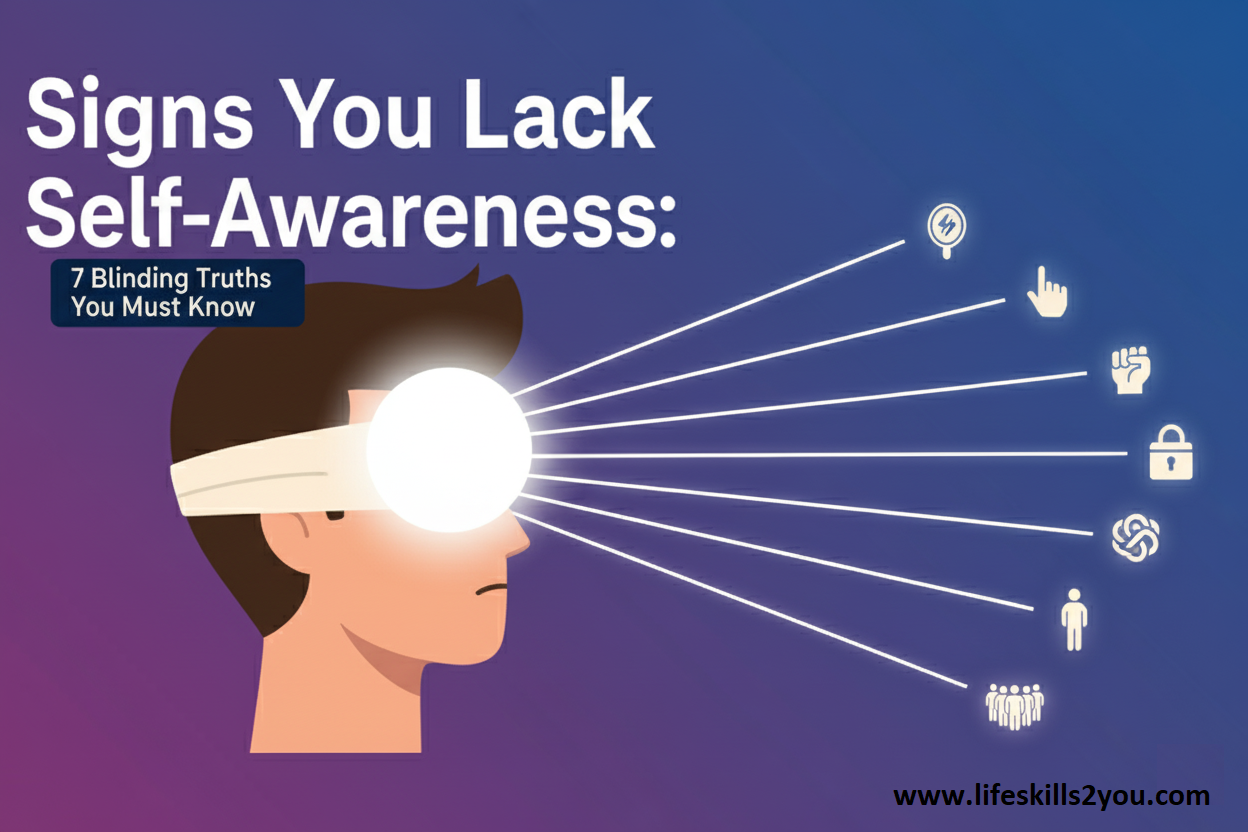
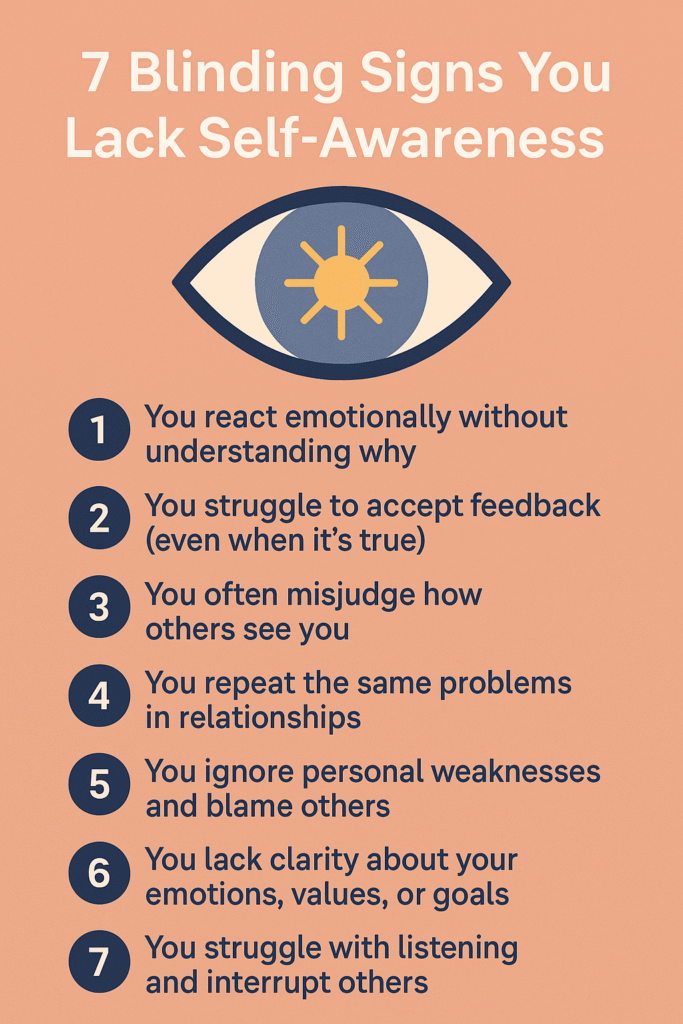
Signs You Lack Self-Awareness: 7 Blinding Truths You Must Know

Introduction

Discover key signs you lack self-awareness and learn science-backed strategies to improve emotional intelligence, relationships, and personal growth.

Have you ever walked away from a conversation and wondered, “Why do people react to me this way?” Or felt stuck in the same patterns no matter how hard you try to change? If so, you’re not alone. In my 12+ years as a life skills trainer and personal development coach, I’ve seen one recurring issue that quietly sabotages success, confidence, and relationships: a lack of self-awareness.

Most people believe they are self-aware. In fact, a study by organizational psychologist Dr. Tasha Eurich found that 95% of people think they’re self-aware — but only 10–15% actually are.
That shocking gap is where frustration, conflict, emotional stress, and stalled personal growth are born.

When you don’t recognize your emotions, blind spots, weaknesses, or behavioural patterns, you end up repeating the same cycles — sometimes for years. You may misread situations, misunderstand people, fail to grow, or unknowingly push others away. These patterns aren’t rooted in laziness or lack of intelligence — they are rooted in blindness.

And that’s why understanding the signs you lack self-awareness is a transformative first step.
Not to judge yourself.
Not to feel guilty.
But to finally illuminate the behaviour patterns blocking your growth so you can break free.

In this comprehensive, psychology-backed guide, we’ll dive deep into the 7 Blinding Signs You Lack Self-Awareness (And What to Do About It). You’ll find:

✔ Real-life coaching examples
✔ Behaviour science insights
✔ Emotional intelligence frameworks
✔ Easy, actionable steps
✔ Motivational quotes

By the end of this article, you’ll not only understand your blind spots — you’ll know exactly how to rise above them with clarity, emotional strength, and renewed personal power.

Let’s begin.


1. You React Emotionally Without Understanding Why

One of the strongest signs you lack self-awareness is reacting impulsively without recognizing the emotional trigger. This happens when your internal world controls you instead of the other way around.

Why This Happens (The Psychology Behind It)

According to the cognitive-behavioural model, emotions arise from thoughts — but when those thoughts are unconscious, the emotion feels “sudden” and uncontrollable.

You may feel:

  • Angry without knowing why
  • Anxious without a clear reason
  • Irritated even in small interactions
  • Defensive during feedback
  • Hurt by neutral comments

This happens because your brain is operating on automatic emotional scripts rooted in past experiences.

Real-Life Example (Client Story)

During a corporate training session, I worked with a manager, let’s call her Priya. She often snapped at her team but insisted she was “just stressed.”
After coaching, she realized she felt threatened whenever someone questioned her ideas — not because they were wrong, but because she grew up being criticized harshly at home.

Her emotional reactions had nothing to do with her team — but everything to do with her past.

What to Do

  • Name the emotion
  • Ask: “What triggered me?”
  • Track emotional patterns in a journal
  • Pause for 10 seconds before reacting
  • Use the CBT technique: Thought → Feeling → Behaviour

Motivational Quote:


“You cannot change what you refuse to acknowledge.”


2. You Struggle to Accept Feedback (Even When It’s True)

Do you feel attacked when someone gives you suggestions? Do you justify, argue, or shut down?
This is one of the most common signs you lack self-awareness — especially in professional settings.

Why Feedback Feels Like a Threat

According to Harvard Business Review, the brain interprets negative feedback as a threat to identity.
The less self-aware you are, the stronger the threat response.

Real-Life Example

A young entrepreneur I coached would get offended anytime investors or team members gave feedback. He believed feedback meant he wasn’t good enough.
Once he reframed feedback as data — not judgment — he started growing fast.

What to Do

  • Remind yourself: Feedback is information
  • Ask clarifying questions instead of defending
  • Thank the person
  • Implement one small action from the feedback
  • Evaluate patterns across repeated feedback

3. You Often Misjudge How Others See You

One of the most eye-opening signs you lack self-awareness is the disconnect between how you think others perceive you vs. how they actually do.

People who lack self-awareness often believe:

  • They are good communicators (but seem rude)
  • They are calm (but appear cold)
  • They are confident (but come across arrogant)
  • They are helpful (but seem controlling)

This “self-other gap” is part of social psychology’s reflected appraisal theory, which explains that we form our identity based on how we think others see us — but we often misinterpret it.

Real-Life Example

During a leadership training, one participant believed he was an “approachable leader.”
But 7/10 employees said they were afraid to speak to him because of his strict tone.

This was a powerful wake-up moment that helped him transform his leadership style.

What to Do

  • Ask 3 trusted people: “How do I show up?”
  • Use anonymous surveys (great for work)
  • Record yourself speaking and observe body language
  • Accept that perception is reality in relationships

4. You Repeat the Same Problems in Relationships

If you keep experiencing:

  • The same arguments
  • The same breakups
  • The same miscommunications
  • The same emotional patterns

…these are strong signs you lack self-awareness in relationships.

Behaviour Science Explanation

People repeat relational patterns because of subconscious attachment styles, learned behaviour, and emotional wounds.

Without self-awareness:

  • You attract similar partners
  • You make similar mistakes
  • You hold the same beliefs
  • You respond with the same emotional habits

Real-Life Example

A coaching client kept dating emotionally unavailable partners. She insisted, “All men are the same.”
Through deep introspection, she realized she herself feared intimacy — so she subconsciously chose partners who couldn’t get close.

What to Do

  • Identify recurring patterns
  • Understand your attachment style
  • Track emotional triggers
  • Seek emotional intelligence training
  • Learn reflective communication

5. You Ignore Personal Weaknesses and Blame Others

People who lack self-awareness often externalize problems:

“It wasn’t my fault.”
“They misunderstood me.”
“I didn’t do anything wrong.”

This avoidance protects the ego — but destroys growth.

Psychological Insight

This is linked to the self-serving bias, a cognitive bias where you credit yourself for successes and blame others for failures.

Real-Life Example

I once coached a team leader who blamed poor team results on “lazy team members.”
But after a performance audit, he discovered the real issue was his unclear communication and lack of follow-up.

This realization changed everything.

What to Do

  • Ask: “What part of this is in my control?”
  • Identify your role in every conflict
  • Accept that weakness ≠ failure
  • Use self-assessment tools (Johari Window, MBTI, EI scales)

6. You Lack Clarity About Your Emotions, Values, or Goals

If you don’t know:

  • What you want
  • What motivates you
  • What drains you
  • What your values are
  • What direction you’re moving in

…these are powerful signs you lack self-awareness.

Why This Happens

Many people live on autopilot — influenced by society, family expectations, and comparison culture.

Without clarity:

  • Decisions feel heavy
  • Motivation drops
  • Purpose feels missing
  • Emotional confusion increases

Real-Life Story

A young professional I worked with jumped from job to job feeling unfulfilled.
He thought something was wrong with his career — but the real issue was that he didn’t know his values.
Once we identified his core values (creativity, autonomy, impact), he finally found a career that fit him.

What to Do

  • Write your top 5 values
  • Reflect weekly on emotional highs and lows
  • Journal: “What do I want?”
  • Set 90-day goals
  • Conduct a monthly self-audit

7. You Struggle With Listening and Interrupt Others

Poor listening is one of the strongest signs you lack self-awareness because it shows a lack of presence.

Why This Happens

People interrupt because they are:

  • Preparing responses
  • Seeking validation
  • Feeling insecure
  • Distracted
  • Avoiding discomfort

Real-Life Example

During communication training, I met a participant who constantly interrupted others without realizing it.
Once she watched a recording of herself, she was shocked — and immediately started improving.

What to Do

  • Pause 2 seconds before responding
  • Listen to understand, not respond
  • Take notes during conversations
  • Validate what the other person said
  • Use the “Tell me more” technique

To Get More insights You Maye Refer This External Resources

✔ Harvard Business Review – “Self-Awareness Can Help Leaders More Than an MBA”
https://hbr.org
✔ Positive Psychology’s guide on self-awareness
https://positivepsychology.com


Conclusion

Self-awareness isn’t a skill you master once — it is a lifelong journey. The more you understand your thoughts, emotions, triggers, patterns, and relational behaviours, the more power you gain over your life.
By recognizing these 7 blinding signs you lack self-awareness, you open the door to stronger relationships, clearer goals, emotional freedom, and lasting personal growth.

Remember:
Self-awareness is not about judging yourself — it’s about discovering yourself.

Every great leader, communicator, and emotionally intelligent person began with a single brave step: the willingness to look within.

If you commit to even one strategy from this guide, you’ll notice powerful changes in the way you think, feel, and connect with others.

Thank you for exploring this insightful article.
If you’re hungry for more knowledge, don’t miss out on our other engaging articles waiting for you. Dive into our treasure trove of wisdom and discover new perspectives on related topics.
Click ‘Our Blog and How to Guide to embark on your next adventure.
Happy reading!


FAQs On Signs You Lack Self-Awareness: 7 Blinding Truths You Must Know

1. What is self-awareness in simple terms?

Self-awareness is the ability to understand your thoughts, emotions, behaviours, and how they influence your life and relationships. It’s the foundation of emotional intelligence.

2. Why do most people lack self-awareness?

Because emotions and behaviours are often unconscious. People operate on autopilot, shaped by conditioning, habits, and emotional wounds.

3. How do I know if I lack self-awareness?

Look for patterns like repeating conflicts, emotional overreactions, defensiveness, miscommunication, or not understanding your triggers.

4. Can self-awareness be learned?

Absolutely. With reflection, feedback, journaling, mindfulness, and emotional intelligence training, self-awareness improves significantly.

5. Why does feedback hurt?

Feedback threatens your identity. When self-awareness is low, the ego feels attacked, leading to defensiveness.

6. How do I become more self-aware daily?

Practice mindfulness, ask for feedback, journal emotions, pause before reacting, and track behaviour patterns.

7. Is self-awareness related to mental health?

Yes. Higher self-awareness improves emotional regulation, reduces stress, and builds resilience.

8. Can self-awareness improve relationships?

Definitely. When you understand your triggers and behaviour patterns, communication, trust, and empathy naturally strengthen.

9. What tools help develop self-awareness?

CBT worksheets, emotional journals, values assessments, feedback surveys, coaching, meditation, and personality tools.

10. How long does it take to develop self-awareness?

It varies — but consistent practice can show visible improvements within weeks.

How to Identify My Core Values: The Simple Power Guide

Introduction

Learn how to identify my core values using a simple 4-step method. Discover what truly drives you and shapes your decisions—so you can live with clarity and purpose.

Have you ever felt torn between two choices—even when neither option felt completely right? Or maybe you’ve followed a path that looked impressive from the outside but felt strangely empty on the inside. If so, you’re not alone. Thousands of people struggle with this quiet inner conflict simply because they’ve never paused to ask one transformational question: “What do I truly value?”

Understanding your core values isn’t just a personal development exercise—it’s the foundation of emotional alignment, life clarity, confidence, and meaningful decision-making. It affects how you choose your relationships, your work, your boundaries, your goals, and even your definition of success. And yet, most people go their entire lives without consciously identifying their values.

This article is a complete, research-backed, experience-rich guide on how to identify my core values using The Simple 4-Step Guide on How to Identify Your Core Values, a proven framework I’ve used with professionals, entrepreneurs, students, and leaders from diverse backgrounds.

You’ll learn the behavioural psychology behind how values shape human decisions, real case studies from training sessions I’ve conducted, and step-by-step tools you can apply immediately. Whether you’re navigating a life transition, healing from burnout, seeking direction, or simply wanting to align your life with who you truly are—this guide is your starting point.


What Are Core Values & Why Do They Matter?

Core values are the deeply held beliefs that guide your decisions, attitudes, and behaviours. They are the invisible internal compass shaping what feels right, meaningful, fulfilling, or in conflict.

According to the Harvard Business Review, values are the most reliable predictors of long-term behaviour and alignment. Psychology also supports this—studies on Self-Determination Theory show that alignment with personal values increases life satisfaction, motivation, and emotional resilience.

In simple words:

👉 Values = What matters most to you, beyond external expectations.

Some people value adventure.
Some value security.
Some value creativity.
Some value compassion.
Some value independence.

There is no right or wrong.
There is only alignment or misalignment.


Signs You’re Not Living Your Core Values

Before we learn how to identify my core values, here are subtle signs your values are unclear or unmet:

  • Feeling internally conflicted even when life “looks good”
  • Emotional exhaustion without clear reasons
  • Difficulty making decisions
  • Having goals that don’t excite you
  • Repeatedly choosing things that don’t feel aligned
  • Feeling guilty for prioritizing your own needs
  • Irritability, frustration, or loss of direction

In my workshops, people often realize that their stress isn’t from work or relationships—it’s from living out of alignment with values they weren’t even aware of.


The Simple 4-Step Guide on How to Identify Your Core Values

Here begins the core framework.

Step 1 — Reflect on Your Peak Moments

Psychology research shows that emotionally intense moments—positive or negative—reveal what we value most. This step helps you identify the emotional markers that point to your true priorities.

Ask Yourself:

  1. What moments in life made me feel deeply fulfilled?
  2. When did I feel proud of myself?
  3. Which achievements felt meaningful—not just impressive?

Example (Real-Life Coaching Experience)

A client once told me that the most meaningful moment of her life was not when she got promoted—but when she mentored a junior employee who later succeeded.
That revealed her core values were impact, growth, and service, not prestige or status.

Your Task:

Write down 5–7 peak moments and note what made each meaningful.

Peak experiences act like a spotlight revealing what brings you joy, fulfillment, and meaning.

According to psychologist Abraham Maslow, peak experiences are “moments of highest happiness or self-actualization.” These moments uncover what your mind and soul naturally move toward.

Why Peak Moments Reveal Values

Because values fuel emotions.
Whenever you felt deeply satisfied, a hidden value was being honored.

Deeper Coaching Questions:

  • What activities make you forget time?
  • When did you feel “this is who I truly am”?
  • What were you doing the last time you felt at your best?
  • What are accomplishments you cherish even if nobody else praises them?

Real-Life Example 1: Entrepreneur Story

I once coached a young entrepreneur who thought his core value was success.
But when we examined his peak moments, he consistently described events where he helped people solve difficult problems.
His true values were innovation, service, and problem-solving.

He later pivoted to building solutions-focused products instead of chasing trends—and his business exploded.

Real-Life Example 2: Student Transformation

A college student felt aimless and unmotivated.
While revisiting peak experiences, she realized her happiest moment was organizing a student-led blood donation drive.
This revealed the values of leadership, impact, and community.

When she shifted her academic path toward social work and youth development, she said:

“For the first time, life makes sense.”


Step 2 — Identify Your Trigger Moments

Just like positive moments reveal values, negative ones reveal violated values.

Reflect On:

  • When did I feel angry or frustrated?
  • When did I feel disrespected?
  • What situations felt draining or “wrong”?

Example (Training Session Insight)

During a leadership workshop, one participant realized he got extremely frustrated when people didn’t follow through on commitments.
This revealed his values: responsibility, integrity, and trust.

Your Task:

Write 5–7 moments where you felt upset or uncomfortable. Ask: What value was violated here?

If peak moments reveal alignment, trigger moments reveal violation.

Why Negative Emotions Hold Clues

Neuroscience shows that emotional discomfort activates the brain’s threat system.
This is usually a sign that something important—your values—is being challenged.

Advanced Reflection Prompts:

  • What situations make me feel “this isn’t okay”?
  • When have I felt my boundaries were crossed?
  • What behaviors do I absolutely not tolerate?
  • What frustrates me repeatedly, even in different environments?

Real-Life Example 1: Workplace Conflict

A corporate manager kept clashing with his team over missed deadlines.
He thought they were “lazy,” but during reflection he realized something deeper:

His value of discipline and commitment was being violated.

Once he communicated this clearly (instead of assuming), team dynamics improved drastically.

Real-Life Example 2: Relationship Insight

A woman constantly felt hurt when her partner made decisions without consulting her.
When she explored this trigger, she discovered her value was partnership and equality.

Once she expressed this value, the relationship finally felt balanced.

Trigger moments don’t show weakness.
They show your values protecting you.


Step 3 — Extract Value Themes

Now that you have emotional data, cluster them into themes. For example:

  • Moments of mentoring → Growth, Contribution, Service
  • Moments of frustration when unheard → Respect, Communication
  • Moments of joy in learning → Curiosity, Knowledge, Self-improvement

Pro Tip:

Values are always emotional.
If it doesn’t evoke emotion, it’s not a core value.

At this stage, we begin connecting emotional dots.

How to Find Themes

You will likely notice repeating concepts such as:

  • Growth
  • Commitment
  • Authenticity
  • Freedom
  • Stability
  • Creativity
  • Impact
  • Connection

Value Clustering Exercise (Used in Training Programs)

Step A — List all emotional words that came up
Step B — Sort them into groups
Step C — Give each group a “value title”

Example:

Group 1: Learning, curiosity, reading, courses → Growth
Group 2: Helping, teaching, mentoring → Contribution
Group 3: Silence, reflection, solitude → Inner peace

Important Note:

A person can have many values, but not all are core.
Core values show up across decades and major life milestones.


Step 4 — Prioritize Your Top 5 Non-Negotiable Values

This is the most important part.
You will end up with 10–20 values—but only 5–7 truly define your life.

To prioritize, ask yourself:

  1. If I had to choose between these two values, which would I pick?
  2. Which values show up in ALL major life decisions?
  3. Which values, if violated, make me feel deeply uncomfortable?

Example (Corporate Coaching Case Study)

An executive identified 12 values but struggled to prioritize.
After a value-elimination exercise, she discovered her non-negotiables were:

  • Freedom
  • Creativity
  • Family
  • Authenticity
  • Growth

This is where clarity becomes power.

Value Prioritization Techniques

Here are 3 methods used in leadership institutes (including ones referenced by Harvard leadership frameworks):

A. Forced Choice Method

Pick between two values:

  • Freedom or Stability?
  • Achievement or Peace?
  • Family or Growth?

This reveals your non-negotiables.

B. Visualizing the Future Method

Imagine your life 10 years from now.
Which values MUST be present for that version of you to thrive?

C. Regret Test

Ask:
“If I lived 5 years violating this value, would I regret it deeply?”

The ones that hurt the most are core values.

This clarity helped her recognize why she felt suffocated in a rigid corporate job—her value freedom was being crushed. Soon, she transitioned to consulting and described it as “finally breathing again.”


🌟 Motivational Quotes to Reinforce Learning

“Your values are the blueprint of the life you are meant to live.”

“When you honor your values, you honor yourself.”


How Core Values Shape Decisions, Relationships & Happiness

Understanding how to identify my core values is only the first step.
The real power comes from USING them.

Here’s how values influence every aspect of life:

1. Decision Making

Values act like filters.
If you value freedom, you will naturally avoid micro-managed environments.

2. Career Choices

People often choose careers because of money or prestige.
But long-term satisfaction comes from alignment with values like impact, learning, or creativity.

3. Relationships

Misaligned values create friction.
Aligned values create harmony.

4. Emotional Health

Psychologists note that living against your values creates “cognitive dissonance”—a silent inner stress.


External Reference Examples

You may find deeper insights from psychology and behavioural studies here:


How Core Values Directly Impact Your Life (Advanced Breakdown)

Let’s deepen your understanding.


1. Core Values Influence Identity

When people say:

  • “I don’t know who I am anymore”
  • “I feel lost”

…it’s often because they’ve lost connection with their values.

Identity = Values + Beliefs + Behavior

A strong sense of self comes from knowing your value foundation.


2. Core Values Shape Your Goals and Priorities

If your goals don’t match your values, you will self-sabotage.

Example:

  • If your value is family, but your career goal consumes all your free time → conflict.
  • If your value is creativity, but your goal is a rigid, repetitive job → burnout.

Values create sustainable goals.


3. Core Values Build Stronger Relationships

People with conflicting values can still love each other — but shared values create emotional alignment.

What matters most is:

  • Respect
  • Communication
  • Mutual understanding
  • Priority alignment
  • Boundaries

These are all value-driven behaviors.


4. Core Values Reduce Stress & Anxiety

A lot of emotional stress comes from living in misalignment.

Psychologists call this “cognitive dissonance.”

Once you identify and honor your values, life begins to feel:

  • Lighter
  • Clearer
  • More meaningful
  • Less chaotic

This is why identifying values is essential for mental wellness.


5. Core Values Accelerate Decision-Making

When you know your values:

  • You stop overthinking
  • You stop living for approval
  • You stop choosing what looks good and start choosing what feels right

Values act like a filter.

Imagine deciding between two job offers:

  • One pays more but limits freedom
  • One pays slightly less but offers flexibility

Your values will make the right choice clear.


The Science Behind Values (Psychology + Behaviour)

Core values aren’t just “nice ideas.”
They are rooted in behavioral science.

Here’s the science:

Self-Determination Theory (SDT)

Human motivation thrives when aligned with autonomy, competence, and relatedness — all value-driven needs.

Cognitive Dissonance Theory

Living against your values produces internal stress and confusion.

Maslow’s Hierarchy of Needs

Self-actualization happens only when your actions align with your values.

Positive Psychology

Values create purpose and emotional well-being.

All of these psychological frameworks reinforce one truth:

👉 When you live your values, you live in alignment with your highest potential.


Practical Tools to Discover and Apply Your Values

Here are advanced techniques used in coaching, therapy, and leadership development.


1. Value Journaling

Daily prompts:

  • Did I honor my values today?
  • Which value guided my biggest decisions?
  • Which value did I ignore?

Journaling builds awareness.


2. Values in Action (VIA) Strengths Test

This is a research-backed assessment from the VIA Institute on Character.
It helps you identify your strengths and values.


3. Life Satisfaction Mapping

Draw a circle with 8 life areas:

  • Work
  • Health
  • Family
  • Friends
  • Spirituality
  • Growth
  • Fun
  • Contribution

Rate each 1–10.
Where you’re unhappy → a value is missing.


4. The “Perfect Day” Exercise

Imagine your perfect day from morning to night.
What values appear naturally?

Freedom? Connection? Creativity? Growth?

Your imagination reveals your heart.


How to Live According to Your Values

Identifying values is step 1.
Living them is step 2.

Here’s how.


1. Translate Values Into Habits

Example:

  • Value: Growth → Habit: Learn 30 mins daily
  • Value: Family → Habit: No phone during dinner
  • Value: Health → Habit: Exercise 4x weekly

2. Use Values as Decision Filters

Before making a decision, ask:
“Does this align with my top 5 values?”


3. Set Boundaries Based on Values

If you value:

  • Peace → limit toxic environments
  • Respect → no tolerance for rude behavior
  • Freedom → avoid restrictive commitments

4. Evaluate Your Career Against Your Values

Misalignment = burnout
Alignment = flow

This is why so many people quit high-paying jobs—they weren’t aligned.


5. Revisit Your Values Every 6–12 Months

Values can evolve.
Re-examine them regularly.


Conclusion

Your core values are not just philosophical ideas; they are the blueprint of your identity, the compass of your decisions, and the foundation of your emotional well-being. When you discover your values, you’re not learning something new—you’re remembering who you’ve always been. And once you know them, everything begins to make sense: your choices, your patterns, your triggers, your passions, and your inner conflicts.

By following The Simple 4-Step Guide on How to Identify Your Core Values, you give yourself the power to create a life that feels aligned, meaningful, and purposeful. The clarity you gain will help you make better decisions, set stronger boundaries, build deeper relationships, and design a future that matches your true self.

Values are not goals.
They are your truth.
And when you live by your truth, life transforms.

If you haven’t already, take time today to list your peak moments, identify your triggers, extract themes, and choose your top 5–7 core values. Your life will become lighter, clearer, and more intentional.

Thank you for exploring this insightful article.
If you’re hungry for more knowledge, don’t miss out on our other engaging articles waiting for you. Dive into our treasure trove of wisdom and discover new perspectives on related topics.
Click Our Blog and How to Guide to embark on your next adventure.
Happy reading!


10 FAQs How to Identify My Core Values

1. What exactly are core values?

Core values are the deeply rooted beliefs that guide your behavior, decisions, and emotional responses. They represent what matters most to you at a fundamental level.

2. Why is it important to know my core values?

Because values shape your identity, relationships, career choices, and emotional well-being. When you align your actions with your values, life becomes more meaningful and less stressful.

3. How many core values should I have?

Most people have 5–7 core values. Fewer gives clarity; more becomes confusing.

4. Can my values change over time?

Yes. Major life events—parenthood, career shifts, trauma, breakthroughs—can reshape values.

5. What if I don’t know my values at all?

You’re not alone. Most people don’t until they go through a structured exercise like the 4-step guide.

6. Are values the same as goals?

No. Goals are achievements.
Values are principles that guide how you live and behave.

7. What if my values conflict with each other?

That’s normal. Prioritizing your top values helps resolve internal conflict.

8. Can values help with anxiety or stress?

Absolutely. Clarity reduces overthinking and emotional confusion.

9. Should I make life decisions based on my values?

Yes. Decisions made through values lead to long-term satisfaction.

10. How often should I reflect on my values?

Every 6–12 months or whenever you feel lost, stuck, or misaligned.

Exit mobile version