Master Cognitive Restructuring: Transform Your Mindset

Introduction:

Master Cognitive Restructuring: Transform Your Thought Patterns

Our thoughts hold immense power—they shape our emotions, actions, and overall well-being. Negative thought patterns can trap us in cycles of stress, anxiety, and low self-esteem. Cognitive restructuring, a cornerstone of cognitive-behavioral therapy (CBT), offers a practical and transformative way to break free from these cycles. By learning to identify, challenge, and reframe unhelpful thoughts, you can develop a more balanced mindset, better emotional regulation, and stronger resilience in the face of life’s challenges.

This article will explore the fundamentals of cognitive restructuring, its benefits, and actionable steps to help you incorporate this life-changing skill into your daily routine.


What is Cognitive Restructuring?

Cognitive restructuring is a process of recognizing and altering distorted or negative thought patterns. These thoughts often stem from cognitive distortions—unhelpful, biased ways of thinking that can lead to emotional distress.

For instance, someone who thinks, “I always fail at everything,” may struggle with low confidence and avoid challenges. Cognitive restructuring helps replace such generalizations with realistic and constructive perspectives, like “I didn’t succeed this time, but I can try again and improve.”

This process not only improves mental well-being but also equips individuals with tools to tackle stress, anxiety, and challenges in a healthier way.


Why Are Our Thoughts So Important?

Thoughts act as the bridge between our experiences and emotions. A single thought can shape how we perceive a situation, which in turn impacts how we feel and behave. For example:

  • Situation: A friend doesn’t respond to your message.
  • Negative Thought: “They must be upset with me.”
  • Result: You feel anxious or upset.

By restructuring the thought into something more balanced, like “They might be busy and will reply later,” you can neutralize negative emotions and avoid unnecessary stress.


The Science Behind Cognitive Restructuring

Cognitive restructuring is grounded in evidence-based research. It is a core technique in CBT, a psychological approach proven to be effective for managing anxiety, depression, and stress-related disorders. By actively reprogramming how we think, we can reshape neural pathways in the brain, fostering healthier mental habits over time.

Studies show that regularly challenging and reframing negative thoughts not only improves emotional well-being but also enhances problem-solving skills and resilience.


Common Cognitive Distortions

Here are some of the most common cognitive distortions that cognitive restructuring aims to address:

  1. All-or-Nothing Thinking: Viewing situations in black-or-white terms with no middle ground.
    • Example: “If I don’t succeed perfectly, I’m a failure.”
  2. Catastrophizing: Imagining the worst-case scenario.
    • Example: “If I mess up this presentation, I’ll lose my job.”
  3. Overgeneralization: Drawing sweeping conclusions based on a single event.
    • Example: “I was late today; I’m always unreliable.”
  4. Emotional Reasoning: Assuming feelings are facts.
    • Example: “I feel unworthy, so I must be unworthy.”
  5. Labeling: Assigning a fixed, negative label to oneself or others.
    • Example: “I’m just bad at relationships.”

Steps to Practice Cognitive Restructuring

  1. Identify Negative Thoughts
    The first step is to become aware of your negative thoughts. This can be achieved by journaling or pausing to reflect when you feel upset. Write down the situation, the thought that crossed your mind, and how it made you feel.
  2. Challenge the Thought
    Ask yourself the following questions to test the validity of your thought:
    • Is this thought based on facts or assumptions?
    • What evidence supports or contradicts it?
    • How would I view this situation if I were an observer?
    • Am I engaging in any cognitive distortions?
  3. Reframe the Thought
    Replace the negative thought with a balanced, constructive alternative.
    • Original Thought: “I’ll never succeed in this job.”
    • Reframed Thought: “This is challenging, but I’m learning and improving every day.”
  4. Practice Thought Stopping
    When intrusive or repetitive negative thoughts arise, practice visualizing a stop sign or saying “stop” aloud. Redirect your focus to an activity that calms or uplifts you, such as deep breathing, listening to music, or engaging in a hobby.
  5. Reinforce Positive Thinking
    Consistently practicing cognitive restructuring rewires your brain to adopt healthier thought patterns. Over time, this becomes a natural response to challenges.

Applications of Cognitive Restructuring

1. Stress Management

By reframing stressful situations, you can reduce feelings of overwhelm and foster a sense of control. For example, instead of thinking, “I have too much to do; I’ll never finish,” try reframing it as, “I can tackle one task at a time and prioritize what’s most important.”

2. Overcoming Anxiety

Anxious thoughts often stem from catastrophizing or assuming the worst. Cognitive restructuring helps ground these thoughts in reality and promotes a calmer outlook.

3. Enhancing Relationships

Assumptions or misinterpretations can cause conflict in relationships. By challenging these assumptions, cognitive restructuring fosters empathy and clearer communication.


Tips for Success

  1. Be Patient with Yourself
    Changing thought patterns takes time. Celebrate small wins and progress.
  2. Practice Mindfulness
    Mindfulness helps you stay present and observe your thoughts without judgment, making it easier to identify and challenge distortions.
  3. Seek Support
    Share your journey with trusted friends, family, or a therapist who can offer encouragement and insights.
  4. Use Structured Tools
    Apps like CBT Thought Diary or Moodnotes provide guided exercises for cognitive restructuring.

Inspirational Thought

“Your mind is a powerful thing. When you fill it with positive thoughts, your life starts to change.”


Additional Resources for Cognitive Restructuring

To deepen your understanding, consider exploring these resources:

  1. “Feeling Good: The New Mood Therapy” by Dr. David D. Burns – A comprehensive guide to CBT techniques.
  2. Articles on cognitive restructuring available at Psychology Today or the American Psychological Association.

Conclusion

Cognitive restructuring is more than a technique—it’s a transformative tool for improving your mental well-being and quality of life. By recognizing and reframing negative thought patterns, you can build resilience, enhance relationships, and achieve a more balanced, fulfilling mindset.


Call to Action

Thank you for taking the time to explore this powerful skill! If you found this article helpful, don’t stop here. Dive into our other engaging resources to discover even more strategies for personal growth and empowerment. Click Our Blog or How-to Guide and start your next journey today. Happy reading!


FAQs on Cognitive Restructuring: Changing Your Thoughts to Cope Better

Q1: What is cognitive restructuring?

Cognitive restructuring is a therapeutic technique used to identify and change negative or distorted thought patterns. It involves challenging unhelpful beliefs and replacing them with more constructive, realistic perspectives to improve emotional and mental well-being.

Q2: How does cognitive restructuring work?

The process involves four key steps:
1. Identifying negative thoughts.
2. Challenging cognitive distortions.
3. Replacing negative thoughts with balanced alternatives.
4. Practicing mindfulness and reinforcement to maintain positive thinking.

Q4: Can I practice cognitive restructuring without professional help?

Yes, many people practice cognitive restructuring independently using self-help guides, journaling, and mindfulness techniques. However, working with a trained therapist can provide deeper insights and tailored strategies, especially for complex emotional challenges.

Q5: What are cognitive distortions?

Cognitive distortions are irrational or exaggerated thought patterns that negatively affect how we perceive situations. Common examples include:
1. All-or-Nothing Thinking: Viewing things as entirely good or bad.
2. Catastrophizing: Assuming the worst-case scenario.
3. Overgeneralization: Applying one bad experience to all similar situations.

Q6: How long does it take to see results from cognitive restructuring?

Not exactly. While positive thinking focuses on adopting an optimistic mindset, cognitive restructuring involves critically examining and replacing distorted or negative thoughts with realistic, constructive alternatives. It emphasizes balance rather than blind positivity.

Q7: Is cognitive restructuring the same as positive thinking?

Not exactly. While positive thinking focuses on adopting an optimistic mindset, cognitive restructuring involves critically examining and replacing distorted or negative thoughts with realistic, constructive alternatives. It emphasizes balance rather than blind positivity.

Q8: Can cognitive restructuring help with stress management?

Yes, cognitive restructuring is a powerful tool for stress management. By reframing negative thoughts, you can reduce emotional distress, think more clearly under pressure, and approach challenges with a proactive mindset.

Q9: What tools can I use to practice cognitive restructuring?

Some helpful tools include:
1. Thought Journals: Track and analyze your thoughts.
2. Worksheets: Many cognitive-behavioral therapy (CBT) resources provide structured guides.
3. Apps: Tools like Moodnotes or CBT Thought Diary offer guided cognitive restructuring exercises.

Q10: Is cognitive restructuring backed by science?

Yes, cognitive restructuring is a well-researched component of cognitive-behavioral therapy (CBT), which has been proven effective in numerous studies for managing mental health issues like anxiety, depression, and stress-related disorders.

Q11: Can cognitive restructuring improve my relationships?

Absolutely. By reframing unhelpful assumptions or reactions, cognitive restructuring fosters better communication, empathy, and understanding in relationships.

Q12: Where can I learn more about cognitive restructuring?

You can explore books like “Feeling Good: The New Mood Therapy” by Dr. David D. Burns or consult reputable websites like the American Psychological Association (APA) for resources on cognitive-behavioral therapy and related techniques.

Unlock the Secret to Master Continuous Learning

Continuous learning is the key to thriving in a rapidly changing world. In an era where knowledge evolves at lightning speed, staying ahead means cultivating a mindset of growth and adaptability. Whether you’re looking to sharpen your professional skills, explore new passions, or become a more well-rounded individual, continuous learning empowers you to unlock opportunities and reach your fullest potential. In this article, we’ll explore practical strategies, proven methods, and inspiring insights to help you master the art of lifelong learning. Get ready to transform your approach to learning and achieve remarkable growth.

“Knowledge is power, but applied knowledge is a superpower.”

How to Master Continuous Learning?

Why Continuous Learning Matters

In a world where innovation never sleeps, the importance of continuous learning cannot be overstated. It keeps your mind agile, ensures your skills stay relevant, and enhances your ability to adapt to change. Professionals who invest in lifelong learning often find themselves more confident, adaptable, and successful in their endeavors.

As the saying goes, “Knowledge is power, but applied knowledge is a superpower.” Embracing continuous learning allows you to harness this superpower to overcome challenges and seize new opportunities.


Building a Growth Mindset

A growth mindset is the foundation of continuous learning. This mindset encourages you to see challenges as opportunities and failures as lessons. To nurture a growth mindset:

  1. Embrace curiosity: Question assumptions and seek to understand new perspectives.
  2. Celebrate progress: Recognize even small achievements as stepping stones.
  3. Reframe failure: Instead of fearing mistakes, view them as essential learning experiences.

Dr. Carol Dweck’s groundbreaking research on mindset emphasizes that those with a growth mindset are far more likely to persist in the face of setbacks, making it an essential trait for continuous learners.


Strategies to Cultivate Lifelong Learning

Here are actionable ways to integrate continuous learning into your life:

  1. Set Clear Goals
    Define what you want to learn and why. Goals help focus your efforts and measure your progress. For example, if you aim to master digital marketing, break it into smaller goals like learning SEO or social media analytics.
  2. Leverage Online Learning Platforms
    Platforms like Coursera, Udemy, and LinkedIn Learning provide courses on diverse topics. The accessibility and flexibility of these resources make them a favorite for professionals and students alike.
  3. Adopt Microlearning
    Short, focused learning sessions help retain information better. Apps like Duolingo or Blinkist are excellent for quick, daily learning.
  4. Seek Feedback and Mentorship
    Constructive feedback helps identify areas for improvement, while mentors can provide guidance and share valuable experiences.
  5. Apply What You Learn
    The best way to solidify knowledge is by applying it. Practice skills in real-world scenarios, whether through projects, volunteering, or side gigs.

The Role of Curiosity in Continuous Learning

Curiosity drives exploration and innovation. Here’s how to ignite and sustain it:

  • Ask more questions: Even if they seem basic, questions are the starting point of deeper understanding.
  • Explore diverse fields: Learning about seemingly unrelated topics often sparks creativity and innovation.
  • Keep a learning journal: Document what intrigues you and revisit it for inspiration.

Embracing Technology for Learning

Technology has revolutionized how we learn, offering unprecedented access to resources. Here are a few ways to use tech to your advantage:

  • E-learning platforms: Websites like Khan Academy and Skillshare provide free and paid resources.
  • Podcasts and audiobooks: Perfect for learning on the go.
  • AI-powered tools: Apps like Quizlet or Grammarly can enhance your learning experience.

Overcoming Challenges in Continuous Learning

Embarking on the path of lifelong learning isn’t without hurdles. Here’s how to overcome them:

  1. Time Constraints
    • Utilize time-blocking techniques to dedicate specific hours for learning.
    • Replace passive activities like scrolling social media with productive learning.
  2. Lack of Motivation
    • Connect learning goals to personal aspirations to stay driven.
    • Join communities or learning groups for accountability and support.
  3. Information Overload
    • Focus on one skill or subject at a time to avoid feeling overwhelmed.
    • Use tools like Notion or Evernote to organize and prioritize learning materials.

Thought for the Journey

“The capacity to learn is a gift; the ability to learn is a skill; the willingness to learn is a choice.”

Brian Herbert

Your willingness to embrace learning will determine how far you can go in both personal and professional realms.

Resource Recommendations

For further inspiration and strategies, check out:


Conclusion

Continuous learning is not just a skill but a way of life. By fostering curiosity, leveraging technology, and overcoming challenges, you can transform your approach to growth and success. Whether it’s enhancing your career, exploring passions, or staying relevant in an ever-changing world, mastering continuous learning will always serve you well.


Call to Action

Thank you for exploring this insightful article! If you’re hungry for more knowledge, don’t miss out on our other engaging articles waiting for you.

Dive into our treasure trove of wisdom

Discover new perspectives on related topics to embark on your next adventure. Happy reading!


FAQs: How to Master Continuous Learning

1. What is continuous learning, and why is it important?

Continuous learning refers to the ongoing process of developing new skills, gaining knowledge, and staying updated in your personal and professional life. It’s crucial because it helps you adapt to change, stay competitive in your field, and achieve personal growth.

2. How can I start incorporating continuous learning into my daily life?

Begin by setting clear learning goals, dedicating specific time for learning, and exploring resources like online courses, podcasts, or books. Start small with microlearning techniques, such as dedicating 15–30 minutes daily to focused study or practice.

3. What are some of the best platforms for online learning?

Popular platforms include:
1. Coursera: Offers courses from top universities.
2. Udemy: Provides affordable, topic-specific courses.
3. LinkedIn Learning: Focuses on professional skills.
4. Khan Academy: Free educational resources for all ages.

4. How can I overcome the challenge of staying motivated to learn?

1. Tie your learning goals to personal or professional aspirations.
2. Break your goals into smaller, manageable steps.
3. Join a learning community or group for accountability.
4. Reward yourself for achieving milestones.

5. What is microlearning, and how does it help?

Microlearning is a focused learning method involving short bursts of content, such as 5–10 minute lessons or quick videos. It helps improve retention and makes learning more manageable, especially for busy individuals.

6. How can I balance continuous learning with a busy schedule?

Use time-blocking techniques to allocate dedicated learning time. Incorporate learning into your routine by listening to audiobooks or podcasts during commutes or while exercising. Replace unproductive activities like scrolling social media with educational content.

7. How does a growth mindset contribute to continuous learning?

A growth mindset encourages you to embrace challenges, view failures as learning opportunities, and believe in your ability to improve. This mindset helps you persist in your learning journey, even when facing obstacles.

8. What are some common mistakes to avoid when pursuing lifelong learning?

1. Trying to learn too many things at once, leading to overwhelm.
2. Focusing only on theoretical knowledge without practical application.
3. Neglecting feedback and avoiding accountability.

9. Can technology help with continuous learning?

Absolutely! Technology offers tools like:
1. E-learning platforms for structured courses.
2. Mobile apps for quick lessons (e.g., Duolingo, Quizlet).
3. AI tools like Grammarly for skill enhancement.
4. Podcasts and audiobooks for on-the-go learning.

10. Are there any free resources for continuous learning?

1. Khan Academy: Free courses in various subjects.
2. OpenLearn by the Open University: Free educational content.
3. YouTube: Tutorials and informative videos.
4. Podcasts: Cover diverse topics, often free.

Empower Learning: How to encourage self-directed learning?

In an era where knowledge is power, the ability to learn independently is a transformative skill. Self-directed learning not only fosters critical thinking but also encourages lifelong personal and professional growth. By nurturing this skill, individuals can chart their learning journeys, adapt to changes, and seize opportunities with confidence. This blog explores actionable strategies to inspire self-directed learning, guiding you toward becoming autonomous learners ready to conquer challenges and achieve aspirations.

The Power of Self-Directed Learning

Self-directed learning (SDL) is a dynamic approach where individuals take the reins of their education, setting goals, identifying resources, and evaluating progress independently. It’s about taking control—building not only knowledge but also resilience, creativity, and adaptability.

When learners become self-directed, they:

  1. Cultivate confidence in their abilities.
  2. Adapt to evolving environments.
  3. Achieve more profound satisfaction in learning outcomes.

Strategies to Encourage Self-Directed Learning

1. Cultivate a Growth Mindset

To promote SDL, instill the belief that abilities can be developed through effort and learning. Carol Dweck’s concept of the growth mindset emphasizes resilience, encouraging learners to embrace challenges and persist despite setbacks.

2. Create a Supportive Learning Environment

A conducive learning atmosphere inspires curiosity and engagement. Offer tools, access to resources, and a safe space where learners feel encouraged to explore.

Actionable Steps:

  • Provide online learning platforms or libraries.
  • Encourage collaboration and discussion to share insights.
  • Set achievable milestones to maintain motivation.

3. Teach Goal Setting and Planning

Help learners define SMART (Specific, Measurable, Achievable, Relevant, Time-bound) goals. This structure keeps their learning journey organized and focused.

Example: If someone wants to learn coding, break the goal into steps like understanding basics, practicing daily, and completing a project within three months.

4. Encourage Reflection and Self-Assessment

Reflection enhances learning by helping individuals recognize their progress and areas for improvement.

Activity Suggestion: Maintain a learning journal to track achievements, note challenges, and brainstorm solutions.

5. Introduce Diverse Learning Tools

Offer access to e-learning platforms, mobile apps, podcasts, or online communities. These tools provide autonomy while keeping learners engaged with varied content formats.

Why Self-Directed Learning Matters

Empowered learners are better prepared to:

  • Stay competitive in fast-changing job markets.
  • Develop critical problem-solving skills.
  • Build adaptability to navigate uncertainties.

“Own your journey; the world is your classroom!”

How to Foster Autonomy in Learning

To ensure self-directed learning flourishes, educators, trainers, and mentors play a pivotal role. Here’s how to encourage autonomy without overwhelming learners:

1. Provide Guidance Without Micromanaging

Learners should feel supported but not dependent. Strike a balance by offering initial guidance, then gradually stepping back as confidence builds.

Example: A mentor might outline the steps to mastering a skill and then allow learners to determine the pace and sequence based on their comfort level.

2. Encourage Curiosity and Exploration

Self-directed learning thrives on curiosity. Foster this by introducing learners to a broad spectrum of topics and encouraging them to dive deeper into areas of personal interest.

Tip: Pose open-ended questions like, “How would you approach solving this issue in a unique way?” to stimulate independent thinking.

3. Use Problem-Based Learning

Presenting real-world challenges helps learners apply knowledge practically while fostering critical thinking. Problem-solving tasks make learning more meaningful and less abstract.

Example: Ask learners to design a simple app or manage a small project, pushing them to research, strategize, and implement solutions independently.

Overcoming Challenges in Self-Directed Learning

While self-directed learning has numerous benefits, it’s not without its hurdles. These include procrastination, lack of direction, or feeling overwhelmed. Below are strategies to overcome these barriers:

1. Combat Procrastination

Encourage learners to use time-management tools, break tasks into smaller chunks, and reward themselves upon completing milestones.

Tool Suggestion: Apps like Trello or Todoist help learners organize tasks efficiently.

2. Provide Role Models and Mentorship

Seeing others succeed in SDL can be a powerful motivator. Connect learners with mentors or share success stories of self-made achievers.

3. Promote Emotional Resilience

Encourage learners to embrace failures as part of the journey. By normalizing setbacks, learners can develop the grit needed to persist.

“Every failure is a stepping stone to mastery.”

The Role of Technology in Self-Directed Learning

The digital age has revolutionized self-directed learning, offering unparalleled resources. Leverage technology effectively to make learning more engaging and accessible.

1. Utilize Online Learning Platforms

Platforms like Udemy, Khan Academy, or LinkedIn Learning provide structured courses that learners can explore at their own pace.

2. Embrace Gamification

Gamified apps like Duolingo or Quizlet make learning fun and interactive, encouraging consistent engagement.

3. Leverage Social Learning Networks

Online communities such as Reddit’s educational forums or Quora enable learners to share knowledge, ask questions, and receive diverse perspectives.

Final Thoughts: Embracing Self-Directed Learning as a Life Skill

Self-directed learning isn’t just about acquiring knowledge—it’s a mindset that equips individuals to thrive in an ever-changing world. Whether it’s mastering a new language, advancing in a career, or pursuing a hobby, SDL empowers individuals to take charge of their journey.

Takeaways from the Article

  • Foster curiosity, reflection, and autonomy.
  • Use tools and technology to enhance learning experiences.
  • Embrace challenges as opportunities to grow.

Recommended Readings:

Thank you for diving into this guide on self-directed learning. Ready to empower yourself further? Explore more transformative content on our Our Blog and How to Guide. Let your learning journey begin—today!

Frequently Asked Questions (FAQs) on Self-Directed Learning

What is self-directed learning (SDL)?

Self-directed learning is a process where individuals take responsibility for their own learning journey. This includes setting learning goals, finding resources, assessing progress, and applying knowledge independently.

Why is self-directed learning important?

SDL is essential for fostering lifelong learning, adaptability, and problem-solving skills. It helps individuals stay competitive in changing environments, build confidence, and achieve personal and professional growth.

What are some examples of self-directed learning?

Examples include:
Learning a new skill through online courses or tutorials.
Pursuing a passion project, like writing a book or creating art.
Researching a topic independently to deepen understanding.

How can I encourage self-directed learning in others?

You can:
Foster a growth mindset.
Create a supportive learning environment.
Teach goal-setting techniques.
Encourage reflection and self-assessment.
Provide access to diverse learning tools and resources.

What are the challenges of self-directed learning, and how can they be overcome?

Common challenges include procrastination, lack of direction, and feeling overwhelmed. These can be addressed by:
Using time-management tools.
Breaking tasks into smaller steps.
Seeking mentorship or guidance.
Embracing failures as learning opportunities.

What tools or platforms are best for self-directed learning?

Some popular tools and platforms include:
Online Learning Platforms: Udemy, Coursera, Khan Academy.
Learning Apps: Duolingo, Quizlet, Notion.
Community Networks: Reddit educational forums, Quora.

Can children and young learners benefit from self-directed learning?

Absolutely! Teaching self-directed learning early helps children develop independence, critical thinking, and a love for learning. Parents and teachers can guide them by providing age-appropriate tools and resources.

How does technology enhance self-directed learning?

Technology offers a wide range of resources, from online courses to gamified apps, that make learning interactive, flexible, and accessible. Tools like learning management systems and virtual communities also support collaboration and engagement.

Is self-directed learning only for formal education?

No, SDL is applicable in all areas of life, including hobbies, professional development, and personal growth. It’s about cultivating the mindset to learn and adapt independently.

How can I stay motivated during self-directed learning?

To stay motivated:
Set clear and achievable goals.
Celebrate milestones and successes.
Keep learning enjoyable by exploring topics of genuine interest.
Connect with communities or mentors for support and encouragement.

Building Trust and Rapport for Personal and Professional Growth

Introduction

Trust is invisible—but its absence is loud.

Have you ever worked with someone highly skilled, yet something felt “off”? Or met a person briefly and instantly felt safe, understood, and open around them? That invisible force shaping those experiences is trust—and its close companion, rapport.

In my two decades as a life skills trainer and personality development coach, I’ve seen careers stall not due to lack of talent, but due to lack of trust. I’ve also seen ordinary professionals rise rapidly because people believed in them. The difference was never IQ or credentials—it was their ability in Building Trust and Rapport for Personal and Professional Growth.

In today’s hyper-connected yet emotionally distant world, trust has become a rare currency. Remote work, digital communication, fast-paced lives, and rising stress have made genuine human connection both more difficult—and more valuable—than ever before.

Whether you are:

  • a leader managing teams
  • a professional navigating workplace politics
  • an entrepreneur building client relationships
  • or an individual seeking deeper personal bonds

Your growth depends on one skill more than any other: your ability to build trust and rapport consistently and authentically.

Psychology confirms this. Harvard research shows that high-trust workplaces experience 50% higher productivity, 76% more engagement, and significantly lower burnout. In personal relationships, trust is the strongest predictor of long-term satisfaction, according to relationship science.

This article is not theory-heavy fluff.

It is a practical, psychology-backed, experience-driven roadmap to mastering Building Trust and Rapport for Personal and Professional Growth—step by step, story by story, skill by skill.

Let’s begin.

What Does Trust and Rapport Really Mean?

Trust vs Rapport – Understanding the Difference

Although often used interchangeably, trust and rapport are not the same.

AspectTrustRapport
NatureLong-term beliefImmediate connection
Built ThroughConsistency & integrityEmpathy & similarity
TimeDevelops over timeCan form quickly
OutcomeReliabilityComfort & openness
  • Rapport is the door opener
  • Trust is the relationship sustainer

True mastery lies in Building Trust and Rapport for Personal and Professional Growth together—not separately.


The Psychology Behind Trust Formation

Trust is not emotional guesswork. It is neurological.

According to social neuroscience:

  • Trust activates oxytocin, the bonding hormone
  • Rapport reduces amygdala threat response
  • Consistency strengthens prefrontal cortex prediction

This means people trust you when:

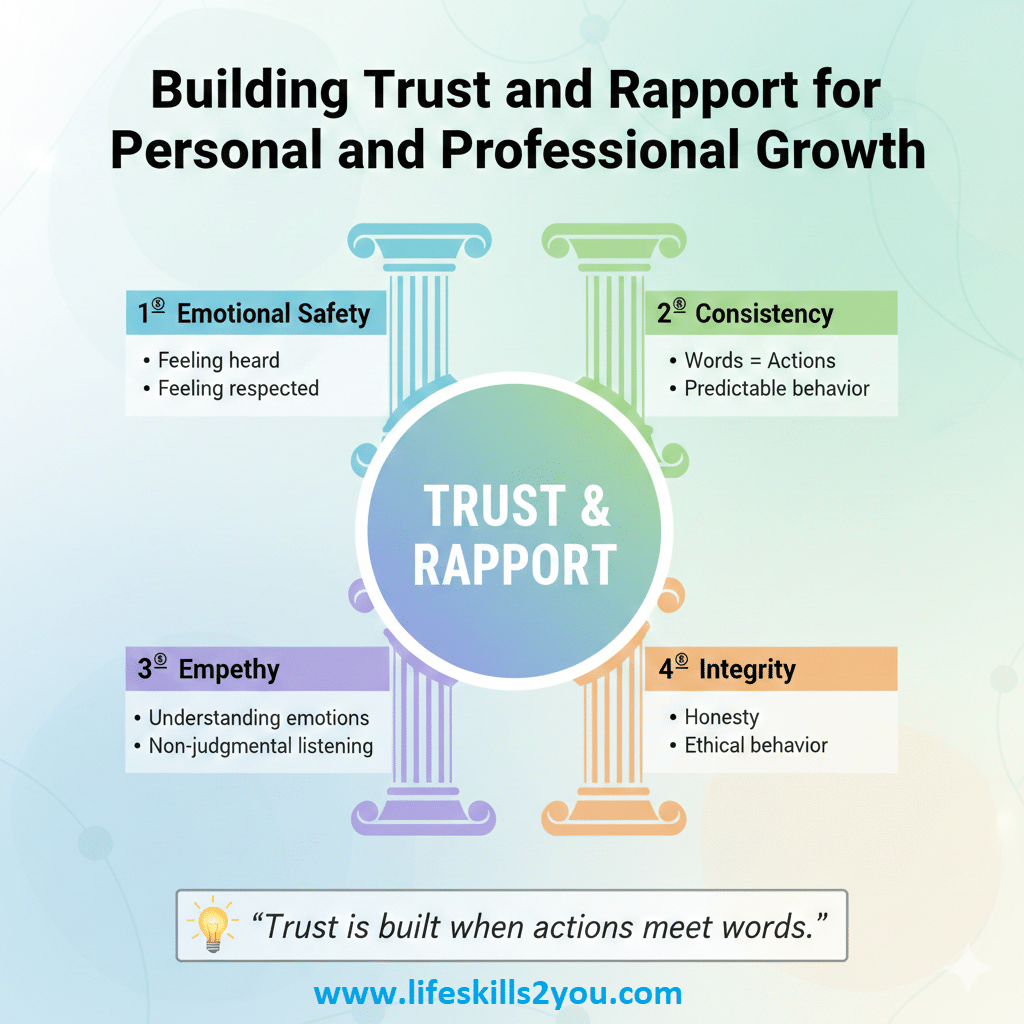
  • You feel emotionally safe
  • You behave predictably
  • You align words with actions

“People don’t trust words. They trust patterns.”


Why Building Trust and Rapport Is Non-Negotiable Today

In Professional Growth

In coaching corporate teams, I often ask:

“Who here trusts their manager enough to speak openly?”

Only 30–40% raise their hands.

Lack of trust leads to:

  • Silent disengagement
  • Fear-driven compliance
  • Innovation shutdown

Whereas Building Trust and Rapport for Personal and Professional Growth leads to:

  • Psychological safety
  • Ownership mindset
  • Faster collaboration

Google’s Project Aristotle confirmed psychological safety as the #1 factor behind high-performing teams.


In Personal Growth

Trust impacts:

Clients struggling with boundaries often don’t lack confidence—they lack trust literacy.

When you trust yourself and others:

  • You communicate clearly
  • You attract healthier relationships
  • You grow emotionally secure

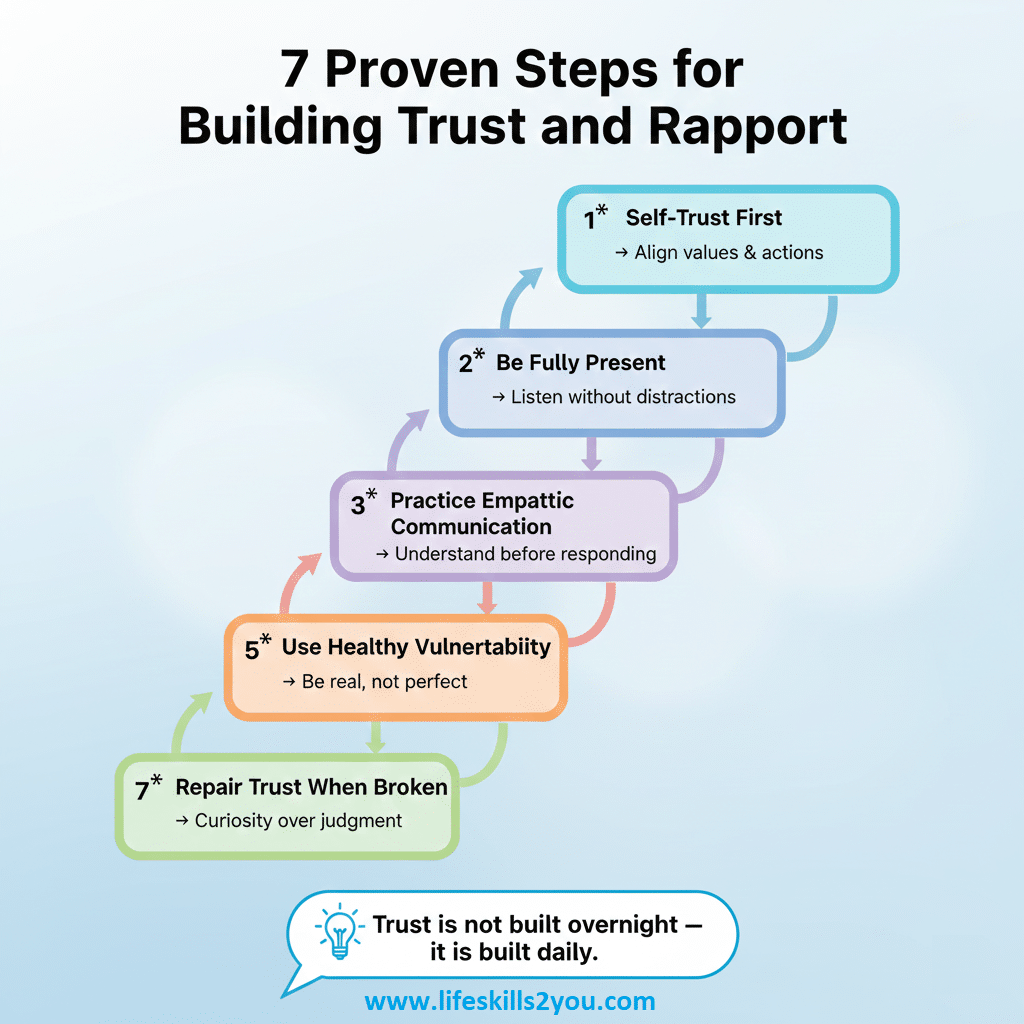
The 7-Step Framework for Building Trust and Rapport


Step 1 – Self-Trust Comes First

You cannot build trust externally if you don’t trust yourself internally.

Self-trust means:

  • Keeping promises to yourself
  • Acting in alignment with values
  • Managing emotions responsibly

🔍 Coaching Insight:
A senior manager once told me, “People don’t listen to me.” After reflection, we discovered he didn’t listen to himself—he ignored boundaries and overcommitted. Once self-trust improved, external trust followed.

Self-awareness, Emotional Intelligence, Authentic Leadership


Step 2 – Presence Over Performance

Rapport is built when people feel felt.

Be fully present:

  • Maintain natural eye contact
  • Avoid multitasking
  • Listen without planning replies

According to Harvard Business Review, leaders who practice active listening are rated as more trustworthy and competent.

“Attention is the rarest and purest form of generosity.”


Step 3 – Master Empathic Communication

Empathy is not agreement. It is understanding.

Use:

  • “I understand how that feels”
  • “That makes sense given the situation”

Avoid:

  • Immediate advice
  • Dismissive positivity

This strengthens Building Trust and Rapport for Personal and Professional Growth faster than any technique.

Empathic Listening, Non-verbal Communication

Related : The Ultimate Guide to Communication Skills, The Ultimate Guide to Emotional Entelligence


Step 4 – Consistency Builds Credibility

Trust grows when actions match words—repeatedly.

In organizations I’ve trained:

  • Managers who followed through built loyalty
  • Those who didn’t lost respect permanently

Consistency includes:

  • Timelines
  • Tone
  • Emotional reactions

People forgive mistakes—but not unpredictability.


Step 5 – Vulnerability with Boundaries

Contrary to myths, vulnerability strengthens trust.

Share:

  • Lessons learned
  • Honest limitations
  • Real challenges

Avoid:

  • Oversharing trauma
  • Emotional dumping

Brené Brown’s research shows vulnerability is the birthplace of trust and connection.


Step 6 – Respect Differences Without Judgment

Trust collapses when people feel judged.

Practice:

  • Curiosity over correction
  • Inclusion over ego
  • Dialogue over debate

This is essential in multicultural teams and relationships.

Inclusive Communication, Psychological Safety


Step 7 – Repair Trust When Broken

Trust will break—it’s human.

What matters is repair.

Effective repair includes:

  • Ownership without excuses
  • Timely apology
  • Changed behavior

According to relationship psychology, repaired trust becomes stronger than untouched trust.


Real-Life Examples of Trust in Action

Example 1: Corporate Leadership Transformation

A mid-level leader reduced team attrition by 40% in 6 months by practicing transparency and listening circles.

Example 2: Coaching Client – Relationship Repair

A client rebuilt a strained marriage by shifting from defensiveness to empathy.

Example 3: Sales Professional

Trust-based selling increased repeat clients without aggressive pitching.

Example 4: Entrepreneur

Building trust online through value-driven content created loyal audiences.


Common Mistakes That Destroy Trust

  • Overpromising
  • Inconsistency
  • Emotional manipulation
  • Fake empathy

Avoid these to protect Building Trust and Rapport for Personal and Professional Growth.


Research & Credible References


Conclusion

Trust is not a soft skill—it is a life skill.

In every role you play—leader, partner, parent, professional—your growth accelerates when trust is strong and rapport is real.

Building Trust and Rapport for Personal and Professional Growth is not about manipulation or charm. It is about integrity, empathy, consistency, and courage.

Build it daily. Protect it fiercely. Repair it humbly.

Your relationships—and your future—depend on it.


Thank you for exploring this insightful article.
If you’re hungry for more knowledge, don’t miss out on our other engaging articles waiting for you. Dive into our treasure trove of wisdom and discover new perspectives on related topics.
Click Our Blog and How to Guide to embark on your next adventure.
Happy reading!


FAQs: Building Trust and Rapport for Personal and Professional Growth

1. Why is trust important for growth?

Trust enables collaboration, openness, and emotional safety—essential for learning and performance.

2. Can rapport be built quickly?

Yes, through empathy, mirroring, and presence—but trust needs time and consistency.

3. How long does trust take to build?

It varies, but consistent behavior over weeks creates credibility.

4. Can trust be rebuilt after betrayal?

Yes, with accountability, transparency, and changed actions.

5. Is trust more important than skills?

Often yes—skills open doors, trust keeps them open.

6. How does body language affect rapport?

Open posture, eye contact, and tone strongly influence trust perception.

7. Can introverts build rapport effectively?

Absolutely—authentic listening often builds deeper trust.

8. What role does honesty play?

Honesty builds credibility, even when messages are uncomfortable.

9. How do leaders create trust fast?

By listening, following through, and modeling vulnerability.

10. Is trust measurable?

Yes—through engagement, retention, and feedback patterns.

Building Resilience: How to Bounce Back from Life’s Challenges

Learn effective strategies to overcome life’s hurdles and building resilience for a brighter future. Discover how to bounce back stronger!

Building resilience is crucial in navigating life’s unpredictable twists and turns. Challenges are inevitable, but our response to them determines our growth and success. In this article, we delve into practical tips and techniques to empower you to bounce back from life’s challenges with resilience and grace.


Life is a journey filled with ups and downs, and mastering the art of resilience is essential for navigating its winding paths. Whether it’s facing setbacks in our careers, coping with personal losses, or dealing with unexpected hardships, resilience is the key that unlocks our inner strength and propels us forward. In this article, we’ll explore the transformative power of resilience and learn how to cultivate it in our lives.

Understanding Resilience: The Foundation of Inner Strength

Resilience is more than just bouncing back from adversity; it’s about adapting, growing, and thriving in the face of challenges. At its core, resilience is a mindset—a way of thinking that empowers us to persevere in the face of setbacks and setbacks. Resilient individuals possess a unique set of characteristics that enable them to weather the storms of life with courage and determination.

Cultivating Resilience: Strategies for Success

Resilience is the ability to adapt and recover from adversity, setbacks, and stress. It is a vital quality for navigating the ups and downs of life. While some people may seem naturally more resilient than others, the good news is that resilience is a skill that can be developed and strengthened over time. Here are some detailed strategies to help you build resilience:

Building Resilience: How to Bounce Back from Life’s Challenges Strategies for Success

1. Cultivate a Growth Mindset

A growth mindset is the belief that abilities and intelligence can be developed with effort, learning, and persistence. By embracing this mindset, you can transform the way you view challenges and setbacks.

  • Embrace challenges: Instead of avoiding difficult situations, face them head-on. See challenges as opportunities to learn and grow rather than as threats to your success.
  • Learn from failure: Rather than seeing failure as a permanent state, recognize it as a stepping stone to growth. Each setback is a lesson that can bring you closer to success if you reflect on it and apply the lessons learned.
  • Stay persistent: Resilient people keep going, even when things get tough. They recognize that effort, over time, leads to improvement and positive outcomes.

2. Develop Coping Skills

Coping skills are strategies that help you manage stress, anxiety, and emotional challenges. By having a variety of coping techniques at your disposal, you’ll be better equipped to handle life’s ups and downs.

  • Mindfulness meditation: Practicing mindfulness helps you stay present and grounded, reducing the impact of stress and anxiety. Regular mindfulness practice can help you regulate your emotions and respond to difficulties with a calm and clear mind.
  • Deep breathing: In moments of stress, taking deep, controlled breaths can activate the body’s relaxation response, helping to reduce stress hormones and calm your mind.
  • Positive self-talk: Replace negative, self-defeating thoughts with more empowering and constructive ones. For example, instead of thinking, “I can’t handle this,” remind yourself, “I’ve dealt with challenges before, and I can get through this one, too.”

3. Seek Support

No one can be resilient entirely on their own. Having a network of supportive people around you can make a significant difference in how well you cope with adversity.

  • Build strong relationships: Cultivate a close circle of friends, family members, or mentors who can offer you emotional support, guidance, and perspective. Strong relationships provide a sense of belonging and can offer much-needed encouragement during tough times.
  • Ask for help: Don’t be afraid to reach out to others when you need assistance or advice. Resilience isn’t about handling everything alone—it’s about knowing when and how to lean on others for support.
  • Join a community: Being part of a group with shared interests or goals, whether it’s a professional organization, support group, or social club, can provide a sense of belonging and a source of encouragement.

4. Stay Flexible

Adaptability is a cornerstone of resilience. Life is full of uncertainties and changes, and being able to adjust to new circumstances is crucial for maintaining your well-being.

  • Embrace change: Instead of resisting change, learn to see it as an inevitable part of life. By being open to change, you can respond more effectively and creatively to new challenges.
  • Reframe setbacks: When things don’t go as planned, try to reframe the situation. Instead of focusing on what’s going wrong, think about what you can learn or how you can adapt your approach to move forward.
  • Stay open-minded: Keeping an open mind allows you to consider alternative solutions and new opportunities. Flexibility in thinking makes it easier to pivot when unexpected challenges arise.

5. Practice Self-Care

Taking care of your physical, emotional, and mental health is essential for building resilience. Self-care replenishes your energy and helps you maintain the strength needed to face life’s challenges.

  • Prioritize sleep: Adequate rest is crucial for physical and emotional well-being. Good sleep improves your mood, cognitive function, and ability to handle stress.
  • Exercise regularly: Physical activity not only strengthens your body but also boosts your mood and reduces feelings of anxiety. Exercise releases endorphins, which help counteract stress.
  • Nourish your mind and soul: Engage in activities that bring you joy and relaxation. Whether it’s reading, gardening, painting, or spending time in nature, these activities can help rejuvenate your mind and spirit.
  • Set boundaries: Knowing your limits and setting healthy boundaries with others is a key aspect of self-care. Protect your time and energy by saying no when necessary, and avoid overcommitting to things that may drain you.

6. Focus on Meaning and Purpose

Resilient individuals often have a strong sense of purpose and meaning in their lives. Having a reason to persevere can provide the motivation needed to overcome even the most difficult challenges.

  • Identify your values: Knowing what is most important to you—whether it’s family, career, creativity, or community—can help you stay grounded and motivated in the face of adversity.
  • Set meaningful goals: Establish clear, attainable goals that align with your values. Working towards goals that are personally meaningful gives you a sense of purpose and direction.
  • Cultivate gratitude: Practice focusing on the positive aspects of your life, even in tough times. Gratitude can help shift your perspective and increase your emotional resilience by reminding you of the good things that still exist in your life.

By implementing these strategies into your daily life, you can cultivate resilience and develop the inner strength needed to overcome life’s challenges with grace and resilience.

Remember, resilience is not about avoiding adversity altogether but rather about bouncing back stronger when faced with it.

For further reading on building resilience, check out “Building Resilience by American Psychological Association.

Building Resilience: How to Bounce Back from Life’s Challenges

Embracing Adversity: The Path to Personal Growth

Adversity is an inevitable part of life, but it’s how we respond to it that defines us. Instead of viewing challenges as roadblocks, see them as opportunities for growth and self-discovery. Every setback is a chance to learn, adapt, and become stronger. Embrace adversity with courage and resilience, knowing that it is the fuel that propels you toward your full potential.

Overcoming Obstacles: Lessons in Resilience

Throughout history, countless individuals have overcome seemingly insurmountable odds through sheer resilience and determination. From athletes who bounce back from career-ending injuries to entrepreneurs who turn failures into successes, the stories of resilience are all around us. Take inspiration from these examples and remember that you, too, have the power to overcome any obstacle that comes your way.

Conclusion: Building Resilience for a Brighter Future

In conclusion, building resilience is a lifelong journey that requires dedication, effort, and a willingness to embrace life’s challenges head-on. By cultivating a growth mindset, developing coping skills, seeking support, staying flexible, and practicing self-care, you can strengthen your resilience muscle and bounce back stronger from life’s trials. Remember, resilience is not about avoiding adversity altogether but rather about facing it with courage and resilience.

As you embark on your journey to build resilience, remember

“Success is not final, failure is not fatal: It is the courage to continue that counts.”

– Winston Churchill

For more to know The science behing resilience, explore “InBrief: The Science of Resilience“.

Thank you for exploring this insightful article. If you’re hungry for more knowledge, don’t miss out on our other engaging articles waiting for you. Dive into our treasure trove of wisdom and discover new perspectives on related topics. Click ‘Our Blog‘ and ‘How to Guide‘ to embark on your next adventure. Happy reading!

FAQ’s : Building Resilience: How to Bounce Back from Life’s Challenges

1. What is resilience?

Resilience is the ability to adapt, recover, and grow stronger after facing adversity, stress, or setbacks. It’s the skill that helps people cope with life’s challenges and bounce back from difficult experiences.

2. Can resilience be learned or developed?

Yes, resilience is a skill that can be developed with time and practice. While some people may naturally exhibit more resilience, anyone can strengthen their resilience through strategies such as cultivating a growth mindset, developing coping skills, and practicing self-care.

3. What are some strategies to build resilience?

Key strategies to build resilience include:
Cultivating a growth mindset
Developing a toolbox of coping skills
Seeking support from others
Staying flexible and adaptable
Practicing self-care for physical and mental well-being
Focusing on meaning and purpose

4. How can a growth mindset help with resilience?

A growth mindset encourages the belief that challenges and setbacks are opportunities for learning and growth. By adopting this mindset, you can view difficulties as temporary and solvable, which makes it easier to stay persistent and optimistic in the face of adversity.

5. What are some coping skills that help with resilience?

Coping skills that support resilience include:
Mindfulness meditation to stay calm and present
Deep breathing exercises to reduce stress and anxiety
Positive self-talk to counter negative thoughts and build confidence
Problem-solving skills to tackle challenges effectively

Exit mobile version